


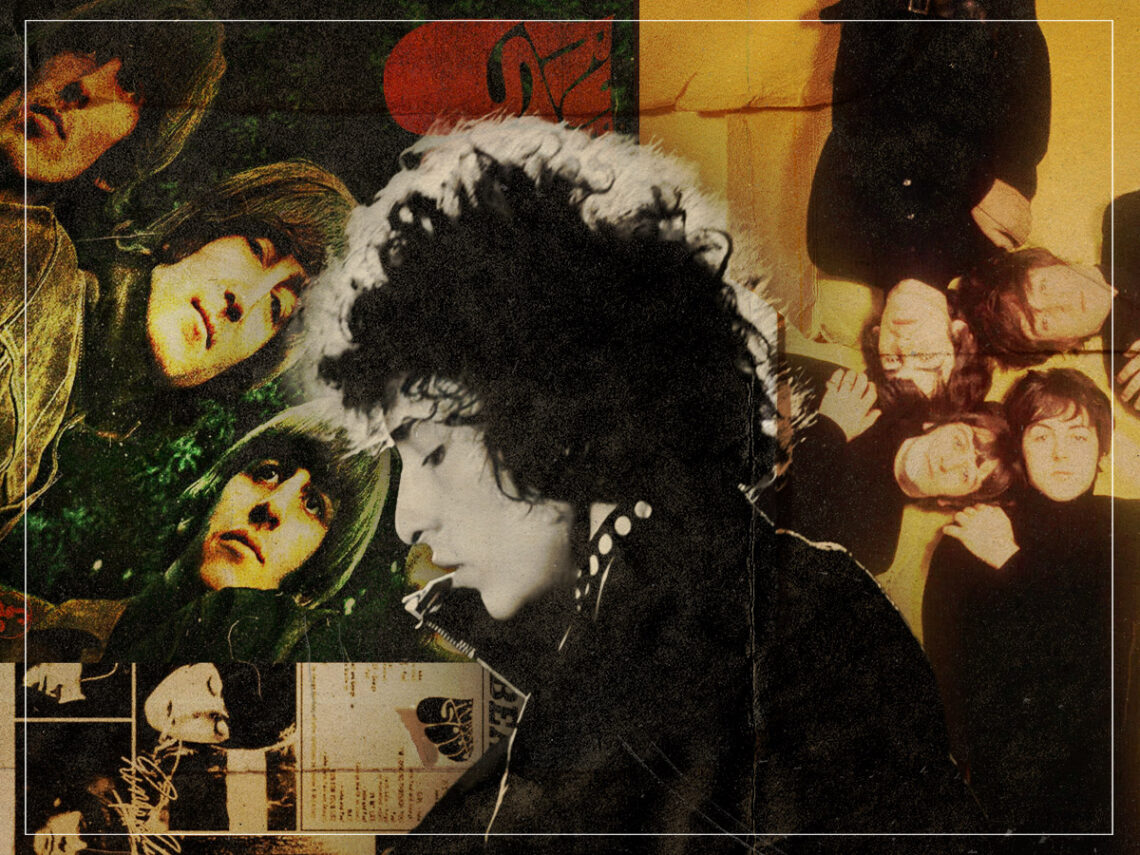
“Just beautiful”: How Bob Dylan’s masterpiece changed The Beatles’ songwriting

It’s 1965, and John Lennon is at the height of his powers as The Beatles reign supreme over the pop culture explosion. Fresh from recording Help!, the band’s best work to date, further fame, fortune, and frenzied adulation are inevitable. Yet, that isn’t what occupies Lennon’s mind as he sits at home in Weybridge, playing a record on repeat. Picking up the phone, he calls Paul McCartney and says something along the lines of, ‘You’ve got to come over and listen to this new Bob Dylan single’.
All Lennon can think of is the track spinning around on his turntable. He eagerly awaits his buddy. When McCartney arrives, he is greeted with the wail of the greatest counterculture anthem ever written: ‘Like a Rolling Stone’. “It seemed to go on and on forever,” McCartney recalls. “It was just beautiful.” A year earlier, they had met the man behind this furiously unfurling song, and it had proved just as impactful.
As Macca said of their famed meeting at the Delmonico Hotel in 1964: “I could feel myself climbing a spiral walkway as I was talking to Dylan. I felt like I was figuring it all out, the meaning of life… I was going ‘I’ve got it!’ and wrote down the key to it all on this piece of paper. I told [Beatles roadie Mal Evans] ‘You keep this piece of paper, make sure you don’t lose it because the meaning of life is on there. Mal gave me the piece of paper the next day, and on it was written ‘There are seven levels.’ Well, there you go, the meaning of life…”
That piece of reverential-sounding nonsense might remain a mystery, but the penny would soon drop when it came to Dylan’s music by the time ‘Like a Rolling Stone’ came around. “Dylan is a fantastic composer,” McCartney told Flip Magazine in 1966. “At first, I didn’t understand. I used to lose his songs in the middle but then I realized it didn’t matter. You can get hung up on just two words of a Dylan lyric. ‘Jealous Monk’ or ‘Magic Swirling Ship’ are examples of the fantastic word combinations he uses. I could never write like that and I envy him. He is a poet.”
With ‘Like a Rolling Stone’ Dylan revolutionised the way that people look at songwriting, the mighty Beatles included. With the glowering track, “He showed all of us that it was possible to go a little further,” McCartney told Clinton Heylin. The collision of rock ‘n’ roll with lyrical poetry and societal sagacity was a portent force that sent heads wobbling. Now, songs didn’t have to be structured with a one-track mind. Only a few years earlier, if your song was longer than three minutes, it would never have been played on the radio, and then suddenly Dylan had a hit that went “on and on” for over six minutes.

The song was such a pandora’s box moment that the radiowaves had no choice but to make room for it. The swirling welter of everything it contained was a revelation for artists still thinking on conventional terms. The Beatles were now set to pair introspection and profundity with pop. They were about to boldly ditch the hand-holding sentiments that had first propelled them and dare to be entirely different—spearheading their own “revolution”.
“I think it was Dylan who helped me realize that,” Lennon declared with love. “I had a sort of professional songwriter’s attitude to writing pop songs, but to express myself I would write ‘Spaniard In The Works’ or ‘In His Own Write’ —the personal stories which were expressive of my personal emotions,” he said.
Continuing, he added: “I’d have a separate ‘songwriting’ John Lennon who wrote songs for the sort of meat market, and I didn’t consider them, the lyrics or anything, to have any depth at all. Then I started being me about the songs… not writing them objectively, but subjectively.” In essence, he began to write for himself and, oddly enough, found greater universality in doing so.
Rubber Soul, The Beatles’ next album following ‘Like A Rolling Stone’, would feature tracks like ‘Norwegian Wood’, a song that even had Dylan stating, “What is this? It’s me, Bob. (John’s) doing me!” And Lennon himself would even say of songs at this feet-finding stage, “That’s me in my Dylan period again. I am like a chameleon… influenced by whatever is going on. If Elvis can do it, I can do it. If the Everly Brothers can do it, me and Paul can. Same with Dylan.”
The band might have assimilated his influence a bit less obviously in future, but they were now looking to stretch their songs to new limits—everyone was. After all, ‘Like a Rolling Stone’ crucified the crux of counterculture’s exposed Achilles heel—and it did it with such rafter-ratling disdain that the clouds of the commercial ceiling were shifted, and people could see past the boundaries towards what a rock song could be.
Dylan had always written with the notion that songs were “more important than just light entertainment. They were my preceptor and guide into some altered consciousness of reality. Some different republic, some liberated republic.”
Now, that republic had its own national anthem and it was extending its influence to the colonies. The world would simply never truly be the same when Dylan’s cutting intellect, stirring poetry and the brilliance of the soaring melody all mingled into one pop culture opus that still delivers a cognisant dose of adrenaline to this day. The Fab Four might remain the most influential band in history, but you can see the waterline in their discography before ‘Like a Rolling Stone’ and afterwards, as Dylan re-defined their musical outlook with a masterpiece. Any song that forced The Beatles to reconsider their musical stance had to be one hell of a song.

Never Miss A Beat
The Far Out Beatles Newsletter
All the latest stories about The Beatles from the independent voice of culture.
Straight to your inbox.