


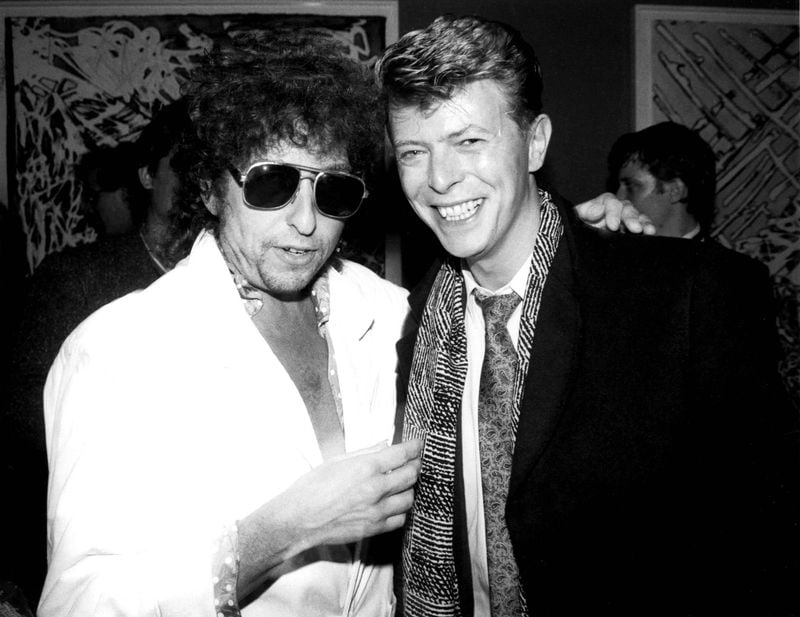
How Bob Dylan and David Bowie ruined music

When Thomas Midgley Jr. set out to prevent engine knocking and make the world a more fuel-efficient place, he invented leaded petrol. It was a huge success until people realised how damn damaging it was. Cursing this oversight that cost the world so much and took the lives of millions, he decided to right his wrong and turned his attention to refrigeration. He invented CFCs, another masterstroke that worked a treat but sadly may as well have stubbed a cigarette out on the ozone layer. The moral is when it comes to innovation, it’s difficult to see how things will pan out in the long run. Even with foolproof brilliance, folks might pick up the wrong signal and succumb to folly. Bob Dylan and David Bowie know this all too well.
“Oh, hear this, Robert Zimmerman,” Bowie sang in tribute to the progenitor of modern music, “I wrote a song for you.” He’s not the only one; it’s just others have done it less directly. Both these wild originals came with a unique style. You can’t help but imitate your heroes, but there are certain elements of their respective oeuvres that should have stayed unique to them. As it happens, triumphs become tropes that fail to grasp the intent in the first place.
Take, for instance, the way that the brilliance of The Office has sadly resulted in folks thinking that merely looking down the lens of the camera is a joke in itself. That isn’t the funny bit. The same can be said for Dylan and Bowie—the magic of Dylan’s pointed edge is not simply the dissonance, and the lure of Bowie’s image is not just the daring effrontery. Unfortunately, these are the elements that have mutated, persevered and resulted in perversions within modern music.
We’re diving into these sorry twists of fate below. These are the various ways that the magnificence of two of history’s greatest artists has turned towards maleficence. It’s an unfortunate truth: even masterpieces can be mutated into mucky foulness. Thanks for nought, lads.
How Bob Dylan and David Bowie ruined music:
Bob Dylan
Song length
90 minutes is the ideal length for a film, and three minutes is the perfect stretch for a pop song. I didn’t make these rules up, they are decreed somewhere in the makeup of the universe, and while there are a million worthy exceptions, there are many more examples that fall foul of disobeying this law. Sadly, these follies operate on a license that Bob Dylan’s brilliance handed down.
As John Cooper Clarke once wrote: “I love Bob Dylan, but I hold him responsible for two bad ideas: a) the extended running time of the popular song and b) the lyric sheet. Both fine for Bob who usually occupied the extra time in agreeably entertaining ways. The rot, however, set in between 1968 and 1975 when the airwaves were clogged with over-manned combos of cheesecloth-shirted bozos, with names like Jon Hiseman’s Colosseum… the end is listless.”
With most great boundary-pushing art, it usually results in sorry imitators clinging to the lowest common denominator of the feat—Dylan’s progress became dreary prog. His sprawling epics like ‘Sad-Eyed Lady of the Lowlands’ used space to transfigure the usual cliched honeypie song into a realist journey over the potholes and pretty vistas on the memory lane of love. That was scrapped by many bands who seemed to think that the depth came from the distance itself. All of a sudden, you had fools desperately defying pop by pretentiously wailing ‘look how good I am’ for interminable dreary eternities. All thanks to Dylan and his double album exploration.
Dissonance
Frankly, it isn’t stated enough how downright pretty most of Dylan’s music is. His melodious mastery often gets lost beneath the welter of everything else. However, there is also one element to his music that does its best to mask it: the damn screeching harmonica. Granted, there are moments where it elevates his music with a sweep of visceral texture, but more often than not, I think I’d expunge it from the audio mix of history.
While largely tolerable and occasionally brilliant in Dylan’s work, the reverberations of his howling harmonica have been dire. In the early 1960s, this ear-splitting sound unapologetically called attention to his tracks. It said, ‘I’m not here to be nice and sing radio hits about hand-holding’. It served its purpose on this front. But sadly, subsequent artists took that to mean it’s cool to sound nasty. Thus, we are now beset by a million moments amid smooth travelling melodies that are there for the express purpose of sounding ‘interesting’ but instead are simply manufactured unpleasantries. As a rule, dissonance ought to get in the sea.
David Bowie
Evolution
A while ago, I was interviewing a band about their forthcoming album. When the topic turned to inspirations and influences, they simply rattled off a list of sounds that were wildly unfamiliar to their oeuvre to date. The chat was less about concepts, feelings and atmospheres and more about forced sonic developments. This is a crux that has led to countless bands failing to surpass their debut and trading sounding like themselves to borrowing from someone else. And it’s all Bowie’s fault.
He was the king of evolution, like a musical Charles Darwin. But he knew what drove it and which shoe fit. As he told Joe Smith in 1987, “The Ziggy thing was worth about one or two albums before I couldn’t really write anything else around him or the world that I wanted to sort of put together for him.” But most acts aren’t one-shot cartoon characters. Different rules apply, and Bowie’s chameleonic brilliance sets a dangerous precedence. He was, in many ways, the dreaded Dr Frankenstein who created second album syndrome.
He was so bombastic and loved by so many that rather than marvel at his message of putting on a show, people have figured that if you’re not moving on then you’re standing still. There might be a grain of truth to that, but the reason Bowie succeeded was becasue he had depth, sincerity and a sense of self-understanding in each of his outings. This allowed them to be fully formed and thought out, as opposed to saying, ‘I think we should chuck a synth in this album’. He failed his way towards this realisation so that when he was ready to move on, his next chapter was naturally propped by a backlog of ideas. Now, you have artists changing tact ten tracks into their journey.
Vocal affectations
We live in an era beset by people trying to add interest to their act through patently apparent vocal affectations that grate like a knife running over glass. Indeed, Bowie exaggerated his cockney charm from time to time, but this was done with a soulful, almost comic intent. Now, it is done to make a voice stand out from the crowd as ‘weird’, and it eviscerates any soul in the performance simply because it fails to be genuine. All too often, this crooning croak sounds exactly the same as everyone else pulling the same stunt.
This soft, breathy, almost singing in cursive style is now everywhere. It makes lyrics near nonsensical, often completely runs counter to the feel of the song itself, and ultimately, is more irritating than a dental drill as syllables are weirdly rendered unpronounceable. It is as though the artist is singing with a toffee in their mouth. Unbearable. And if you’re not catching my drift, then you can see it beautifully illustrated in the video below. Thanks again, Bowie.

Never Miss A Tale
The Far Out Bob Dylan Newsletter
All the latest stories about Bob Dylan from the independent voice of culture.
Straight to your inbox.