


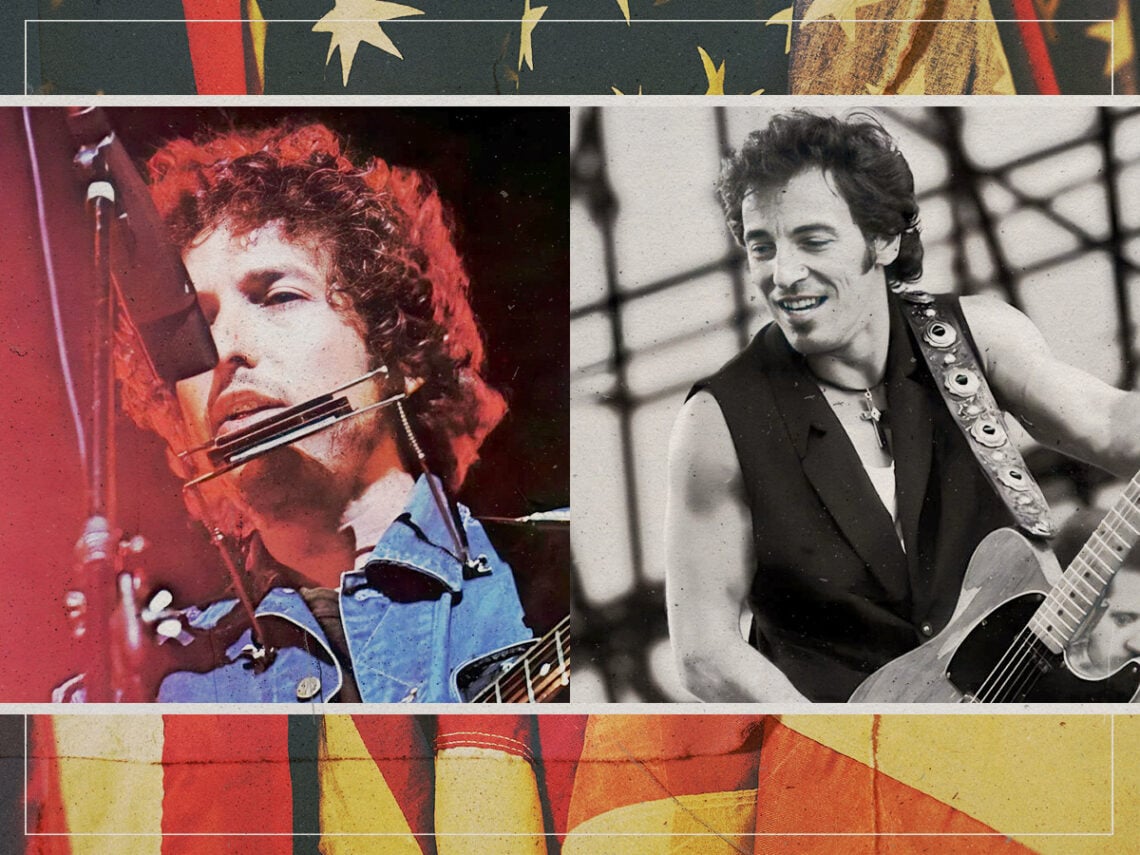
The Bob Dylan albums Bruce Springsteen called definitive: “A version of my country”

From day one, Bob Dylan always aimed to inspire people with his tunes. He could take or leave the admiration he earned as one of the greatest songwriters in the world, but long after he’s departed from this Earth, songs like ‘Blowin’ In the Wind’ and ‘The Times They Are A-Changin” will remain the benchmark for great protest songs. Bruce Springsteen was one of many Dylan acolytes in the early 1970s, but his approach to songwriting was more influenced by Dylan’s rock and roll era.
While the typical image of Mr Zimmerman seems to be a rock star with an acoustic guitar and a massive sinus infection, his roots weren’t remotely connected to rock and roll when he started. His first love was Woody Guthrie, so albums like The Freewheelin’ Bob Dylan were just an excuse for him to live out his fantasy of being a songwriting troubadour, whether that meant writing about the world around him or crafting stunning love songs like ‘Don’t Think Twice It’s All Right’.
Once acts like The Beatles started gaining traction, sticking strictly to an acoustic guitar to get your point across became almost impossible. The Fab Four admitted to being humungous Dylan fans, but he didn’t think his acoustic guitar was the right approach anymore. He needed to wake the people up, and Bringing It All Back Home was just the vehicle he needed to reach the masses again.
Even though many fans instantly cringed when they heard an electric guitar on a folk project, Springsteen saw something different. Since none of the songwriting suffered for it, he had suddenly found a new way of communicating to his audience with a lot more punch, eventually taking things one step further on ‘Like A Rolling Stone’, which blew down the doors for what a typical pop hit could be.
Whereas Dylan was still a songwriting god before then, Springsteen said Bringing It All Back Home and Highway 61 Revisited were what hooked him in, telling Rolling Stone, “Those were my Dylan records. I didn’t know anything about Dylan as a folk performed until long after I was into him for ‘Like A Rolling Stone’. Those were definitive. They were showing me a version of my country that I knew was true but had not been whispered to me previously.”
If the folkie showed ‘The Boss’ a world that he hadn’t seen before, the heartland rocker would spend the rest of his career peeling back the layers of that world. Even though most rock acts were making songs about running away from problems, Springsteen brought everything back down to Earth, appealing to the blue-collar set of rockstars that had to work for everything they wanted.
But that’s not to say Springsteen completely copied his idol’s playbook step by step. There are some similarities in the way that they both approached small-town living, but when ‘Thunder Road’ comes on, this is not the Dylanesque writing that makes people confront the hard truths of the world. It’s a story of a bunch of kids trying to make sense of the world the 1960s created and whether or not they even fit into it anymore.

Never Miss A Tale
The Far Out Bob Dylan Newsletter
All the latest stories about Bob Dylan from the independent voice of culture.
Straight to your inbox.