


‘Blue Skies’: Ella Fitzgerald’s greatest vocal performance

Scat singing gets a bad rep these days, and if I’m being real with you, it probably should. Now, I know that there’ll be a fleet of waistcoated hepcats taking to the streets with the express intention of introducing a bass clarinet to my frontal cortex for saying so.
However, be as real with yourself as I’m being with you: when you think of scat singing, do you think of Ella Fitzgerald? Or do you think of Howard Moon nervously pointing his finger guns at you and going “owww, chika-chikaaaaa”? Exactly.
Which is a crying shame because when being performed by a vocalist at the level of virtuosity of the aforementioned Ella Fitzgerald, one can easily get it. One can see not only how lively and fun the vocal technique can be, but also how exciting it can be. How it can both be a way of playing off the other instrumentalists and keeping the anarchic, free spirit of jazz alive, and a way of focusing the song around a single, solid melody.
There are many, many examples of Ella Fitzgerald showing off her amazing prowess at scat singing. The greatest of all may be during her 1960 performance of ‘Mack The Knife’ in West Berlin, where she forgot the lyrics and effortlessly continued the song, bringing it home with wordless vocalisations to an astonished crowd. However, if we’re talking about the greatest Ella Fitzgerald vocal performance of all time, we’re going to have to look a little deeper than a track that merely epitomises one sliver of her vocal skill rather than the gamut of her abilities.
The natural-born collaborator who could play off any bandmate with her scat singing prowess, and the sheer vocal dexterity that sees her never put a note out of place no matter how improvised it may be, for that, we need only look one way: the version of Irving Berlin’s ‘Blue Skies’ she recorded for her 1958 album Ella Fitzgerald Sings the Irving Berlin Song Book.
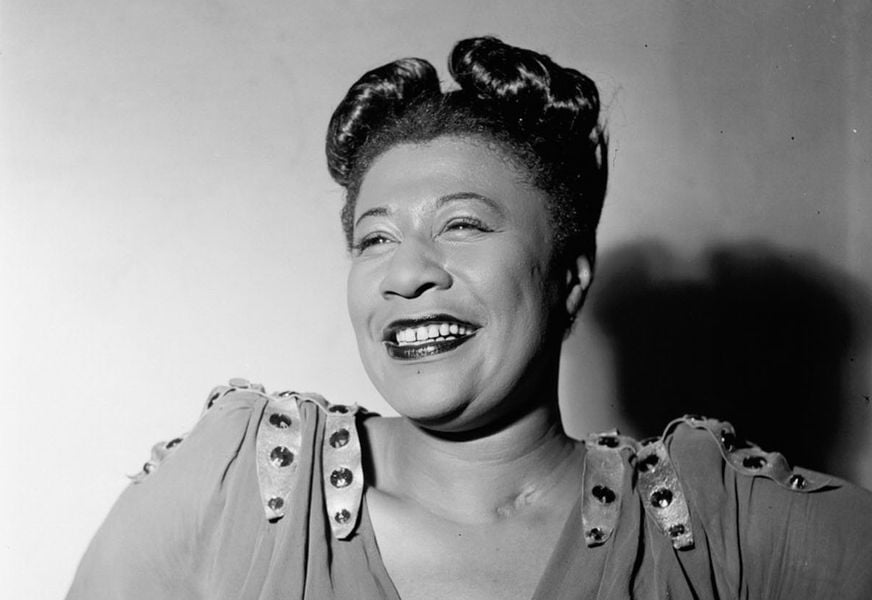
Why did Ella Fitzgerald cover ‘Blue Skies’?
By taking on the song, Fitzgerald was taking on one of Berlin’s true masterpieces. This was a song that premiered in the Rodgers and Hart musical Betsy. A song that went down so spectacularly on opening night that, so the legend goes, the audience demanded 24 encores of ‘Blue Skies’. Despite the musical itself being such a catastrophe that it barely lasted a month on Broadway, Berlin had a hit, to the extent that Al Jolson also recorded the song for the first talkie movie, his musical picture, The Jazz Singer.
The song was covered by the leading lights of jazz after that. In fact, at one point, the number eight and number nine spots of the Billboard pop charts were two versions of ‘Blue Skies’. The former by Count Basie, the latter by Benny Goodman. A murderer’s row of talent, I’m sure you’ll agree. However, none of them were ever called ‘The First Lady of Song’, and when Ella Fitzgerald took on a song, she always made the definitive version of it; ‘Blue Skies’ is no different.
Stripping the Broadway stylings in favour of the most authentically jazz arrangement of them all, Fitzgerald weaves a vocal intro as captivating and joyous as any Django Reinhardt guitar solo. Her notes couldn’t be more perfectly in tune if they were rung on a bell, yet with a lightness of touch that almost feels shrugged off like it was nothing at all.
Then, she truly takes control of the song with Berlin’s lyrics, and if you need me to tell you she knocks it out the park, then clearly you haven’t heard Ella Fitzgerald sing before. With no vocal gymnastics or straining from the melody as written, she anchors the song. Truly captivating despite Paul Weston’s magnificent arrangement giving Fitzgerald a run for her money, the song takes flight at the end, as her vocal rises through her considerable range.
As if it could get any better, a delightfully wrong-footing finale sees Fitzgerald threaten to release the hounds with a classic Broadway belt of an ending. Then, in an act of genuinely laugh-inducing brilliance, dropping down the scale with a frantic last few seconds of scat singing before ending on a low B that is worthy of 24 encores of its own, it is effortlessly perfect, as ‘Lady Ella’ often was.
