


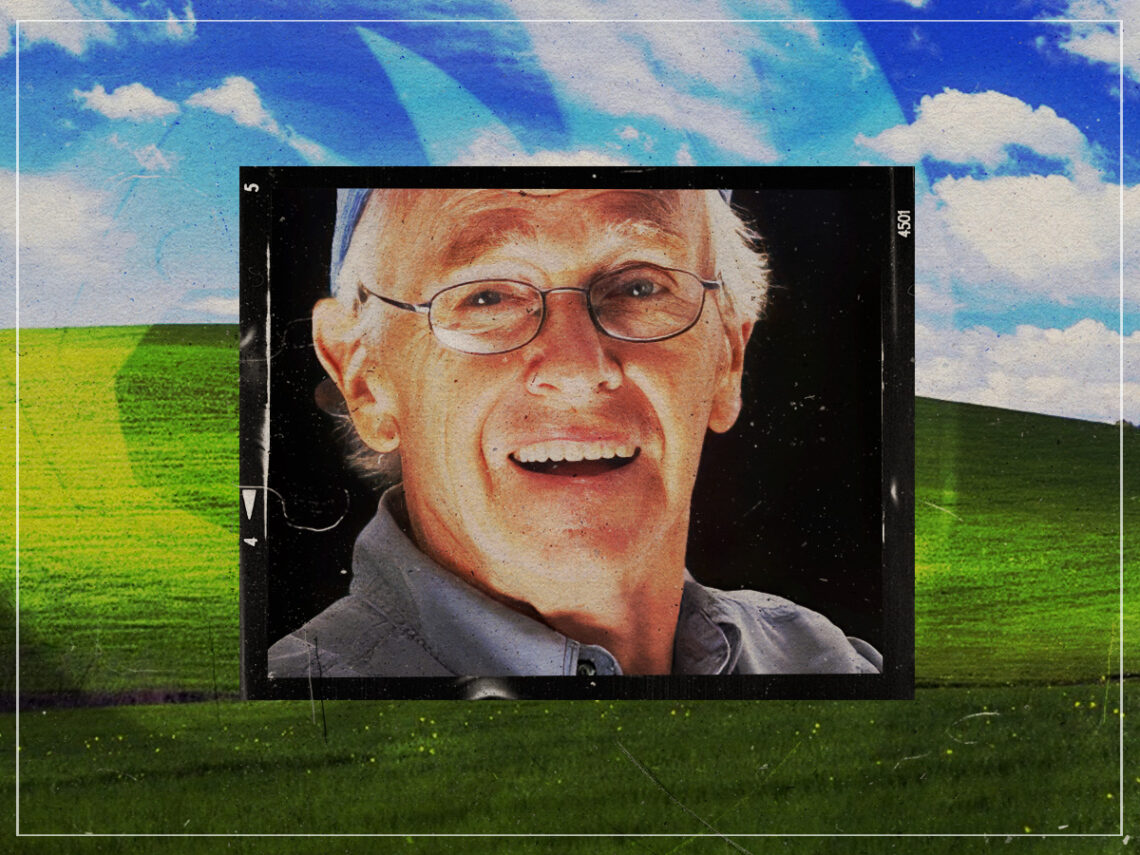
‘Bliss’: The photograph viewed by billions

One of the most viewed photographs in history owes its success to an insect infestation. In the late 1990s, Napa Valley became inundated with phylloxera, a microscopic pest that destroyed its vineyard’s grapes. To the tune of half a billion dollars, 50,000 acres of infested vineyards were removed – but the landscape became surprisingly idyllic as a result, with sporadic rows of grapevines replaced by lush, evergreen grass.
Those grassy knolls were forever immortalised in one chance picture taken by Charles O’Rear. On a rare Friday without an assignment from National Geographic, he raced down Highway 121 to visit his girlfriend, Daphne Irwin. He and Irwin, whom he later married, were working on a book about wine country at the time, so he was paying extra attention to the scenery.
A storm had just passed, the sun finally peeking out of the clouds that had poured down with rain weeks earlier. It looked like a simple scene a child would draw, just one huge hill in front of a cloudy sky. That cartoonish perfection was irresistible to O’Rear. “My God, the grass is perfect! It’s green! The sun is out; there’s some clouds,” he recalled thinking right before pulling off the road near the Napa–Sonoma county line to take pictures of it.
Half of the beauty of the images he took – of which there were only four – was the distinct lack of vineyards busying the foreground, which naturally didn’t seem a great fit for the wine country book. Instead, he listed it on Corbis as a stock photo. Completely unedited, they sat unclaimed on the licensing site, which was incidentally founded by Bill Gates.
A few years later, O’Rear got a call from Microsoft, asking to use his image, at the time named Bucolic Green Hills, as the new default background for its latest operating system. Although a non-disclosure agreement prevented him from revealing the price, they paid so much for the image that FedEx refused to mail it. When O’Rear tried to send over the negatives, it emerged that Microsoft had valued the photograph so highly that there wasn’t a shipping company in existence willing to cover the insurance. O’Rear took a plane to their headquarters instead.
The photograph has consistently stirred debate, and the price was no exception to heated discussion. O’Rear has claimed it was the second largest sum received by a living photographer for one sole image, just behind Dirck Halstead’s picture of Bill Clinton hugging Monica Lewinsky.
Another contentious element of the photo lies in the editing. O’Rear has always insisted that he never photoshopped it, but its vibrant green shades have led to yet more debate. He used a Mamiya RZ67 medium-format camera, using Fujifilm’s Velvia film, which is said to be popular among nature photographers because it saturates colour so well (Microsoft have since admitted they enhanced the green shades and cropped the image slightly).
Still, O’Rear has always maintained it was that combination of film and camera that made the colours pop so much. “It made the difference and, I think, helped the photograph stand out even more,” he said. “I think that if I had shot it with 35mm, it would not have nearly the same effect.”
Microsoft dubbed his image Bliss, and since Windows XP’s 2001 launch, it’s been estimated to have been seen by a billion people, at least. Something of a happy accident, O’Rear was never really sure what drew Microsoft to it. “I have no idea what [they] were looking for,” he once said. “Were they looking for an image that was peaceful? Were they looking for an image that had no tension?”
The photo is unique in its ubiquity, having been seen everywhere, from the White House to school classrooms across the world. Although Microsoft has long phased it out, if you were to show it to someone even now, they’ll insist they know it from somewhere. O’Rear’s Bliss and the inherent sense of “I’ve seen that before” it distils realise what is, to most photographers, a pipe dream.
