


Was Björk’s ‘Hunter’ video inspired by her murderous stalker?

Celebrity Worship Syndrome is a condition that surprisingly dates back to the 18th century. Fundamentally, this arose as societal demographics began to lean towards individualism. Americans were even prophetically described as “an individual-loving people” in 1911 by a theatre producer who noticed the rising trend of obsessing over stardom rather than the plays themselves. In recent times, this has escalated. Along with our increasing love of individuals, comes the correlating dark caveat of people with obsessive addictive disorders pertaining to celebrities. Perhaps the darkest example of this is Richard Lopez’s relationship with the Icelandic musician Björk.
In 1996, Ricardo Lopez began recording a series of video diaries. During the videos, he discusses his plans to kill Björk and his obsession with the singer. While there is a slew of troubling reasons for his sudden desire to murder the singer since his obsession started three years earlier, he eventually channels these into one racial agenda: she was dating a black man.
In his early videos, the former pest exterminator describes Björk as his muse and expresses that she gives him a “euphoric feeling”. Alongside the videos, he began keeping a written diary which documents his decline from a reclusive fan to a stalker detached from reality. He writes: “I couldn’t have sex with Björk because I love her.” He also expresses a desire to invent a time machine so that he could befriend her as a child and have an “effect on her life”.
The tragic details of his diary depict him as a man subsumed by his own perceived shortcomings, tormented by his gynecomastia (the enlargement of the breasts in males), and steadily drifting from reality. Then, in 1996, he discusses reading Entertainment Weekly in his Florida apartment and discovering via an article that she was dating Goldie. “I wasted eight months,” he wrote, “and she has a fucking lover.” From this moment on he becomes consumed by the notion of punishing Björk.
With his video diaries growing more deranged, he outlines his plan to mail Björk a book that would shoot HIV-infected needles into her arms when she opened it. He then realises that this wouldn’t work and comes up with the plan to mail her an acid bomb concealed within a book. His hope was to either disfigure her for life or kill her outright.
He believed that this would not only impact her life in some way – an influence which he craved – but also help to amend his own ailing mental health. As he says in one of his videos, he wishes to document “my life, my art and my plan. Comfort is what I seek in speaking to you … I am being my own psychologist. You are a camera. I am Ricardo.”
Throughout the following weeks, he tests out various mechanisms for his acid bomb. Then on September 12th, 1996, he mails the deadly contraption and records his final video. During this disturbing recording, he shaves his head, paints his face with red and green stripes, colours his nipples, listens to Björk’s ‘I Remember You’, sits down on the sofa in front of a sign that read ‘The Best of Me, Sept. 12’ and holds a loaded revolver in his hand while breathing maniacally. As the song climaxes, he says, “This is for you,” and shoots himself in the mouth.
The letter bomb that was sent that day was quickly intercepted by the police and detonated safely by the authorities after the FBI informed Scotland Yard of his plan when they discovered his corpse shortly after the suicide. Nevertheless, the news reached a 30-year-old Björk and she was traumatised by the event. At the time she was recording her third album Homogenic. She moved away from the London recording studio which was suddenly beset by press intrusion and travelled to Spain to record new tracks.
In a Q interview, she reflected on the unnerving stalker incident, commenting: “It was very upsetting. I saw it. You could see the date because it was a home video camera.” With dark kismet, she then reveals, “I remember going to Florida, funnily enough, the night he killed himself. I was two blocks away from him and he didn’t know it. So when the letter bomb he sent travelled to England, I travelled with it.” Also unbeknownst to Lopez, she had ended her relationship with Goldie a few days beforehand.
She continues: “After it happened I got very upset. I wanted to see the video. Once something like that has broken its way into your life, rather than wrap it up and kiss it goodbye, you have to understand it, find a level with that person, from a human point of view.”
Following this disturbing chapter of her life, she released Homogenic in 1997. The album opens with the track ‘Hunter’. This word seemed stark. The title alone is a synonym of stalker and seemed to be a nod to Lopez. In truth the meaning of the song is actually tied to Icelandic folklore. “’Hunter’ is based on what my grandma told me at Christmas; about two different types of birds,” she told The South Bank Show. “One bird always had the same nest and partner all their lives. The other was always travelling and taking on different partners. At some point there was a conscious decision made to remain a hunter.”
In essence, she was feeling the pressures of suddenly being a songwriter who employed a staff of people reliant on her work for their livelihood. This resulted in a struggle to compartmentalise her own freedom and her work and art. She decided to be the hunter, the one who keeps moving rather than settling back into the nest.
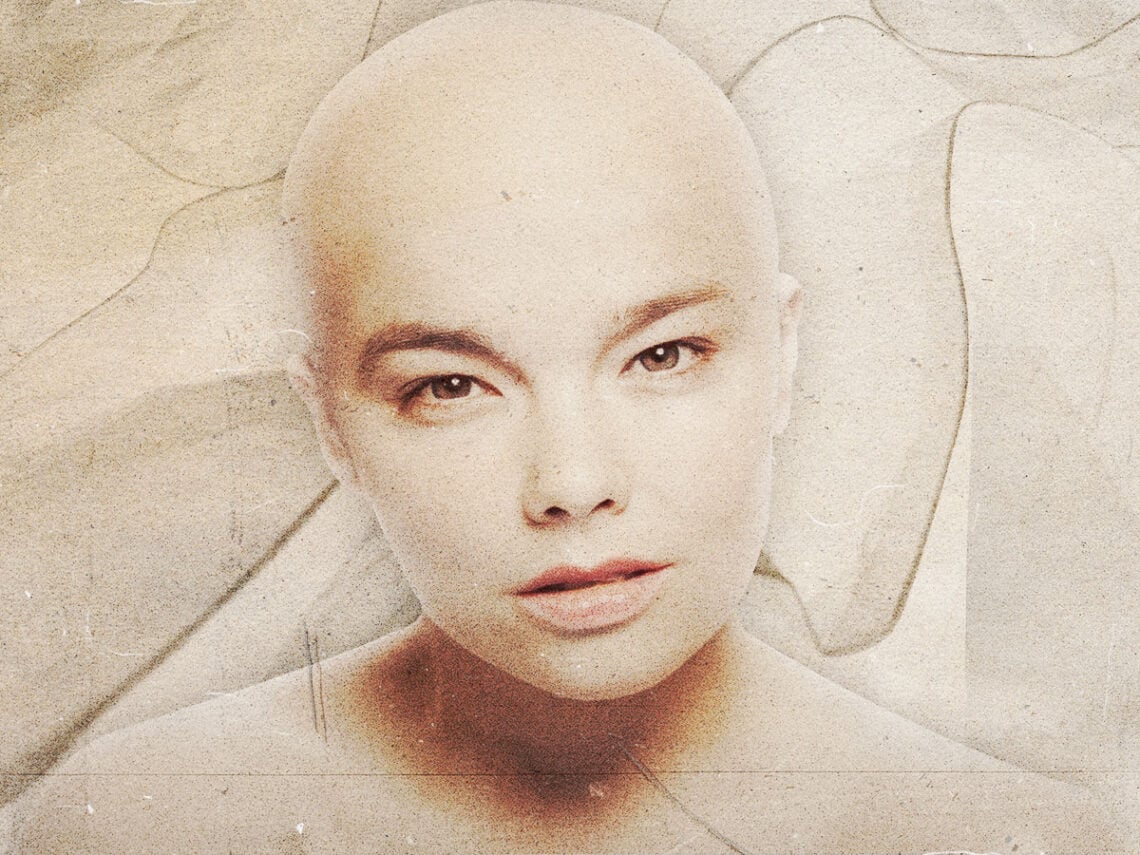
Ostensibly, this has nothing to do with Lopez, however, when you consider that it is essentially about Björk taking a pause before deciding to continue her journey with renewed relishing of the catharsis of art, the concept of her moving on from the harrowing incident gains credence. This notion was furthered even more when the video for the single was released and it bore striking similarities with Lopez’s final tape.
Like Lopez, Björk also bares a shaven head. She also moves her head and changes her facial expressions erratically. While Lopez may well have been applying paint to his face, flashes of blue also appear on Björk’s face as she transforms into a bear—the ultimate hunter. Is this a sign that she did, indeed, “find a level with that [Lopez], from a human point of view,” as she told Q, only that her transformation sees her moving on to a virtuous and noble path of art while Lopez acquiesced to a dark and murderous end?
While the director of the music video, Paul White, said that their efforts purely intended to do something fun and minimalistic with futuristic technology, the similarities might be subliminal nods to moving away from a dark period by an artist overcoming turmoil through the release of creation and its transformative effect.
In the end, this macabre and tragic story shows that we are all capable of obsessions, whether that is the healthy side of enthusing in our passions and work or the dark flipside where obsessive addictive disorders can arise from stress, anxiety and depression.
