


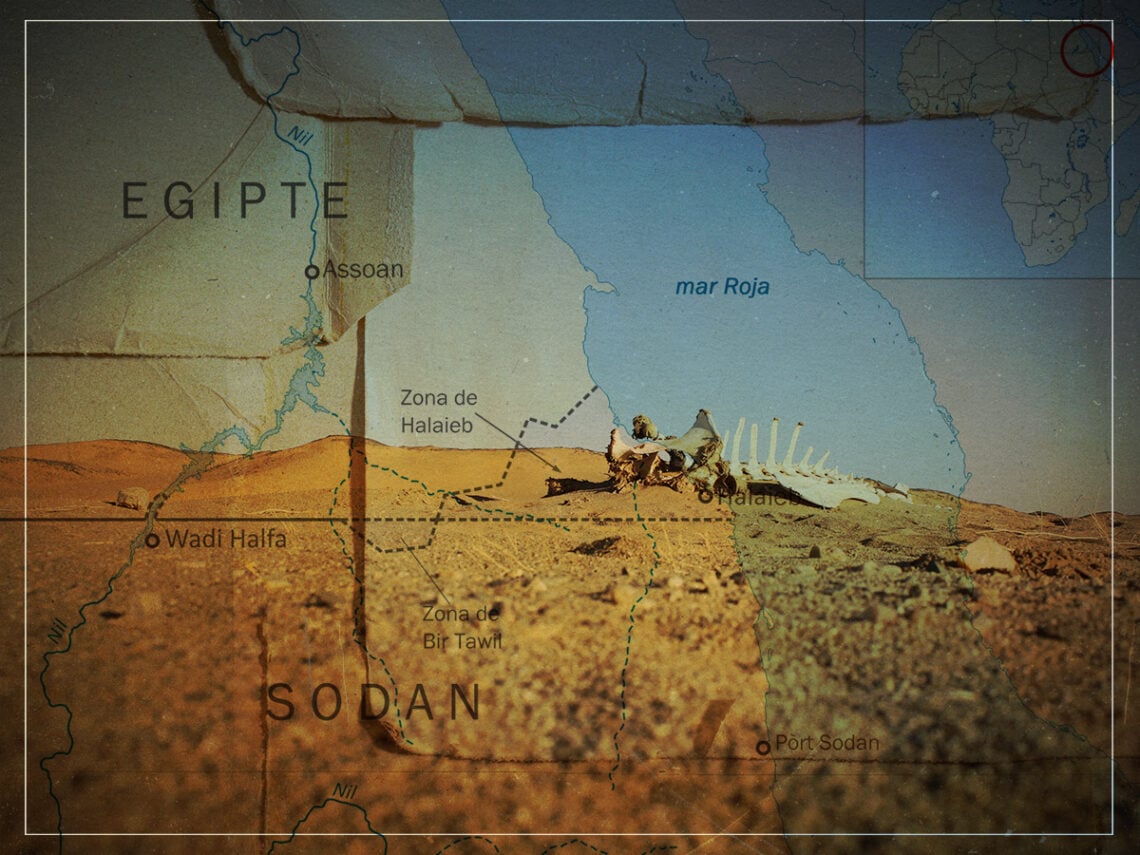
Bir Tawil: the land no country wants to claim

In an era where humanity has explored both poles, sprawled across the globe, and populated some areas so densely that the solution has been to build upwards, untouched land is nearly extinct. With CCTV and technology ensuring that few actions go unnoticed or without consequence, the notion of a place free from the complexities of geopolitics and human interference seems almost mythical. Yet, one peculiar, forgotten strip of land between Egypt and Sudan—Bir Tawil—stands as a rare relic of a time before the self-appointed overlords of Earth made their mark.
Understandably, only a handful of people in either Egypt or Sudan have heard of Bir Tawil. Ironically, its status as an uncontested territory is the result of the very forces it seems to escape: geopolitics, imperialism, and the quirks of cartography. With no governing polity, no permanent inhabitants, and no laws, Bir Tawil remains a true no-man’s-land. Reaching this enigmatic territory can be accomplished in one of two ways.
One way to reach Bir Tawil is by flying to Khartoum, the capital of Sudan, and chartering a jeep—though locals may hesitate due to the dangers involved. From there, you take the Shendi road, driving hundreds of miles to the ancient settlement of Abu Hamed, the last human outpost before the vast, desolate Nubian Desert stretches endlessly into the horizon. The second option is to travel to Aswan, the southernmost city in Egypt, and drive south from there.
Bir Tawil is truly unlike any other place on Earth. While you might encounter the occasional gold miner sifting through the barren ground for elusive specks of gold, the more prominent figures in the area are armed gangs intent on relieving prospectors of their findings. As a result, if you ever venture into the region, you may come across a military unit tasked with keeping the two sides apart. However, reports suggest that their efforts are largely ineffective, leaving the area steeped in tension and lawlessness.
It’s a fitting image of a place with no laws, where the state of nature can unfold as it would do without the consequence and binding of civilisation, and where the sand, rock, and occasionally palm trees are the only actual denizens. With dry winds regularly blowing in from the Arabian peninsula, whipping sand up that stifles visibility, this Mad Max-esque scene partially explains why neither country has laid claim.
Humans are inherently insatiable creatures, a fact well understood by those in power, particularly imperialist regimes. Yet, the lack of claim to Bir Tawil isn’t solely due to its barren topography; it’s rooted in the schemes and greed of our own making. This peculiar situation can be traced back to the colonial era, specifically in 1899, when London and Cairo signed an agreement granting the British Empire and its subordinate, Egypt, shared control of Anglo-Egyptian Sudan. Following 18 years of conflict with Mahdist rebels in Sudan, the agreement cemented Sudan’s status as a British colony. The northern border of this new territory was set along the 22nd parallel, cutting through the Nubian Desert to the Red Sea.
Things weren’t so simple, though. Three years later, the British wrote another document due to tribal claims to lands, some of which considered themselves Egyptian and others Sudanese, and saw the Hala’ib Triangle form. It essentially gave Sudan administrative responsibility for a triangle of land above the Egyptian border.

Things stayed untouched until 1956, a time when Sudan achieved independence. Disputes then emerged over tweaked borders in the two documents, with both arguing control over the Hala’ib Triangle. Then, in the early 1990s, a Canadian oil firm wanted to explore the area for mineral wealth, so Egypt sent its military to “reclaim” it from Sudan. It succeeded, but Sudan still deems the location Sudanese.
But how does this affect Bir Tawil? Well, this ostensibly minor patch of land, just south of the 22nd parallel, has been left in limbo because the countries’ claims on Hala’ib are perched on documents that seem to give responsibility for it to the other country, a real oddity. Resultantly, neither wants to touch Bir Tawil, as to do so would renounce their claim to the supposedly lucrative territory above the 22nd parallel. Therefore, on Egyptian maps, Bir Tawil is shown as Sudanese, and vice versa. It is commonly thought that it holds the legal status of terra nullius – “nobody’s land”.
Also, to keep it in limbo, the Egyptian army restricted much of the area, and people needed to obtain permission first to get close to the border.
Bizarrely, one man from a far-flung land has claimed Bir Tawil. In June 2014, then 38-year-old Virginian farmer Jeremiah Heaton obtained permission and took a 14-hour desert journey to get to this isolated path owned by no one. Why? After his six-year-old daughter, Emily, asked him if she’d ever be an actual princess, he discovered Bir Tawil online and did what any good father would: he strove to make it a reality. He trekked there and planted a flag.
“So be it proclaimed,” he wrote on Facebook, “That Bir Tawil shall be forever known as the Kingdom of North Sudan. The Kingdom is established as a sovereign monarchy with myself as the head of state, with Emily becoming an actual princess.”
Of course, it became a media sensation, and Heaton even started a crowdfunding appeal to raise $250,000 to get his new state off the ground. He faced mockery and confusion and was even accused of being a coloniser by some, but Heaton maintained that he was doing it out of love and that he was taking the opportunity to turn this untouched land into an agricultural and technological hub for all of humanity’s benefit. He reasoned that if no one wanted this patch of land, why should people object to him using it as the basis of his outlandish egalitarian scheme?
It’s safe to say it hasn’t yet come to fruition, and Bir Tawil remains locked in its natural state—and probably will remain so for years to come.
