


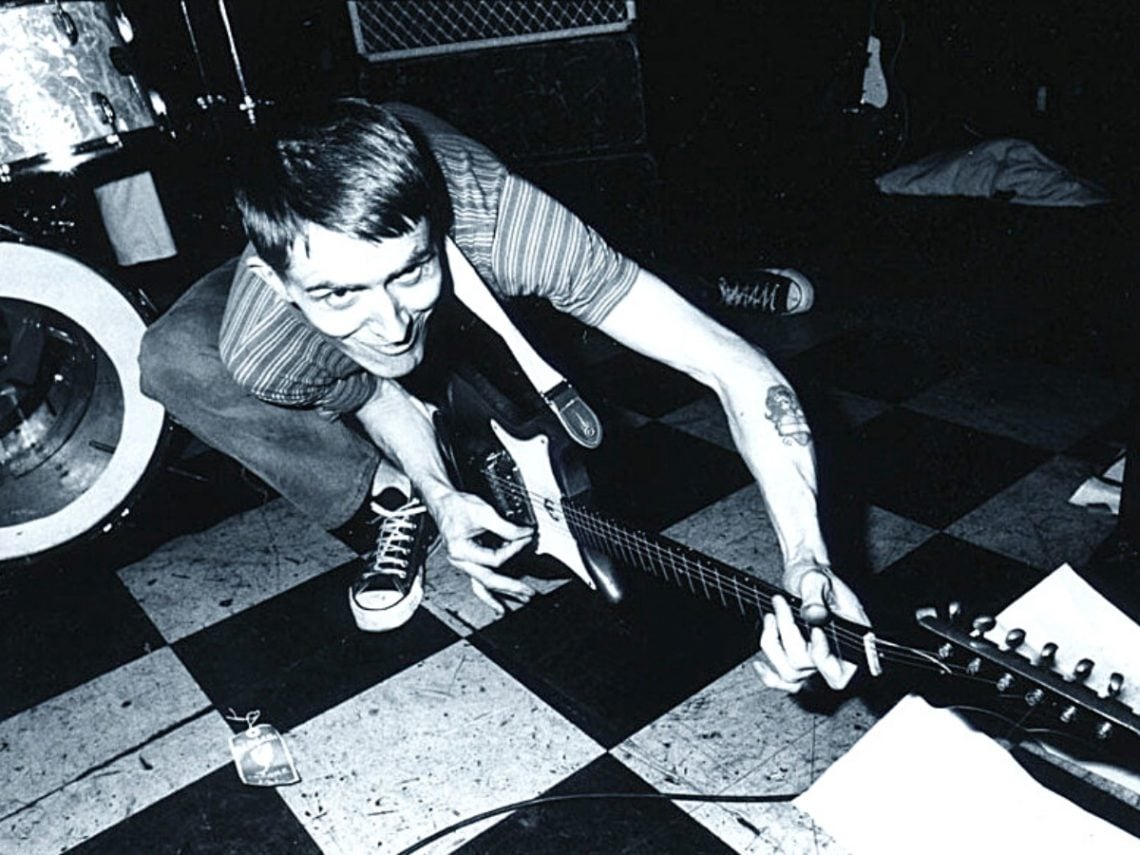
The profound story of Billy Childish and his work ‘Pedophile’

Whilst there are many signifiers of what it means to be a true artist, it is undoubted that Steven Hamper, or Billy Childish as he is best known, has demonstrated almost all of them. Childish is one of the definitive artists of his generation, a polymath committed to expressing his innermost thoughts honestly. Amateurism and free emotional expression are two critical facets of his work which have kept it relevant for over 40 years.
A painter, author, poet, photographer, filmmaker and musician, when it comes to the arts, there’s nothing Childish cannot do or, at least, will not attempt to do. This point extends so far that some commentators have ascribed him the title of a renaissance man. After a brief skim of his meandering life story, you quickly find that this moniker best describes him.
Childish always espoused an unrelenting punk spirit. The story goes that when he was 18 years of age, back in 1977, working as a stone mason in Chatham’s dockyard, he decided to concentrate on his art and never work again. Duly, he smashed his hand with a 3lb club hammer. He signed on for the dole, in what would be his source of income for the next 15 years, and commenced his journey to becoming the renowned artist Billy Childish.
Although he is primarily known for his visual art, Childish has also significantly impacted culture with his music. Over the years, he played in various punk, surf, and garage groups, including Thee Milkshakes, Thee Headcoats, Pop Rivets and the Musicians of the British Empire, and has over 100 albums to his name in what is a feat of the highest order. His work with Thee Milkshakes and Thee Mighty Caesars has been particularly influential, with a host of lo-fi and punk acts namechecking them as inspirations. Most notably, this comes in the form of John Dwyer’s outfit Thee Oh Sees, but Thee Open Sex, Thee MVPs, Thee Tsunamis, and Thee Dang Dangs are also notable fans.
However, Childish’s impact is not just confined to the aforementioned groups. Many other prominent artists, such as the late Kurt Cobain, Graham Coxon and The White Stripes, have also discussed his brilliance. Even Australian pop star Kylie Minogue appreciates his efforts and named her 1997 album Impossible Princess after the book Poems to Break the Harts of Impossible Princesses.
Garage rockers The White Stripes, meanwhile, were the most vocal musical supporters of Billy Childish. In the run-up to their performance on the now-defunct Top of the Pops in the early 2000s, the band asked the show if Childish could paint live on stage with them as they played their hit single ‘Fell In Love With A Girl’. Unfortunately, their wish was denied by the powers that be. “Kind of funny that Kylie Minogue can have seven dancers with her, and we can’t have Billy Childish painting,” frontman Jack White commented on the band’s website. In protest, White wrote ‘B CHILDISH’ on his forearm to clarify his point to the show’s producers.
Childish was once described by his longtime friend and fellow artist, Peter Doig, as “one of the most outstanding, and often misunderstood, figures on the British art scene”. It’s an accurate description given that some of his writings, including 1996’s My Fault, Notebooks of a Naked Youth and 2007’s The Idiocy of Idears, perfectly demonstrate Doig’s point.
The most glaring facet of Childish’s work, however, is the childhood sexual abuse at which he suffered. It is trauma that has proven a prevalent theme. Childish was aged nine when he was subjected to the crime by a male family friend and later articulated on the matter: “We were on holiday,” he said. “I had to share a bed with him. It happened for several nights, then I refused to go near him. I didn’t tell anyone”.
Childish has approached the incident in a handful of his songs, including the 1993 effort ‘Every Bit of Me’. However, none are as bold or significant as the 1992 instrumental ‘Pedophile’, which he released with Thee Headcoats. A rumbling piece of surf punk, there are hues of Link Wray (pardon the pun) and the more menacing sound of The Cramps.
Despite the excellence of the music, this is not the most profound aspect of the song. Instead, that comes in the form of the front cover art, which features a photograph of the man who sexually abused Billy Childish. It is arguably the most profound instance of art being used to process a crime committed against the self and a child. Whilst this decision is not as well known as other parts of Childish’s oeuvre, it is undoubtedly the most remarkable and deserves much greater appreciation.
Building on the unprecedented step of Childish using his abuser’s photograph on the cover, he shares his thoughts on what he suffered and how he now approaches it as an adult. In 2002, Childish told The Guardian that he now focuses on forgiveness, to such a point that he even considered holding an exhibition called The Forgiveness of Paedophiles. The artist revealed that he now believes that forgiveness and love are the only ways for him to deal with the world in what is a refreshing take on the grave ills that life tends to enact.
Childish has forgiven his father for his many wrongdoings when he was a child, from his life of crime to the violence inflicted on him and his brother. They had long been estranged, but at the time of the interview, Childish was the only member of his family who was friendly with their flawed patriarch. He’s also forgiven the boy who bullied him for four years at school, now understanding the life his tormentor must have led before and, more importantly, after. However, the most significant shock came when Childish said that he had forgiven his abuser and his family for not realising what had happened to him. He did caveat this point by communicating it wasn’t an easy determination. “Sometimes you’ve got to forgive yourself for not being able to forgive,” he expressed. Continuing, he said this was not to embarrass anyone but to create a path to forgiveness, including one for himself.
Noting how art and poetry helped him to “speak about the unspoken”, he elucidated: “My sexual abuse didn’t come out until I started doing poetry readings in my late teens. It was a great relief. I found out how to speak about the unspoken, about the lie of my family. That enabled me to embark on being a human rather than being trapped. It means I can communicate some truth, and that’s what makes life worth living.”
Concluding on the essential nature of communication, Childish said: “Communicating matters more than any material goods. That’s great art’s job. You’ve got to know that it matters to me a lot to know that it matters to you. I invest everything in my work, materially and spiritually. It takes an amazing amount of honesty to do that.”
