


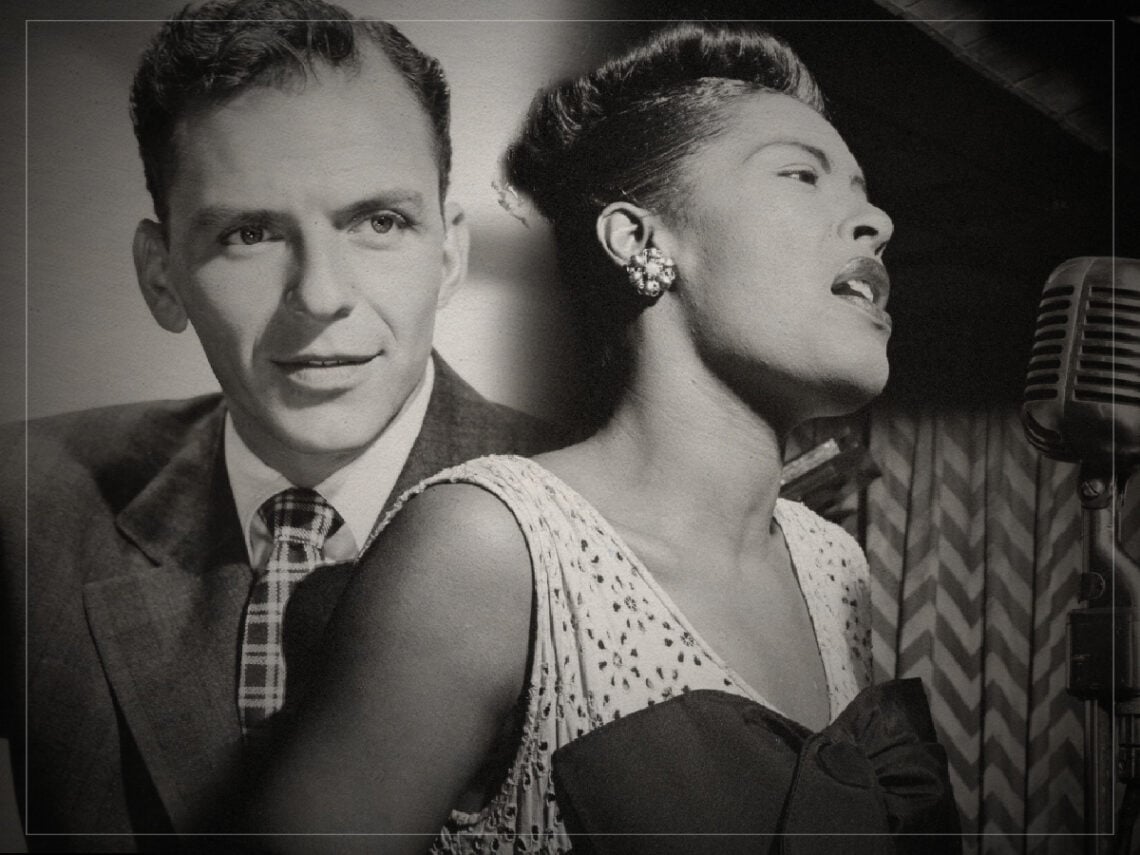
Billie Holiday and Frank Sinatra: The collaboration that never was

When we think of musicians who spoke out in support of the Civil Rights Movement in the 1950s and ‘60s, Frank Sinatra doesn’t tend to spring to mind, but while ‘Old Blue Eyes’ was past his popular peak and not necessarily a hero of America’s youth any longer, he still had a huge platform and chose to use it.
In 1958, Sinatra penned an essay for Ebony magazine, an African American-owned arts and culture publication out of Chicago, titled ‘The Way I Look at Race’, making his philosophy on the subject very clear by starting out describing the racial and ethnic segregation he’d grown up with in Hoboken, New Jersey, during the ’20s and ‘30s.
“There were bitter, bloody block fights between boys of the various groups in which fists flew and rocks aplenty,” he wrote, “My chief recollection of that period in life was that it was bitter, violent, tough and lacking in love and security. But I survived and learned one great lesson: You can’t hate and live a wholesome life. Prejudice and good citizenship just don’t go together. Bigotry is un-American.”
In the same essay, Sinatra spoke in more detail than he ever had before about the influence of Black music on his own development as an artist, specifically putting the spotlight on the great Billie Holiday. “From the days of my childhood I’ve been listening to sounds and singers, both colored and white, and absorbing a little bit here and a little bit there,” he noted, “But it is Billie Holiday, whom I first heard in 52nd Street clubs in the early 1930s, who was and still remains the greatest single musical influence on me. It has been a warm and wonderful influence, and I am very proud to acknowledge it.”
Sinatra and Holiday were both born in 1915, came out of tough working-class backgrounds, and achieved major stardom in the 1940s, but sadly, despite crossing paths on a number of occasions on the jazz circuit, they never performed or recorded together, leaving behind one of the great, lost ‘what if’ collaborations in American music history.
Looking back, the two singers had a substantial window of opportunity to work together, considering they both recorded much of their most popular material on the same label, Columbia, and had a friendly relationship rooted in mutual respect. It was a very different time in America, however, and Holiday faced obstacles that went beyond the racist policies already in place in much of society, which weren’t limited to the Southern states either.
In New York City, where Sinatra was king, the infamous ‘Cabaret Card Law’ was regularly applied to block African American artists from being allowed to perform in the city’s nightclubs if they’d previously been charged with a criminal offence. Holiday had her cabaret card revoked after a drug arrest in 1947, near the height of her fame, and she wouldn’t get it back for over a decade, even after serving a year in prison, some prime years in which a potentially deeper connection with Sinatra could have been established, and a duet may have been born.
Sinatra would become more aware of these types of injustices later in his life, and would start using his clout to go to bat for Black artists who’d faced discrimination, including his friends Nat King Cole and Sammy Davis, Jr. For Billie Holiday, though, there wasn’t enough time left to overcome the many abuses she’d suffered. She did perform two successful concerts at Carnegie Hall in her later years, and recorded Sinatra’s ‘I’m a Fool to Want You’ on her final album, 1958’s Lady In Satin, but just a year later, at 44, she was gone.
“’Lady Day’ is unquestionably the most important influence on American popular singing in the last 20 years,” Sinatra wrote a year prior, “With a few exceptions, every major pop singer in the US during her generation has been touched in some way by her genius.”
