


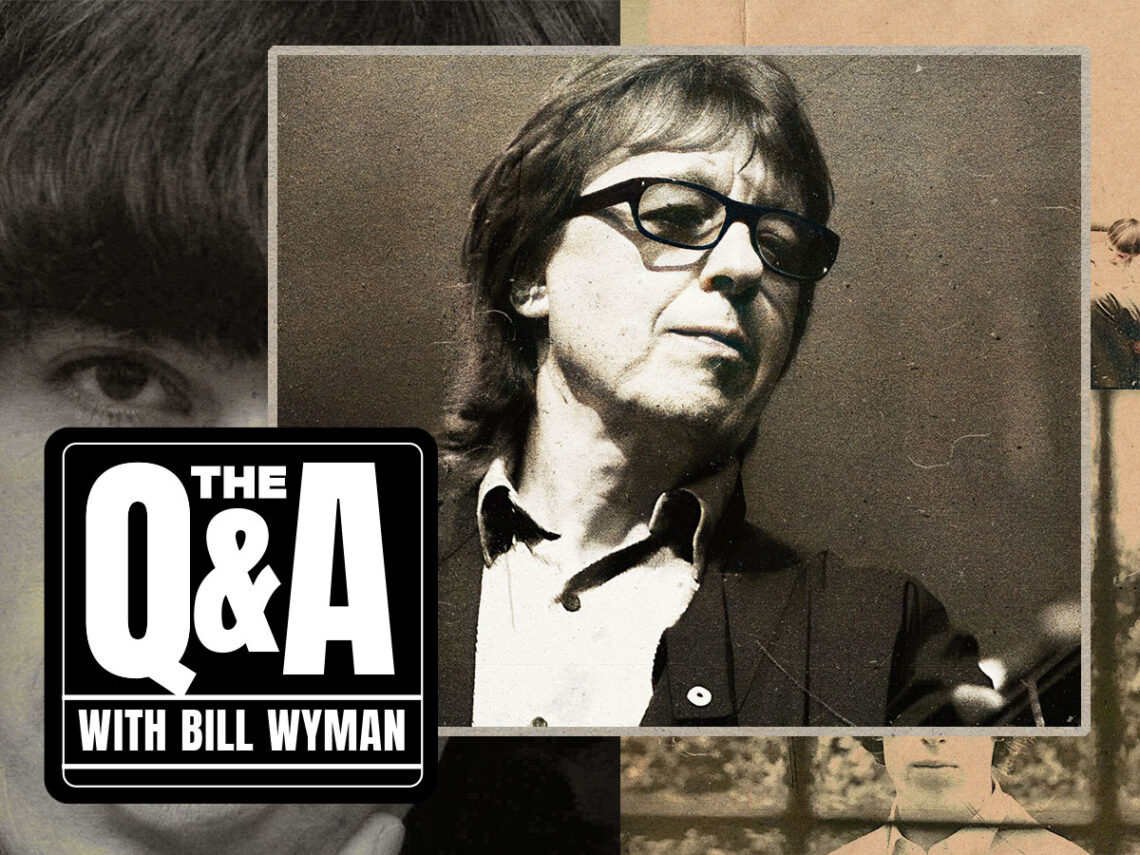
Q&A: Bill Wyman of The Rolling Stones discusses his new book and future projects

Very few musicians reach the same lofty heights as Bill Wyman in their careers. The former Rolling Stones bassist rode a wave of rock ‘n’ roll energy that one can scarcely compare to any other artist in history. However, strangely the star has always appeared somewhat nonplussed by the whole thing. There aren’t many rockers who would’ve given that up to entertain a deep passion for metal detecting.
Growing up in Penge, a poorer region of South London, during the Blitz of World War II, Wyman dreamt of living in the nearby haven for the affluent, Dulwich. However, in 1962, the aspiring bassist entered a Chelsea pub and encountered the most pivotal moment of his life. “On a grey, cold winter’s day on the 8th of December 1962, I went with my drummer friend to a pub in Chelsea called the Wetherby Arms,” Wyman wrote in the introduction to his new book.
“It was here that my life would change forever, taking a turn that I could have never believed imaginable,” he adds. “I had with me my bass and my three amps; and in that pub, I met Mick, Keith and Brian. It has been said I brought electricity to the Rollin’ Stones. I joined the band that day. The boys shared a flat down the road at 102 Edith Grove, and it was here we would meet up for rehearsals, along with Charlie Watts, who joined the band a month later. We were now called the Rolling Stones, without the apostrophe. My journey as a Rolling Stone started in Chelsea.”
Wyman continues: “It’s no wonder Chelsea holds such a warm place in my heart. My love for the neighbourhood continued to grow throughout the 1960s, when I began to go on shopping sprees at the fashionable boutiques in the King’s Road, buying Edwardian velvet jackets from Dandy Fashions, Moroccan clothes and jewellery at the Chelsea Antique Market, and visiting the Chelsea Drugstore, During these escapades, I would inevitably cross paths with the many celebrities who also shopped and ate there. I was part of this exciting new era, when music, fashion, art, film, and theatre were all changing.”
As he revealed in our recent conversation, Wyman’s attraction to Dulwich never waned, but the bond he made with Chelsea in the early 1960s ultimately took the limelight. For six decades, the famous London borough has provided a culturally nurturing and inspiring touchstone for the former Stone and, since 1982, a proud home. Only recently, however, has he delved into the area’s rich history.
In his new book, Bill Wyman’s Chelsea: From Medieval Village to Cultural Capital, the legendary bassist and author takes the reader on a trip through time, framing Chelsea as a cultural hub of London and hence, the world. Serving as a guide of sorts, the book also includes four walking tours, maps, an A-Z of streets and over 300 photographs, many of which were taken by Wyman.
On Saturday, July 1st, from 11am-1pm, Wyman is scheduled to visit Partridges in the heart of Chelsea, London, for a book signing session. The tome satiates a deep passion for cultural history and, of course, his home of many decades. Before the book signing event at Partridges this weekend, I had a chance to catch up with Wyman on a video call to discuss projects present and future.
Bill Wyman discusses his new book and future projects:
Far Out: What inspired you to write Bill Wyman’s Chelsea: From Medieval Village to Cultural Capital?
Wyman: “First, I just took photos around Chelsea – from when I moved here in 1982. Then, I thought, ‘Why don’t I do a book of London, just all over London taking photos?’ And then I realised that it was just going to be so big a job that I’d end up with Encyclopaedia Britannica or something, you know, eight volumes or something. So, I started to focus on Chelsea. And so I then walked every street in Chelsea, taking photos of anything that I thought was unusual, different or interesting, from door knockers to weathervanes to plaques on the walls.
“I ended up with 1800 photos. And then I decided to go street by street and start to find out who was living in the streets and who was living in what houses. I ended up doing that for about four years and finally finished it.”
What did you discover on your rounds?
“I learned Agatha Christie lived in a nearby apartment and Bram Stoker, who wrote Dracula. Then there was Thomas More, Henry VIII, Oscar Wilde. It just went on and on. Actors, actresses, historians and writers.”
How long did it take you to write?
“That doesn’t take as long, probably a year or so or six months.”
What would you have ended up doing for a career had you not met The Rolling Stones in 1962?
“I would have been a photographer, an archaeologist, or a museum curator because they’re the other things I’m very fond of.”
Has history always been one of your biggest passions?
“Well, yeah, because I did it musically as well. After I left the Stones, I formed a band called The Rhythm Kings with some quite famous musicians for 20 years. We searched through old music from the ’30s, ’40s, ’50s and ’60s and did new versions of the songs. So that was a bit of archaeology in music”.
Do you have any favourite pubs or music venues in Chelsea?
“I don’t think there are many music venues in Chelsea anymore, really. There’s one called 606 Club, which is quite a small place that people play. I only went there a couple of times way back.
“As far as pubs, I’m not really a pub person, I don’t drink beer or anything. But I live in an area between Kings Road and the river where I’ve got everything: shopping, restaurants, theatres, cinema. You can also walk down to the riverfront; it’s really nice”.
In the book, you discuss the Chelsea bun and include a recipe. How are your cooking skills?
“Yeah, I talked about the Chelsea bun and the history of it, and the publishers thought they’d put that little bit in to make it interesting. So you can make your own Chelsea buns! I haven’t tried it yet. I’m not really one for the kitchen”.
I remember reading that you’re a big fan of Rupert Bear. Was this interest sustained through your adult years, or was it, like your book, a return to your roots?
“Absolutely. Because when we were children growing up in the war, and just after the war, we never got presents; we were so poor in south London. It was bad enough to try to get food and clothes and whatever. So you never got birthday or Christmas presents. But after my mum and dad managed to scrape some money together, they’d buy us a Rupert annual that all the five children shared.
“So it became an obsession, and over the years, I’ve collected the entire library of Rupert books from 1936 to the present day. And I’ve got dolls, coins, stamps, jugs, medallions and all kinds of things. I’ve also got Rupert badges I wear. The only badges I wear are Rupert Bear badges and Crystal Palace badges because they’re my football team”.
Would you say you find comfort in nostalgia?
“Oh yes, of course! Because I grew up at a time when times were really bad. I lived through the war, you know, sleeping in air raid shelters, going to school with a gas mask on my shoulder, seeing propaganda films at school when you’re five or six years old. We got bombed out twice – V1 rockets, or doodlebugs, as they called them.
“So, those were bizarre times, but everybody around you was in the same situation, so you just accepted it as part of life. But looking back, yeah, I have great memories. Little things that we were able to keep hold of, little possessions, became so important”.
What are your views on the modern sociopolitical climate in London and on a broader scale?
“I don’t want to go there. You turn on the news, and everything’s bad. Hardly ever do you see anything sort of uplifting and positive. So I tend to try to avoid the news unless I hear that it’s necessary to catch up on something, but it’s always bad stuff. I don’t get involved.
“I used to have a friend who was a member of parliament. They used to take me to the Houses of Parliament the whole time, and I’d go to places where the public weren’t allowed, and that was rather magical. But as far as politics is concerned, no”.
How has Chelsea and central London changed for the better or worse over the past six decades?
“The only problems now are on the roads. They’re trying to stop people from driving, basically – putting the speed limit down to 20, and if you drive at 22 and you get caught, you get a speeding fine and three points on your license. It’s ridiculous. Then you have to pay a toll for coming into the environment and another toll if you’ve got a car that isn’t perfect for emissions. And, of course, buildings are being pulled down, and buildings are going up.
“So, London is slightly changing, but it’s still one of the best cities in the world because it’s full of greenery. Almost every street has got trees. You’ve got squares everywhere and tonnes and tonnes of parks. Everybody has little gardens, and if you don’t have gardens, there’re window boxes. England’s famous for its little country gardens, liking nature and liking flowers around. You don’t see that if you go to – I don’t know – Vienna or Frankfurt”.
How do you get around? Do you use the London Underground?
“The last time I was on the Underground was 1964. I use taxis, black cabs. They’re the best. They know all of London. When you go to these other companies, they have to use their bloody phones and work out where the place is”.
I heard you recently reunited with The Rolling Stones for a one-off contribution to the new album. Have you got any other projects on the go?
“I’ve got another book coming out [on the history of a house I bought in Suffolk in 1968] and a solo record coming out in the autumn”.
How’s the solo album coming along?
“I’ve finished it, basically. It’s mixed. I’ve done 12 songs. Five of them I’ve written and, for a change, I’ve done five covers of other people’s songs I like. So I’ve done songs by JJ Cale, Taj Mahal, Bob Dylan, John Prine…:
Did you record the guitar parts too?
“No, I played the bass. I’ve got a drummer, bass, guitar, and just a couple of overdubs, that’s all. No piano, no vocals, no backing vocals, no horns, nothing like that. There’s a little bit of harmonica here and there. It sounds a bit like JJ Cale’s stuff; that’s what I wanted to do. And everybody that has heard the stuff likes it, so it’s quite promising”.
