


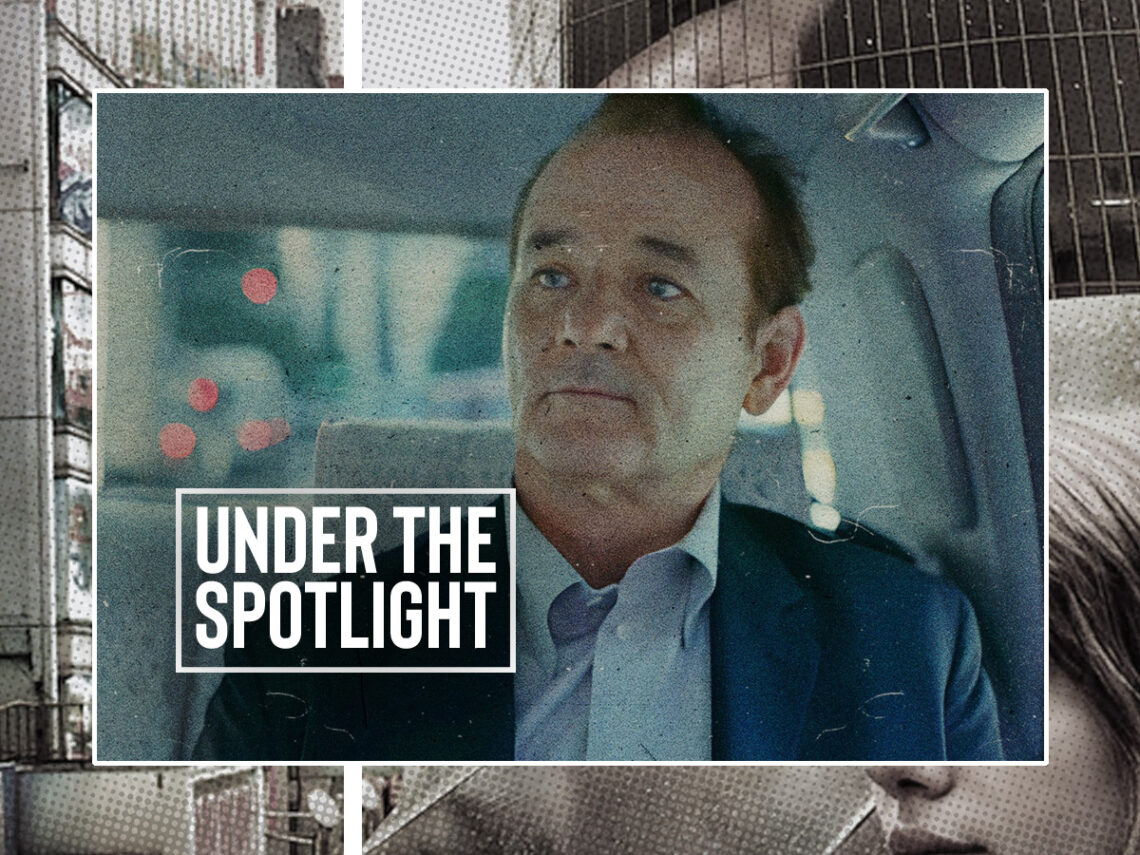
Under the Spotlight: Bill Murray’s claustrophobic alienation in ‘Lost in Translation’

By the mid-2000s, Bill Murray had made a significant departure from his usual acting choices. He had been steadily gravitating towards more meaningful characters and collaborating more often with singular, bold and original filmmakers. Working with auteurs such as Jim Jarmusch on Broken Flowers and Wes Anderson on Rushmore, The Royal Tenenbaums and The Life Aquatic With Steve Sizzou, Murray was forging a distinct brand of rich, darkly comic and thought-provoking performances that ran adjacent to his broader comedy outings.
Of all these artful offerings, there’s one in particular that shines exceptionally brightly in an already luminescent section of the actor’s filmography: Sofia Coppola’s Lost in Translation, which introduced us to Bob Harris, the dwindling film star who finds himself alienated and trapped in an existential crisis whilst working on a job in Tokyo.
Coppola, who won ‘Best Original Screenplay’ at the 2003 Academy Awards, can take a huge portion of the credit for writing powerfully three-dimensional characters on the page. What Murray brings to the role of Harris, however, is not quite as simple as just the excellent performance that it is. He brings a degree of lived experience, a degree of undeniable authenticity that transcends the screen and extends beyond the character.
During an interview with Coppola and Murray, which, funnily enough, is shot by the actual movie’s cinematographer Lance Acord, Murray recalls his immediate connection to the character upon reading the script for Lost in Translation: “I know this, I can do this”. Whilst he certainly wasn’t a fading A-lister like the character of Harris, Murray nevertheless had over two decades of experience working in the film industry and was no stranger to feelings of jadedness when it came to the life of a high-profile actor. Murray continues, “I know a little bit about being a movie star, and a little bit about being a fish out of water.”
Clearly, Coppola assumed this to be the case; she didn’t entertain the idea of any other actor and has outright said the movie wouldn’t have been made had they not been able to get him. Notoriously difficult to contact and known for his reclusive nature, Coppola spent a year trying to get in the same room with him. Even after Murray agreed to do the film, nothing was set in stone, and no contract was signed. It wasn’t until he touched down in Tokyo that she knew her film could happen, and up until that moment, she describes the uncertainty being “the most excruciating thing”.
Some of the greatest comedians are so because of their ability to flirt with darkness. Some of the greatest actors are so because of their instinct to bring comedy to a moment that might not necessarily have demanded it. Murray is both. Whilst Lost in Translation is not a comedy, it nevertheless has comic moments that elevate the sadness and accentuate the sense of loneliness. Focuses on an older man and a young woman who are both adrift in a foreign country; the film is ostensibly a romantic movie. Atypical, almost platonic, somewhat unnerving, but a romance nonetheless.
For Murray, something of a stranger to the genre, he had to find a different way into the movie. “There was some sort of humour that usually accompanies romance that I thought I could tackle and could make it to help tell the story,” he said. “The only question I had was how funny the boss wanted it to be.”
Murray continues, “How funny this could be without affecting the film Sofia wanted to make.”
Along with the delicate and nuanced chemistry between himself and co-star Scarlett Johansson, it is that balance of pushing the comedy to just before the breaking point that makes this one of Murray’s most exceptional performances.
In a particularly memorable scene that encapsulates Murray’s acting in the film, his character Harris is shooting a commercial. It’s an advert for Suntory whisky, the whole reason why he’s in Japan, and the director is capitalising on Harris’ old-school, classic Hollywood aesthetic; think George Clooney in the Nespresso adverts. As the arrogant director swans about the set and shouts at his crew in Japanese, Harris watches in thinly veiled dismay. He can’t understand a word anyone’s saying, but he does understand raised voices and the palpable tension in the room.
As the scene plays out, Murray manages to communicate a whole array of different emotions through the most subtle and nuanced facial expressions. Eyes dart, eyebrows raise, lips purse, and with all of them, we perceive Harris’ profound sense of frustration, confusion, self-doubt and, as the director repeatedly assaults him verbally about how to hold a glass of whisky, his crippling disappointment that this is how low he’s had to sink. All very heavy stuff, and yet it’s all the heavier because Murray lets us laugh at the absurdity of it. When the translator relays a lengthy note of direction to Harris simply as, “Turn right, with intensity”, he responds, “Is that everything? It seemed like he said quite a bit more than that.”
Whilst Murray continues to give us great performances, his turn in Lost in Translation feels like a significant landmark. It demonstrated the best of his comic and emotional capabilities, making it a certainty that fans will remember his work in Lost in Translation for a long time to come.
