


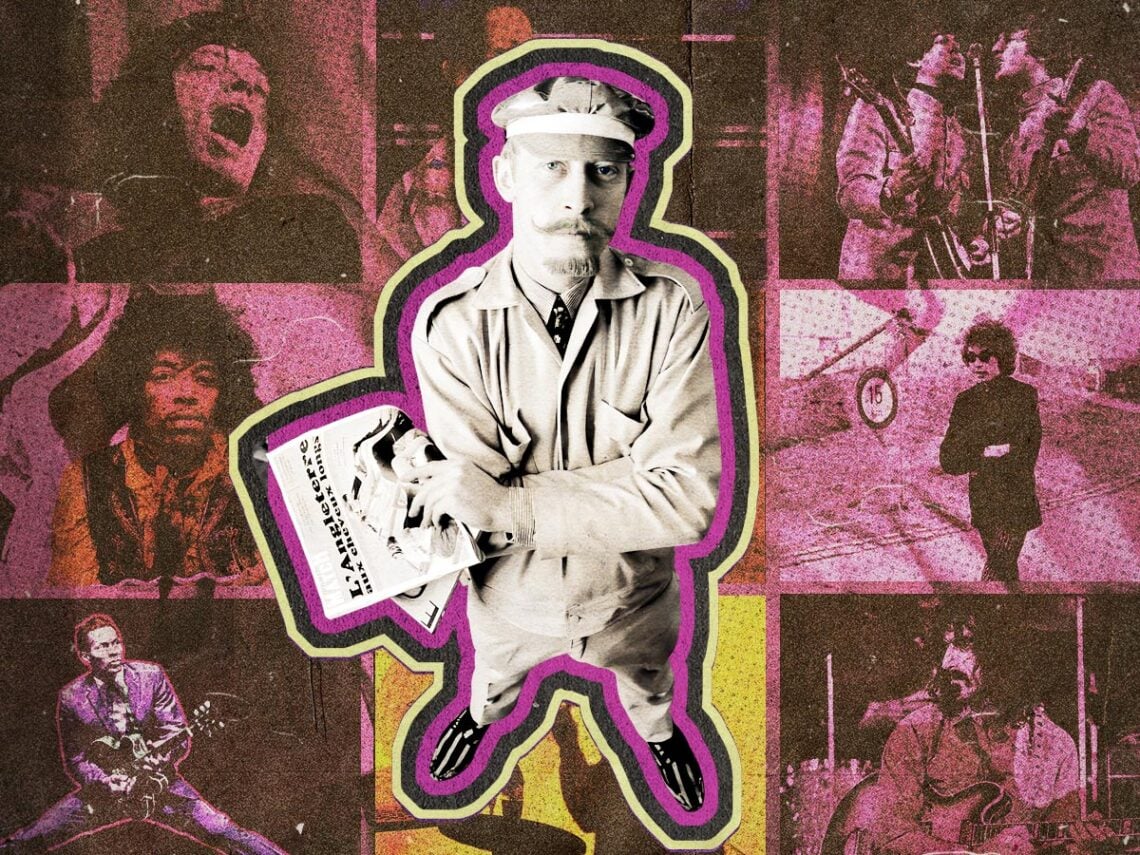
Bent Rej: The photographer who documented a counterculture movement

Rock and roll emerged in the 1950s as a seemingly inevitable artistic by-product of thriving technological evolution and post-war reform. Principally, globalisation and advanced recording technology saw the emergence of early global stars like Elvis Presley and Chuck Berry. Concurrently, great strides in photographic technology catalysed the ensuing age of icon worship. As pop culture propagated, thousands of talented photographers stepped up to the mark to make a name for themselves; Bent Rej was one of the few who prospered.
In the 1960s, we didn’t have the luxury of smartphones encrusted with multiple digital automatic cameras. Naturally, this made photography a challenging yet more immersive vocation. With manual film photography, one must hone a skillset of admirable proportion to ensure the finite and costly film cartridges wouldn’t return from the dark room a blurred, mottled mess or, indeed, a black hole of nothingness. In film photography, light is your friend but also an insidious enemy that draws a fine line on which to tread.
With this in mind, talent was the first step towards eminence in the field of photography. Secondly, unlike abstract painters, photographers must be in the right place at the right time. For many, this would demand intrusion, espionage and, sometimes, a black eye in the desperately frenetic paparazzi occupation. The most satisfactory vantage point, as Bent Rej discovered, was one of friendship.
In his early 20s, Rej found work at the Danish newspaper Ekstra Bladet, where he worked as a photojournalist. The most pivotal moment of his career came in 1965, when, aged 25, he was assigned to document the German leg of The Rolling Stones’ 1965 European tour. He built a rapport with the blossoming British Invasion outfit, especially Brian Jones, and was soon absorbed into the band’s inner circle of associated photographers, media representatives and roadies.
As a close acquaintance of The Rolling Stones, Rej could stretch his artistic legs to capture distinctly personal yet uniquely creative shots of the photogenic group. As well as his behind-the-scenes tour-bus photographs, Rej captured the Stones performing on stage and going about their quotidian domestic lives.
So why did the band welcome Rej into their entourage? During a recent conversation with Far Out, Rej’s daughter Ny explained that her father, who sadly passed away in 2016, “was very fashionable at the time. He was bold, and if he wanted something, he would get it. I think he was also [roughly] the same age as them, and they were very reachable at the time. So, I think he was just the at the right time, at the right place.”
As a friend of The Rolling Stones in the late 1960s, Rej was soon swept into the bustling celebrity underworld of London. Here, he could network with the Stones’ notable peers, including Jimi Hendrix, The Who, The Beatles, The Kinks, Bob Dylan, Small Faces, Frank Zappa and many others. With a camera at his hip at all times, Rej rarely passed up photo opportunities and took some of the most iconic shots of the era.
Although his brush with the late-60s rock scene marks his most famous work, this period in his life was transient. He enjoyed the company of the rockstars but found it difficult to conform to the rock and roll lifestyle. According to Ny, her father wasn’t as interested in the music so much as the artists themselves, and when the inevitable signs of hedonism soaked through, the lifestyle became less attractive.
“They were very good friends,” Ny continued, discussing Rej’s friendship with Jones. “Brian Jones came to live with my parents a few times when he was visiting Copenhagen. So they were buddies, but within a very few years, Brian got into drugs a lot.”
Ny explained that her father’s relationship with Jones deteriorated when the late Stone put LSD in his wine during a private dinner. “He got LSD without knowing it, and then he felt that he couldn’t stay around. I think he wasn’t that into rock and roll music like that. He was just curious, but it wasn’t the music or that life that attracted him. So when he got drugged that time, he withdrew. So it was a very short period, and then he only had very few jobs photographing musicians after that.”
During his short stint as a rock photographer, Rej contributed to various publications, most prolifically to the British magazine Fabulous. Following his disillusionment with the British rock scene, Rej used his experience to pursue an ongoing career in fashion and advertising. His notable material thereafter included a commercial assignment for Fiat in the late 1970s, where he photographed models for the car brand’s annual calendar.
In the late 1980s, Rej was contracted for Carlsberg’s famous “Probably the best beer in the world” marketing campaign. Over two decades working on the campaign, Rej published more than sixty photographs of the bold green Carlsberg lorry at multiple locations worldwide.
As we embark on our Bent Rej retrospective series, we will take a closer look at the fascinating photography from the various chapters of his life. Below, we present some of the highlights at the tip of his iceberg portfolio.


Never Miss A Beat
The Far Out Beatles Newsletter
All the latest stories about The Beatles from the independent voice of culture.
Straight to your inbox.