


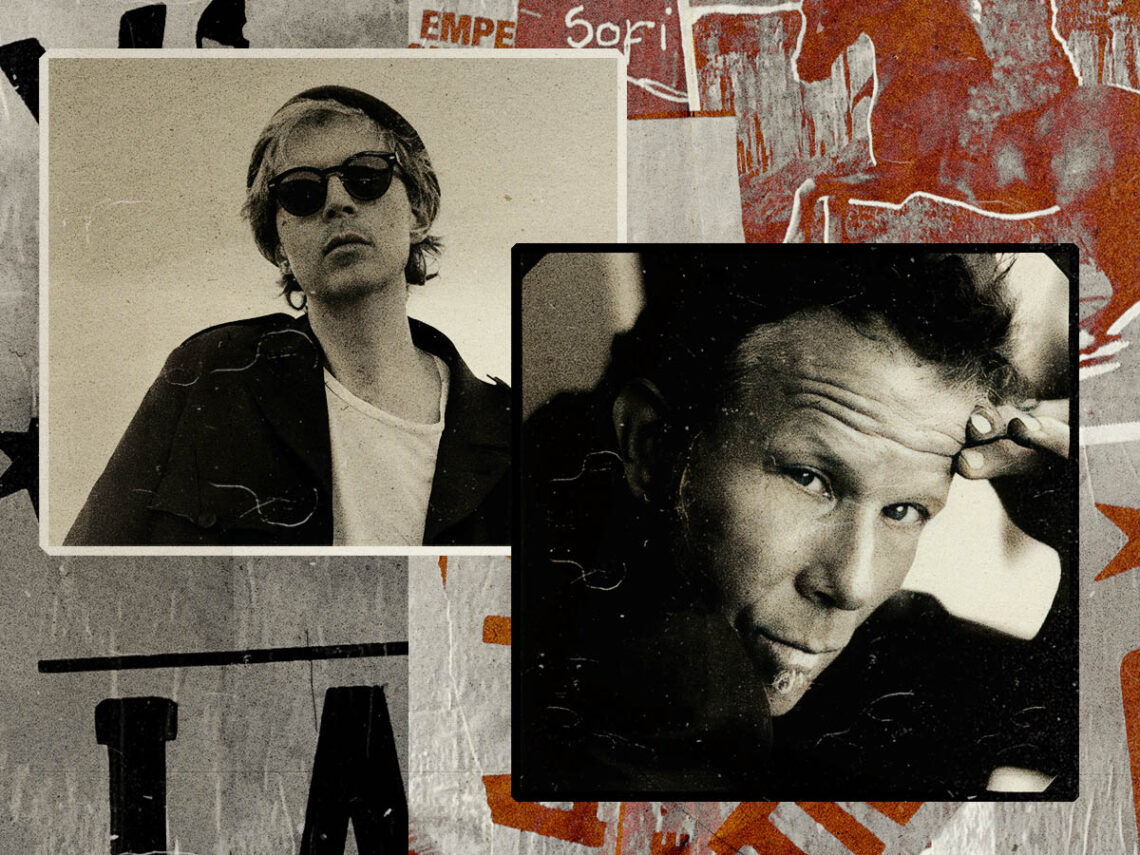
In conversation: Beck and Tom Waits on the nature of influence: “Where does this ‘best’ thing come from?”

There are artists who are inspired by the fame, fortune and the attention of the spotlight, and then there’s the likes of Beck and Tom Waits. These wayfaring figures seem to shrug convention with the aura of the outsider artist while exhibiting the talent of someone who has mastered their craft enough to get playful with it. By doing so, they have undoubtedly changed culture for the better, and for the weirder.
Ironically, Beck even owes his career to skirting the expectations of the spotlight. On the cusp of the 1990s, he was essentially a homeless figure in New York’s anti-folk scene playing shows in order to bolster his pocket change. “I’d be banging away on a Son House tune,” he recalled when discussing the fitting track that launched him: ‘Loser’. “The whole audience would be talking, so maybe out of desperation or boredom, or the audience’s boredom, I’d make up these ridiculous songs just to see if people were listening. ‘Loser’ was an extension of that.”
People were listening – people like Johnny Cash. “I listened to him backstage and I was so impressed with the way that he could do Appalachian music, like a Hillbilly, he’s really good at it. And then his own sort of songs,” Cash said after actively enlisting him as tour support. Cash reserved specific praise for the track ‘Rowboat’, stating: “It sounded like something I might have written or might have done in the sixties when I was going through some weird times.” In fact, Cash liked it so much that he later covered it on his 1996 record Unchained.
And so, Beck became the latest in the long line of alternative music star who almost seem to have inadvertently exercised an influence on culture like Tom Waits before him. This made them a distinct duo to get talking. Which is exactly what they did back in 2009 for a feature on Beck’s official website as he began to muse upon the strange constitution of culture.
Chief among that topics that the pair perused was the idea of influence. Both Beck and Waits never had the music world served to them on a silver spoon, and in some ways dealing with issues like disinterested crowds, dogeared guitars, crackly amps, and the fruitful muse of hardship helped to shape their sound. “I played the Roxy with Jimmy Witherspoon a long time ago, and somebody hit the telephone pole in front on Saturday. Knocked out all the power – this was like 5minutes before we went on. Place was in total darkness. People were lighting candles,” Waits recalled.
“Jimmy Witherspoon went and did a killer show. He just put his organist on a piano, and he has this big big, huge voice anyway. Got right on the lip of this thing. I was freaked out. I didn’t know what to do. He killed. I guess you have to get reduced to that to find out the origin and basic building blocks of what you do are still in tact. Look under the building, make sure the supports are still there and haven’t been eaten through. But, yeah, you can do a lot with a bullet mic and a wah-wah pedal. But before that there was changing your voice and raising your volume. I guess we’ve all gotten very lazy with all the toys that are available,” he said about going back to basics to ensure the elemental soul of your music is still in tact.
Beck agreed that similar circumstances helped to shape his own sound. “I wonder, in a way, if it’s good to put yourself in those positions where you don’t have the equipment, you don’t have those crutches,” he said. “But I think we’re so attuned to hearing it at that volume and having to feel that impact? There’s something maybe uncomfortable now to just hearing somebody’s voice in a room singing.”
This creates something interesting rather than a polished and refined work, which, in fairness, is what some people are obsessed with. This gave pause to Waits to ask: “I guess you can tell when something is primarily cosmetic and lacks the structural integrity. I think we all have an instinct about that. Where does this ‘Best’ thing come from? Is that human? Is that American? Is it all over the world? Everyone wants the best eye surgeon, the best babysitter, the best vehicle, the best prosthetic arm, and the best hat. There’s also the worst of all those things available and they’re doing rather well. Denny’s is doing great. It’s always crowded. You have to wait for a table.”
By embracing the Denny’s of this world, Waits has become a singular force. These are few and far between, as Waits opined: “My theory is that the innovators are the ones that open the door to things, and then behind them there’s a huge crowd and they are trampled by the crowd behind them. And then you have to peel the innovators off the ground like in the movie, The Mask. Like a Colorform.”
Beck backed this up with a bit more of a timeless reference, stating: “I was thinking about influences and people who jump on a train or a trend, follow something. I was reading about the Greek playwright, Euripides, and a few others. He had written 105 plays and two of the plays survived from antiquity. I was thinking, ‘Can you imagine writing 105 plays, and you had to write 105 for one or two of them to survive?’ I was thinking maybe in a way that the people who were influenced by the lost plays are the ones who are going to help them survive in some way. It’s not really about what you’re doing originally, it’s about the transmitting of the thing to the next person. It mutates along the way and turns into other things.”
The ephemeral nature of art and the ripples it casts is something Waits has also clearly given plenty of thinking time to because he added: “It’s like they found one of those van Gogh’s at a garage sale. This woman bought it and she was using it to block out the sun in her kitchen. She was using it as a window shade, so it was getting all faded from the sun. And she cut it because it didn’t fit the window. When they finally discovered she had a van Gogh as a window shade, they brought in all these experts from the museum and they were all filling in her living room.”
Continuing: “They said, ‘How can you cut off the top off this painting?’ And she said, ‘It was just a little piece of the sky.’ Sometimes it’s the value you attach to things. It’s subjective. And we record on stuff that’s going to disintegrate. Just like films are made on celluloid that’s going to vanish, it’s going to be gone. It’s like drawing on wax paper or something.”
Yes, you cannot guess the weird permutations that influence will beget, as the pair concluded: “You know, the yo-yo is a sixteenth century Philippine weapon. It weighed 4 pounds and had twenty feet of cord and only came to the US in 1929 [Waits].” And Beck signing off: “I’m wondering what’s going to show up in 2029 from the fourteenth century? Maybe there are other possibilities in the wings.”
