


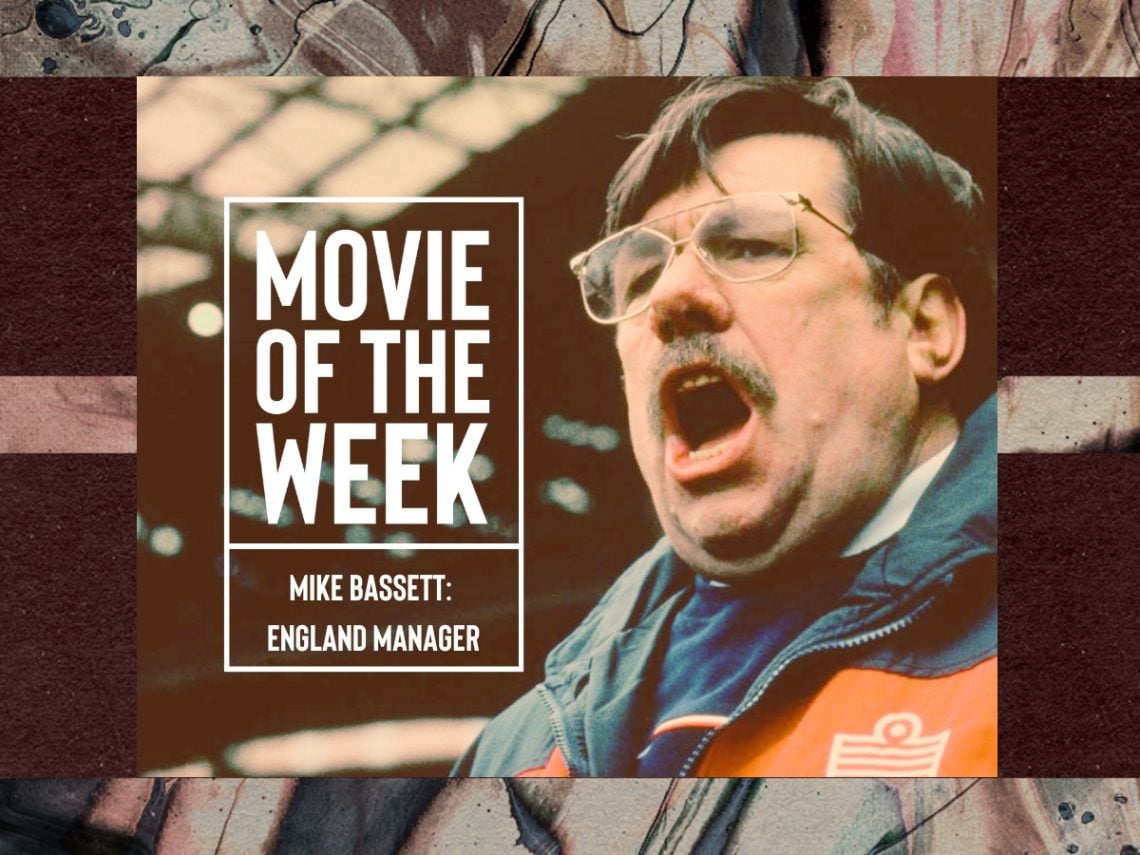
Movie of the Week: The beauty of sporting failure in ‘Mike Bassett: England Manager’

Watching the men’s England football team in the past has been the equivalent of getting a pie and a pint on a rainy away day in Lincoln. ‘Maybe this time it will be good, maybe this time the creamy filling won’t give me long-term PTSD, maybe this time the crust won’t feel like chewing a wet sock’. Despite knowing that the pastries will always disappoint, we keep coming back for more, and despite knowing that England will always disappoint, we keep singing, “It’s coming home!” with blind positivity.
Such is the joy and insanity of being an England fan, as we pray and hope for the three lions to bring a trophy home every two years, only for the back pages of the tabloids to rejoice in our failure with a stupid headline like ‘Eric’s DIER mistake’. Though whilst failure was almost always certainly on the cards back in the 1990s and 2000s, England is fueled with a sense of resurgent pride as we enter into Qatar 2022, having got to the last stages of our previous two tournaments.
Still, those who don’t know history are destined to repeat it, so we thought we’d revisit the hopelessness of the England football team with Steve Barron’s iconic 2001 satire, Mike Bassett: England Manager.
Released the same year as Ricky Gervais’ The Office, Barron’s film utilises a similar mockumentary style in its study of Mike Bassett, played by national treasure Ricky Tomlinson, a scruffy, hopeless football manager who is surprisingly assigned the role of England head coach. Despite having only managed in the murky lower leagues of English football, Bassett is tasked with getting the team to the world cup in Brazil, with the film tracking his absurd tactics to try and get the three lions back to greatness.
Penned by relative unknowns Rob Sprackling and Johnny Smith, the film satirically picks apart the contemporary history of English football, tearing aside any suggestion that English football resembles the ‘beautiful game’. Instead, the film dabbles in absurdity, with Bassett quickly going from fan favourite to the most hated man in the nation thanks to his questionable off-field tactics, including hiring a one-time car salesman as his assistant and using the eccentric training methods of Dr. Shoegaarten to try and whip his players into shape.
Whilst such plotlines are hilariously absurd, others are merely exaggerated versions of real-life individuals, such as Kevin ‘Tonka’ Tonkinson, the Geordie alcoholic, a character who bears resemblance to Paul Gascoigne, who struggled with similar issues throughout his career. It all worked together to reflect the identity of English football at the time, revealing the booze, depravity and disorganisation that existed beneath the majesty of the beloved sport.
But the comedy’s blunt, self-deprecating nature makes it such a source of joy over two decades later, representing the fragility and fallibility of the English national football team that has existed ever since 1966. Though the success of the three lions may have improved since the film’s release in 2001, there will always be a niggling thought that failure is just around the corner.
As screenwriter Rob Sprackling observed in 2018, upon the release of the movie, the English media presumed that with the arrival of the Swedish manager Sven-Göran Eriksson, fortunes for the national team were about to change. “Everything felt like it was going to be all modern and new and professional,” he explained, “The wheels weren’t going to come off and we weren’t going to have disasters. But that wasn’t the case. That’s why people come back to [the film] so often, because the same disasters continue to happen”.
In a strange way, it is the continued incompetence of the English football team that makes each world cup and European championship so charming. If we win, football’s come home, and if we lose, Harry Kane and the 25 other England players simply join the ranks of Michael Owen, Gary Lineker, Stuart Pearce, David Brent and Mike Bassett. Stupid, useless, hilarious and beautiful failures.
