


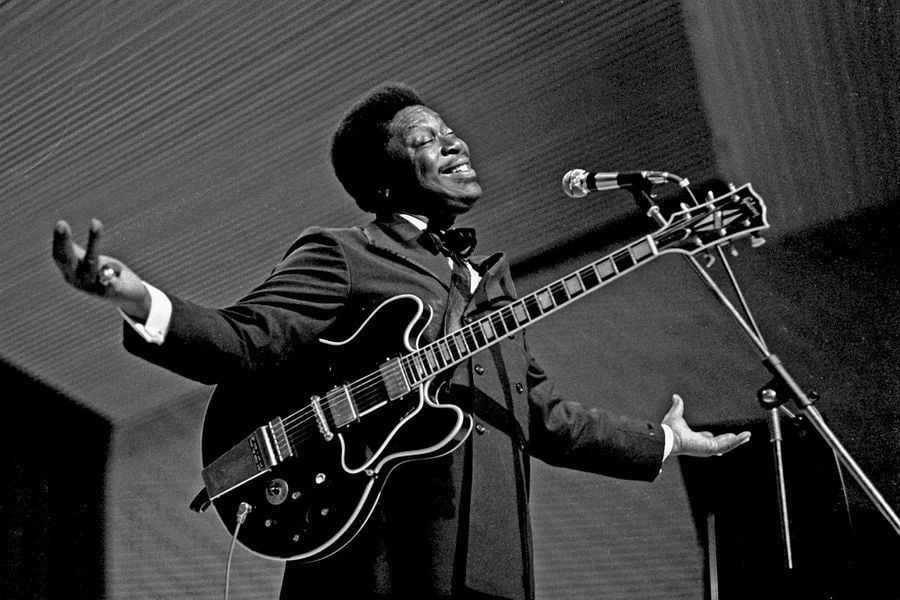
Exploring B.B. King’s love for Frank Sinatra: “No one sings a ballad with more tenderness”

Although he is somewhat overlooked in today’s world, B.B. King was the man. He compounded his undoubted status as one of the definitive blues guitarists with an invariably affable nature. He was one of those rare figures you could sit and listen to for hours talking the world away. Across his career, King regaled fans with unbelievable tales featuring some of the all-time greats in his homely Mississippi drawl, espousing a warmth that society currently lacks.
Aided by his famous weapon of choice, his Gibson ES-335, affectionately known as ‘Lucille’, B.B. King set the world to rights with his authentic take on the blues that was augmented by genuine talent and a knack for doing something different with the raw materials on offer. His work was so consequential that many of the most celebrated subsequent players cite him as a defining influence on their own material, ranging from Jimi Hendrix to Angus Young.
Born in 1925, the blues meant much more to King than purely music; it was a way of life. He was raised on the former Berclair cotton plantation in Mississippi and was brought up singing in local gospel choirs. The blues was a culturally vital means of alleviating the burden of endemic physical and economic racism, as it was for every other African American in the age of Jim Crow.
King released many iconic singles over his career, including ‘Woke Up This Morning’, ‘Please Love Me’, and ‘You Know I Love You’, which are still hailed as blues essentials to this day. He also had a significant hand in inspiring the work of some of the most famous white blues adherents, such as The Rolling Stones and Cream, which helped to expose him to a greater audience than many of his contemporaries.
A true lover of music with a varied taste, there was one vocalist that B.B. King coveted more than any other. This was ‘Ol’ Blue Eyes’ himself, Frank Sinatra, whose music also ranks amongst the most authentic. In his 1996 autobiography Blues All Around Me, King revealed his love for the legendary crooner and said that he practically went to bed every night listening to Sinatra’s 1955 album In the Wee Small Hours.
“I’m a Sinatra nut. No one sings a ballad with more tenderness,” King wrote in his memoir. “I practically put that In the Wee Small Hours album under my pillow every night when I went to sleep.”
It wasn’t just on the music front that B.B. King loved Sinatra, and the pair shared a connection that ran much deeper than that. The Hoboken crooner was such a fan of King’s work that in the 1960s when he was at the peak of his powers, he arranged for King to play at the most famous clubs in Las Vegas, opening his work up to a wider audience. Duly, when looking back, King credited Sinatra with opening doors for Black entertainers who would not usually be given a chance to perform at “white-dominated” venues.
Ironically, B.B. King died on the 17th anniversary of Frank Sinatra’s death, meaning that the two are tied together forever.
