


Five tracks that prove B.B. King was a genius

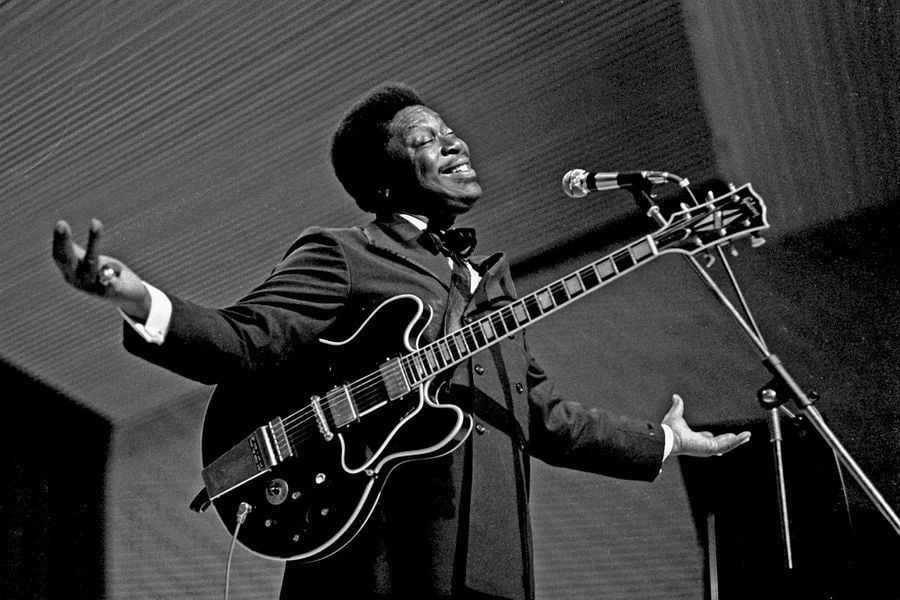
Aside from Ben E. and Martin Luther, there existed another mystical and mercurial legend whose surname was King. Of course, we’re talking about B.B. King, one of the most iconic songwriters of all time. Embodying the blues, he and his famous partner in crime, his Gibson ES-335 ‘Lucille‘, B.B. King was the sort of musician the world no longer creates but is seemingly crying out for.
Born in September 1925, he was of the generation where the blues had a deeper meaning. After all, he was born and raised on the remains of the Berclair cotton plantation in Mississippi and was brought up singing in local gospel choirs. His early life embodied the African-Amerian upbringing in the era of Jim Crowe.
In fact, King wasn’t forced to attend church as a child, he actively wanted to go. He was drawn to the power of the Pentecostal sermons, and it would be at the local Elkhorn Baptist Church in Kilmichael, where he would get his first introduction to the six-string. This would go on to have life-changing consequences. The local minister performed with a cheap Sears Roebuck Silvertone guitar during the services, and it was he who taught the young King his first three chords. Due to the lack of weight placed in records then, not much else is known about King’s earlier life, although it is alleged that at the age of 12, he purchased his first guitar for a handsome $15.00.
Around the age of 16, King would become transfixed with the iconic Mississippi Delta blues genre. It was the classic radio show ‘King Biscuit Time’, that first aired in November 1941, which galvanised his wish to become a radio musician. A self-taught player, whilst on break at the plantation, he would listen to the radio show and dream of a life solely concerned with the blues.
By 1946, King found himself in the Tennesse’s beating heart of African-American culture, Memphis. He had followed his mother’s first cousin and his guitar playing idol, Bukka White there. Fast forward to 1948, and he had successfully immersed himself in the city’s music scene, which included a regular appearance on Sonny Boy Williamson’s radio program on KWEM radio. He would gradually expand his audience playing at bars and grills, and it was here that he met one of the most legendary blues guitarists of all time, T-Bone Walker.
In fact, his first meeting with Walker inspired him to pick up the electric guitar, a move that would culminate in the confirmation of his own iconic status. Of Walker, King said: “Once I’d heard him for the first time, I knew I’d have to have (an electric guitar) myself. ‘Had’ to have one, short of stealing!”
It was in the ’50s where King really started to make his mark. He became part of the historic Beale street blues scene in Memphis, and here he would rub shoulders with Bobby Bland, Ike Turner and the legendary producer, Sam Phillips, to name just a few of the legends he had the pleasure of calling acquaintances.
In that decade he released numerous singles such as ‘You Know I Love You’, ‘Woke Up This Morning’, ‘Please Love Me’ and became a bonafide blues legend. He inspired the classic rock acts of the ’60s such as Cream and The Rolling Stones, who in turn popularised his music and the whole of the blues genre, exposing him to bigger audiences. In 1969, King even opened for The Rolling Stones on their extensive American tour. Then in 1970, he won a Grammy Award for ‘The Thrill Is Gone’, and in 1987 he found himself an inductee of the Rock and Roll Hall of Fame.
He wasn’t called ‘The King of the Blues’ for no reason. King introduced the world to a sophisticated style of soloing that was based on fluid string bends, shimmering vibrato and staccato picking. Through his ’60s “classic rock” disciples his techniques were cemented as cornerstones of modern guitar playing. King influenced everyone from U2 to Jimi Hendrix to Joe Bonamassa, and it is safe to say, that without his contributions, modern guitar playing would look starkly different.
Join us then, as we list just five tracks that prove B.B. King was a pure genius. This is just our opinion but should be used as a prompt for healthy debate and discussion.
Five tracks that confirm B.B. King’s genius:
‘Three O’Clock Blues’
A classic twelve-bar blues standard first recorded by Lowell Fulson in 1946 when King released his version in 1951, it became his first proper hit and went on to become one of the best selling R&B singles of 1952. A slow number clocking in at just 65bpm, it features his bellowing, soulful vocals and many of his most instantly recognisable licks on ‘Lucille’.
This was one of the earliest examples that King was indeed the ‘King of the Blues’. He once said: “When I sing, I play in my mind; the minute I stop singing orally, I start to sing by playing Lucille,” here it is most apparent.
‘The Thrill Is Gone’
The song that earned him a Grammy was actually first written by West Coast blues musicians Roy Hawkins and Rick Darnell back in 1951. Another slow number, ‘The Thrill Is Gone’ places King‘s yearning vocals front and centre, and through employing the gospel vocal technique of melisma, King clearly reflects that the thrill has certainly gone.
A moody, emotive take on the original, it features every classic hallmark of King. Brilliant, bending guitar licks and a soulful atmosphere, this is one of his most memorable outings.
‘Every Day I Have the Blues’
Another classic blues number that was first released when King was just a child in 1935, his version popularised the song and took it in another direction, in the way of the charts. A crisp and relaxed take on the original, featuring the triumphant brass section, ‘Every Day I Have the Blues’, was one of the earliest indicators the King was a genius and a dab hand at reworking blues staples for the modern setting.
Featuring his somewhat youthful but warm, vocals, King’s single is hailed as one of the most definitive blues songs ever released.
‘Lucille’
Clocking in at over ten minutes, ‘Lucille’, taken from its namesake 1968 album, is one of the highlights of King’s career. One can take it as a culmination of everything that came before in King’s career. The incredible production makes you feel as if you’re sat in a smoke-filled bar watching the man himself, and this original ode to his guitar is a marvellous testament to the winning duo of King and ‘Lucille’.
A meandering piece of blues that trudges along, you’re constantly bobbing your head along to the walking bassline. Additionally, it contains some of King’s most iconic solos, and it is moments like these that earned him legions of fans across the world.
‘Rock Me Baby’
One of the most recorded blues songs of all time, King’s makes a good claim for being the best of the lot. With a driving, constant pull, ‘Rock Me Baby’ certainly does what it says on the tin. Featuring his smoky, powerful vocals and some tasty riffs, it contains one of King’s grittiest guitar tones.
King expertly drops in and out with his overdriven guitar, and it is here you can see just how he had such a massive influence on legions of guitarists to come. Harmonics, bends and upstrokes, he utilises nearly every technique in the book.
