


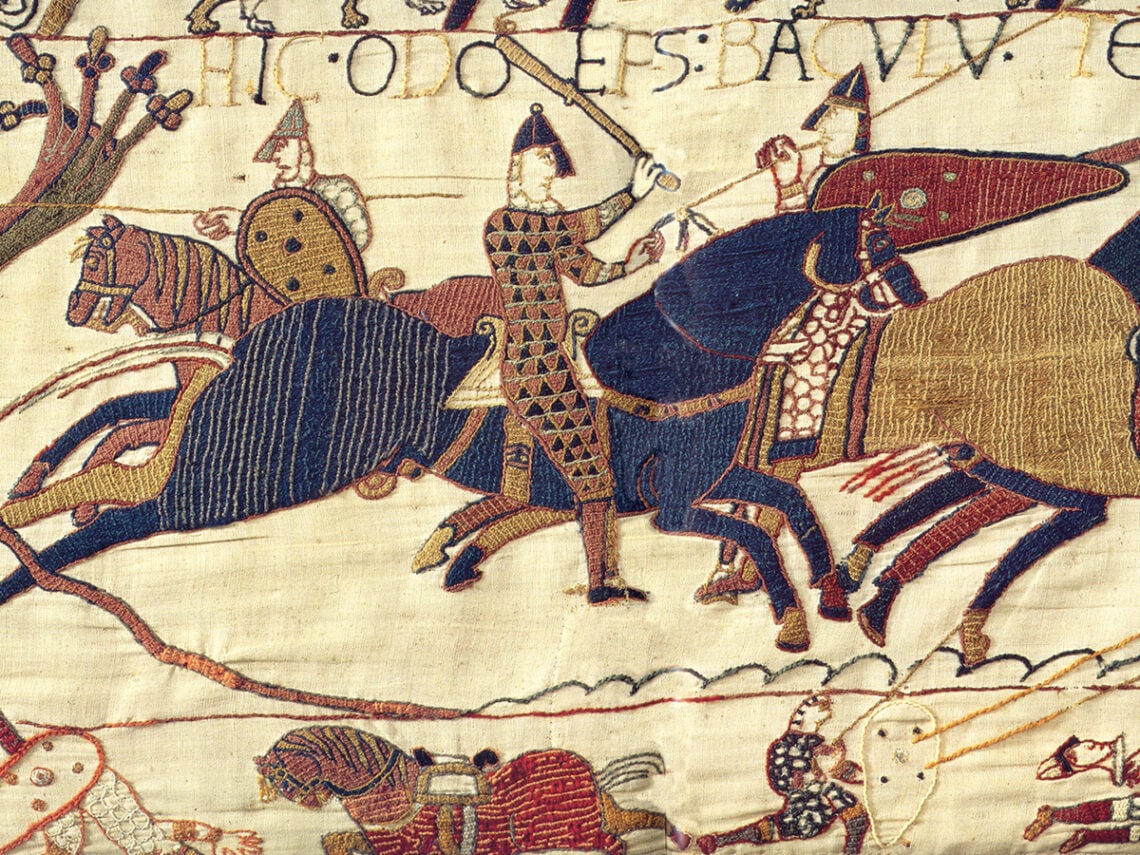
A piece of the Bayeux Tapestry discovered in Germany

A piece of the infamous Bayeux Tapestry has been found in an archive in Germany.
This fragment, believed to have been taken from the underside of the tapestry, was discovered in the Schleswig-Holstein State archive in the north of Germany. It had been there since World War II, when it was owned by the archaeologist Karl Schlabow, who died in 1984.
In 1940, the Nazi Schutzstaffel (SS) regime ordered the remeasurements of the tapestry for research purposes, as the German occupiers were interested in it for racial and ideological reasons.
This fragment is part of the 70-metre-long and 53-centimetre-wide tapestry, which has become a UNESCO Memory of the World item.
The wool and linen embroidery depicts the Norman invasion of England by William, the seventh Duke of Normandy, in 1066. It includes depictions of gruesome battles, journeys on ships and on horseback, and encounters with fantasy creatures. For centuries, experts and the general public have studied it as a visual chronicle recounting the evasion.
A press conference is expected to be held on March 25th to explain the discovery in more detail and the next logical steps for the item.
As the tapestry is considered to be of French cultural property, it is said that the piece will be returned to France later this year, and will begin conservation at the end of August.
