


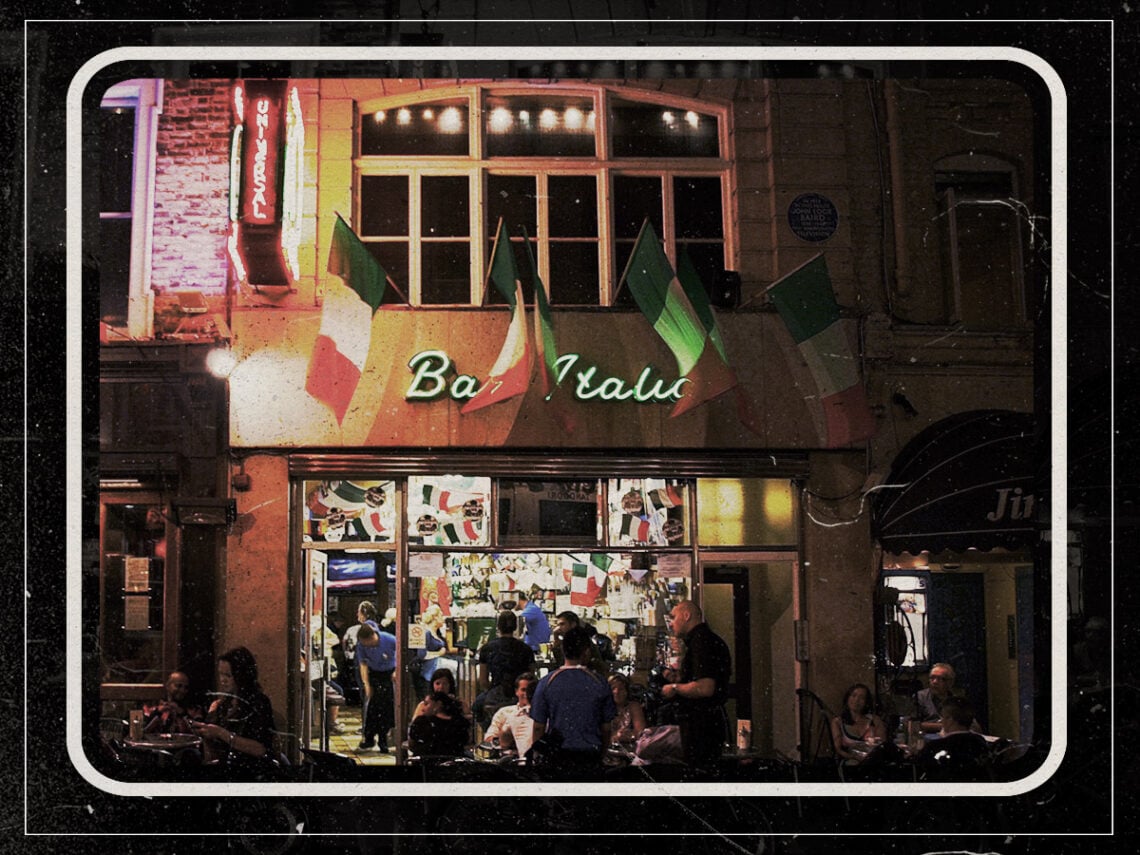
Bar Italia: How a trendy London bar gave birth to TV

You’ve got to admit, television really is one of the greatest inventions to have ever graced mankind.
You could even argue that it has saved as many lives as penicillin has. I don’t even think I’m joking – consider how many of us find solace in a comfort show after a long day of work. I’d be lost without endlessly rewatching episodes of Sex and the City.
The joys of having a way to view everything from 40-minute slices of pure suspense-laden thrillers that keep you coming back for more – suddenly you’ve watched the equivalent of a four-hour movie in one go – or 20-minute bursts of comedy really can’t be understated. I mean, the accessibility of television changed everything when it started to become commonplace in the 1950s.
Not only did television revolutionise entertainment, providing an alternative to going to the movie theatre for those days when you just wanted to stay in, but it also revolutionised the way that we consumed world events. Grisly new stories were given video footage accompaniment, while major events, like the moon landing or JFK’s assassination, could be broadcast for anyone with access to see from their living room.
Yet, who would’ve thought that a bar in London – one that has lent itself to a Pulp song and the name of an indie band – actually had a major part to play in the birth of television? Bar Italia, located in Soho, has quite the reputation as an iconic late-night spot, its central location perfect for those who find themselves in need of a coffee even if it’s getting on towards 3am.
The bar is open every day from 7am until 4am, and it’s here that Jarvis Cocker declared its status as his go-to location following a night of heavy drinking. “That’s what you get from clubbing it, you can’t go home and go to bed/ Because it hasn’t worn off yet, and now it’s morning/ There’s only one place we can go, it’s ’round the corner in Soho/ Where other broken people go,” he sang.
Yet, in 1926, before Bar Italia was established, the location – 22 Frith Street – was rented out by Scottish engineer John Logie Baird. He’d previously built the world’s first-ever television set, becoming determined to pioneer this new and exciting form of technology that could change the world.

By the time he’d moved into the attic of the Soho location, he was ready to give the first proper demonstration of a working television, inviting several spectators round to watch in his laboratory. This was a groundbreaking moment, with Baird showing just how his invention could both transmit and receive moving images.
A blue plaque commemorates this milestone, although most people who visit Bar Italia these days are better acquainted with the place’s Britpop reputation rather than its association with television history. Yet, up in that attic over 100 years ago, Baird changed everything when he demonstrated the power of such a strikingly new form of technology that would soon become an essential part of every family home and something that, these days, most of us can’t live without.
