


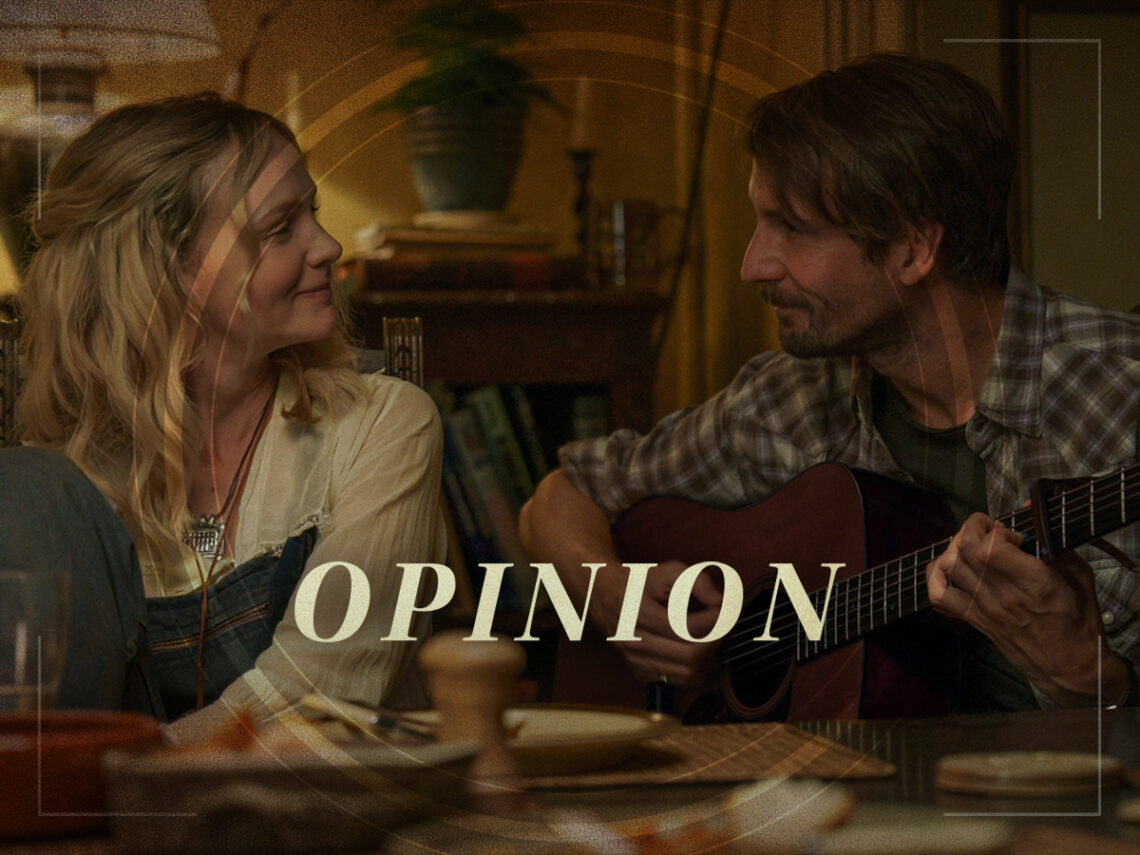
How ‘The Ballad of Wallis Island’ shows us our devotion to music: “Thank you Charles, really”

I don’t think the words quoted in the title are the last ones spoken by Tom Basden’s character, Herb McGwyer, but they’re certainly not far off. He embraces Charles Heath, played by Tim Key, in a heartfelt goodbye as he gears up to leave the titular “Wallis Island”. What has preceded this moment is 90 minutes of some of the funniest and most moving cinema this year. There is plenty we can take away from The Ballad of Wallis Island, but one of the key points I want to focus on is how it justifies our unrelenting devotion to music.
As a music journalist who surrounds himself with art, new and old, every day, I often wonder what someone who had been raised in complete isolation would do if we tried to explain the concept of music to them. When you try to describe it without examples, it does sound quite silly.
“Basically, you can make a tune with your mouth, or with your hands if you play an instrument, and these tunes sound nice, so people listen to them”. That sounds fair enough, something is pleasant, so we engage with it, but then try to explain the concept of a popstar, try telling them about Ticketmaster’s unfair pricing in a bid to see these nice sounds live (even though you can already listen to them at home) and try to get them to wrap their head around what the fuck Gene Simmons is.
If you want to go even deeper than that, take a moment to try and make them understand what my job consists of. I don’t make the music; I slag it off more than anything, yet I work within the industry and am considered a (albeit lesser and lesser) important part of it. The concept is bonkers, and yet none of us flinch at the notion of it; instead, we lean into our obsession and celebrate it. Why? Enter Wallis Island, Herb McGweyer, Nell Mortimer and Charles Heath.
Music relentlessly latches itself to our memories, whether we want it to or not. It’s such a natural part of our lives, not just songs that have been written, but melody in general, as we hear it in bird song, in the wind and with the crashing of waves. It follows us around everywhere, so we can’t help but apply it to various moments.
Ted Giola spoke about our insistence on applying music to memories in his book Love Songs: A Hidden History. “Our everyday existence can morph into a kind of work of art,” he wrote, “Music plays a key role in this process, not just as a soundtrack in the background, but as a constitutive ingredient in generational identity and the individual’s sense of self. The love song doesn’t disappear in this highly charged context—if anything, it takes on new power.”
This theme of music and memories’ inability to escape one another is explored a great deal through the movie. We see it first-hand with McGwyer and Mortimer, as after a tricky break-up, they reflect on days past while re-learning their songs together. It inevitably brings up complicated feelings to the surface, but also reminds them of a time when they were happy together, recalling the moments that inspired songs and special gigs when they were played.

The same applies to Charles Heath, as we learn later in the movie that he and his late wife were obsessed with the group, frequently attending gigs and listening to album after album. The music provides a window into the memory of his wife, as he reflects on the time that they spent together and is taken back to specific gigs and moments that mean a lot to him.
They also act as a gateway to new memories, as we see towards the end of the film. Heath is encouraged to try and get back in the dating game, which McGwyer facilitates by asking the woman who works at the local store, Amanda, to attend a gig with him. The gig is a private performance, which is a plot point the entire movie centres on, but it also marks a significant moment for Heath, one where he gets to remember his past life fondly but is also given a glimpse into what could be a new one. He cries, he laughs, he dances, and music remains at the heart of all of it.
We also learn how the art form can be used to heal. What you have with music isn’t just something that sounds pleasant, but personal information, emotion laid bare, beautifully, that you can engage with whenever you please. The world is a lonely place, particularly when the days are hard, as you spend the majority of time in your own head, and your head becomes a hostile place. When you hear an artist who understands your struggle and lays it out in song, you are given a figurative shoulder to lean on and an individual who tells you indirectly that they understand what you’re going through.
Sociologist Thomas J Scheff discusses this in his book What’s Love Got to Do With It?: Emotions and Relationships in Popular Songs. Here, he speaks specifically about how much he communicates effectively with those in love, but it can also be applied to those who are angry, mourning, or feeling lost.
“In [many] years of teaching college students, I couldn’t help but notice that for many of them, popular songs held a special meaning, as they did to me when I was their age…” In trying to work out why that was the case, he found “Popular love lyrics present a picture of an imagined social-emotional world, and modern societies tend to ignore this world. Since modern societies are highly individualistic, the nature of relationships usually takes a backseat. Modern societies focus on the self-reliant individual.”
The Ballad of Wallis Island is a success. On the surface, it’s a fun British comedy, but there is a deeper reason as to why its run continues to be extended in cinemas and movie-lovers continue to flock to see it. The first is that, yes, it’s incredibly funny and every minute seems to have a laugh genuinely parading in there, but there is more to it than that.
There is a lot of heart and soul in this film, which explores the disintegration of a relationship and the loss of a loved one, and both stories are told through our devotion to music. It makes the pain, frustration and longing that these characters are going through more accessible than ever, and provides a unique backdrop for a truly wonderful tale.
While I’m still not sure whether or not I could explain our obsession with music to someone raised in isolation, I would point out that it can help us through the bad and be an anchor for the good. After that, I’d show them The Ballad of Wallis Island.
