


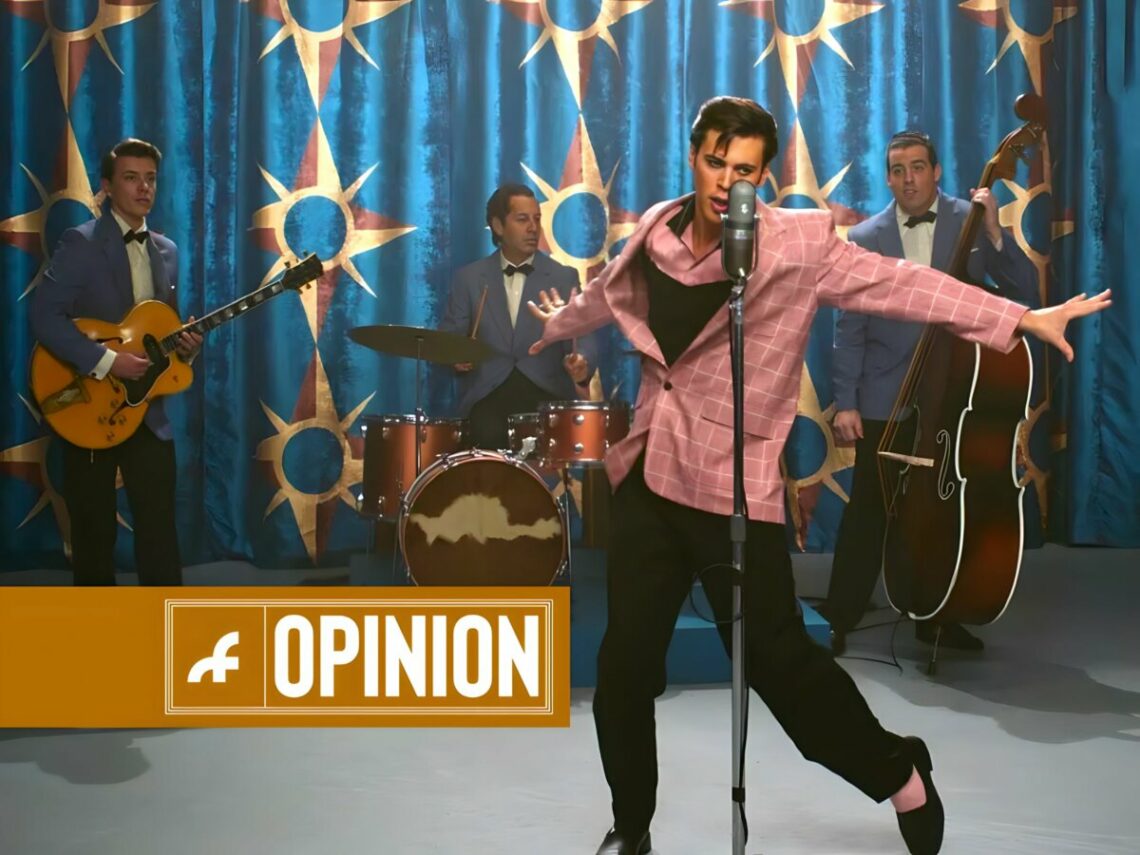
Hear Me Out: Austin Butler’s Elvis impression isn’t enough for an Oscar

Ever since the Academy Awards expanded to allow ten nominations in the ‘Best Picture’ category, the ceremony has seen a far more eclectic array of movies on show at the most star-studded movie event of the year. Whilst the 2023 lineup is dominated by the presence of the multiverse drama Everything, Everywhere All at Once and the anti-war horror All Quiet on the Western Front, one peculiar fixture of the 95th Academy Awards is the Elvis Presley biopic, helmed by Australian filmmaker Baz Luhrmann.
Known for his flashy and flamboyant cabaret style, the films of Baz Luhrmann exist in their own unparalleled realm where style defines substance. Catapulting to international popularity following the success of his ‘red curtain trilogy’ that explored the freneticism of the theatre in 1992s Strictly Ballroom, 1996s Romeo + Juliet and 2001s Moulin Rouge, with each one coming to reflect his eccentric visual identity.
As a style guru and methodical cinematic artist, Luhrmann was the perfect man to helm 2022s Elvis, a film that was due to chart the life of the ‘King of Rock and Roll’ from his early years in Memphis, Tennessee, to his tragic death in his Graceland mansion. His direction didn’t disappoint either, giving Elvis the kind of camp serenade that his career was built on, relating his commercial efforts with that of the traditional American carnival.
In translating this message, Luhrmann makes the bold move to sideline the titular music icon, making his manager Colonel Tom Parker (Tom Hanks), the narrator of the film, with events being viewed from his perspective. As a carnival worker by background, Parker makes Elvis into the greatest show on earth, and, as a result, lead actor Austin Butler gives a karaoke impression of the ‘King of Rock’ in order to fit Luhrmann’s bill.
Sure, it would churlish not to acknowledge the great lengths Butler went to physically and mentally mimic Elvis, with the actor telling Entertainment Weekly: “I created my own archive of how he said every word and every diphthong, and the way that he used musicality in his voice”. Still, any talented vocalist or exuberant uncle with too much time on their hands can recreate the mannerisms of the American icon; translating the intricacies of his psychology is far harder.
Sharing similarities to Rami Malek’s Freddie Mercury impression in 2018s Bohemian Rhapsody, Butler’s performance looks great on the surface, but beneath the cleverly layered prosthetics and impressive hairstyling is a performance that lacks any kind of emotional nuance. Rarely anything but charmingly suave or performatively angry, Butler offers little insight into the man behind the star.
Partly at fault for Butler’s lack of emotional power is Luhrmann, who structures his film like a whistle-stop museum tour of Elvis’ highlights, allowing staggeringly little time to indulge ourselves in the real superstar. Giving no time for character growth or development, the titular musician turns from an enthusiastic young boy to a worldwide superstar in the space of the film’s opening half an hour.
When up against such complex performances as Colin Farrell in The Banshees of Inisherin and Paul Mescal in Aftersun, Butler’s turn in Elvis feels amateurish. Still, much like Rami Malek, who walked away with an Oscar for his performance as Freddie Mercury, we may indeed see Butler claim his first Academy Award, with the potential win ready to set yet another low standard in the history of the Hollywood ego-stroking ceremony.
