


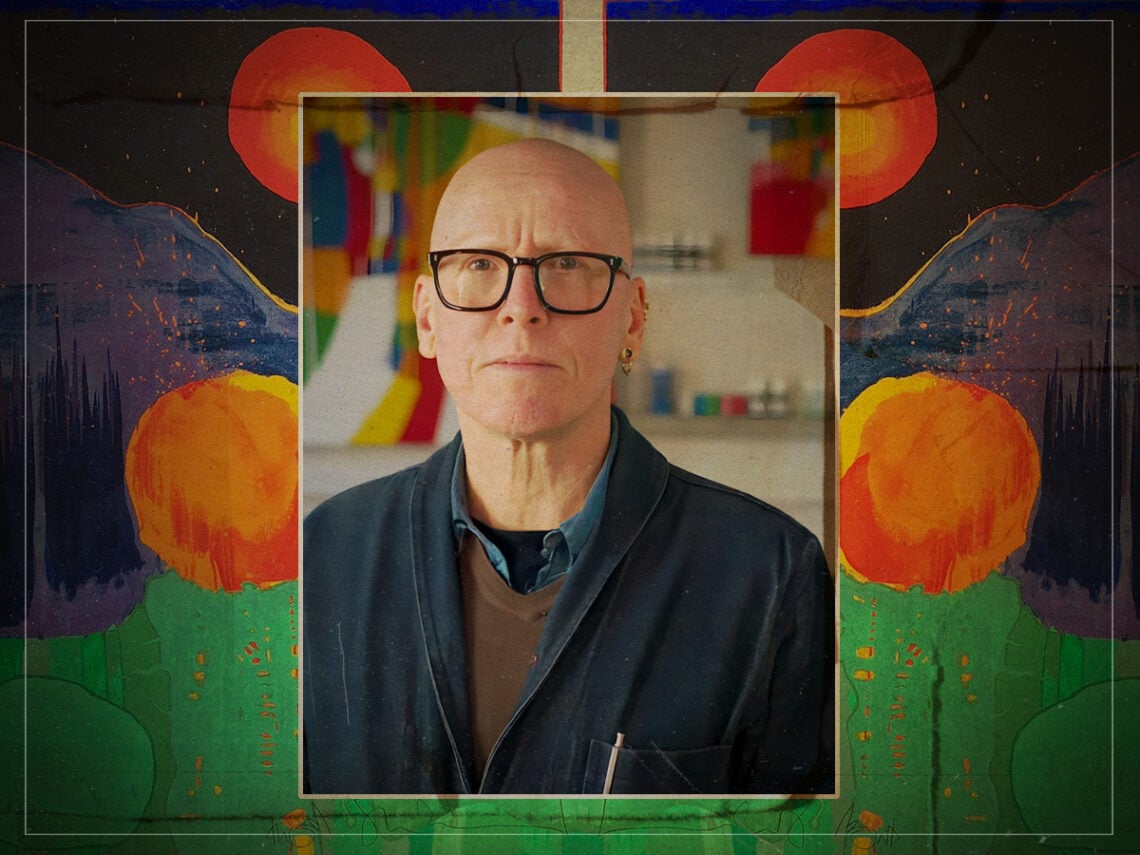
Stanley Donwood: The artist behind Radiohead’s album covers

When it comes to making music, Thom Yorke, the lead vocalist of the alternative rock band Radiohead, says art-making is a fundamental part of the process.
Indeed, art played a major role in both Yorke’s personal and professional life, even before he became the famed musician he is known as today. He studied Fine Art at the University of Exeter, where he met Dan Rickwood, now professionally known as Stanley Donwood, the man behind all of Radiohead’s album covers. But Donwood was and still is more than just a best friend to Yorke; he’s basically his free therapist (more on that later), sounding board, and the sixth member of the band.
But when Yorke met Donwood, he was sceptical. The first time they encountered at art school, Donwood was alone, reading a book rather aloofly, so Yorke thought the relationship with his future course-mate could go one of two ways: he would either love the guy or find him absolutely unbearable. Shocker, it turned out to be the former, and Donwood was first invited to collaborate on the creation of a Radiohead album cover for ‘The Bend’.
Making the album covers is a “simultaneous composition,” said Donwood over email. Donwood will sit in on the studio sessions, whilst the music is being made, sometimes listening to the same bar hundreds of times, and come up with ideas. Donwood never makes a cover from a finished product but from the whole process of recording the music, which is why covers can often seem abstract to what the music itself is about.
Donwood emphasises that he was never a musician, and “doesn’t really understand music”, but when he listens to Radiohead, a mental process, akin to Synesthesia is triggered, where he is visually able to map out the music and conceptualise the cover.

For Yorke, who gets art, the two mediums work in tandem. He said, “the music and the visual work both matter very much to me. One liberates the other.” In this way, Radiohead embraces the universal importance of all artistic mediums and the intrinsic connection between them, whereby one cannot exist without the other.
Each Radiohead album marks a different chapter or story, snapshots of both exterior life and interior landscapes. Going back to why Donwood was somewhat of a therapist to Yorke, he was able to “pull stuff out of my head in a way that just blows my mind in all different directions.” This is why each album cover is so different and unique.
Donwood humbly describes his successful career as “a series of accidents”, but his skill at combining a mix of different media proves otherwise. For example, Kid A was inspired by the wars in Yugoslavia, when “people that looked like us and dressed like us were suddenly dying and being put into concentration camps”. This is reflected in the dark palette and barren, icy landscape featured on the cover, which is made through print and computer software.
On a similar but also staggeringly different wave, Ok Computer featured an imaginary, hypothetical scene in a “nuclear winter, where a bomb had just exploded”. Each time an album cover was being made, new challenges and rules were set. In this example, Donwood said he wasn’t going to get rid of any mistakes, rather would leave them in and just cover them, creating a collage effect. He points out the smudged human figure on the right and the big blue and black cross that was put to cover something he didn’t like. He describes this process as echoing the way of life: “You can’t undo mistakes in life, so why should you in art.”
Natasha Podro, the curator of the Ashmolean Museum in Oxford, described the covers as looking like “each had been made by completely different artists”. She announced the opening of a new exhibition at the museum that aims to be a 30-year retrospective of Donwood and Radiohead’s artistic collaboration.
In conversation at the London Original Print Fair (LOPF), at Somerset House, she described having to sift through hundreds of hard drives and sketchbooks to determine what was best-suited for the exhibition. Jokingly, she described the process of collaborating with the two artists as effortless, because they were just the right amount of “quality control freaks”.
Radiohead’s album covers, some of which were exhibited at this year’s 40th LOPF, are screen prints, which typically consists of an image conceived by an artist on one surface and then transferred to another. The same print can be made multiple times to make plenty of copies, and the end product is the print itself, not the original block, etching, or plate on which it was printed. However, because Donwood also works on computer software and other forms of digital print technology, the “print” term, in this case, also refers to the practices outside of what I just described, which is the traditional print-making practice.
Alongside Podro, the director of Tin Man Art Gallery, a London-based gallery run by James Elwes, insisted on the importance of championing print as a legitimate art form, because of its “highly democratic properties” that relieve the medium of the “poshness of fine art”.
Prints, like those made by Donwood, ensure that great art can be mass-produced and distributed to art lovers and collectors of all kinds, so that anyone can have a great artwork hanging in their home.
