


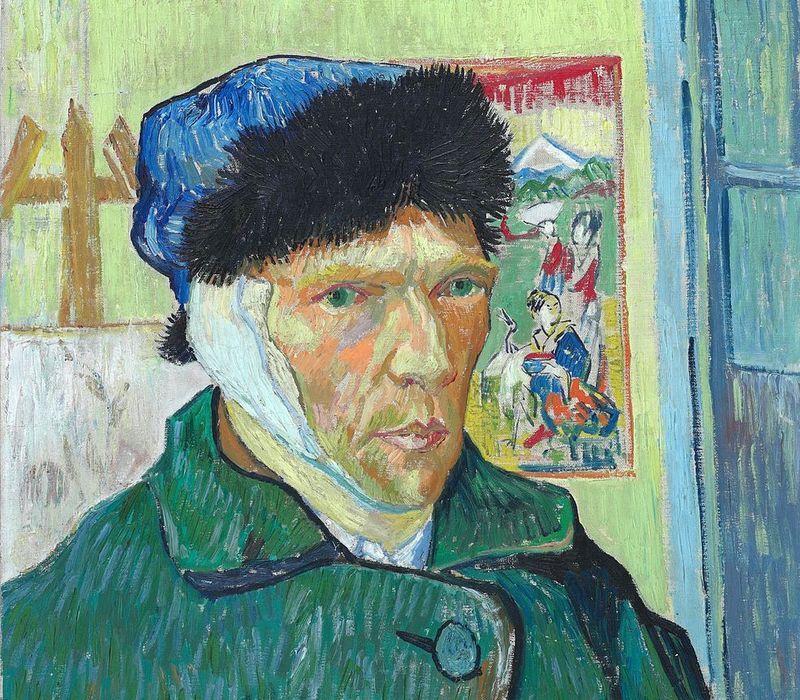
The comical art prank at MoMA involving Vincent Van Gogh’s ear

When you think of severed ears, which hopefully isn’t all that often unless you’re a highly sentient dog with a craving for pork, it’s pretty much a straight shootout between Vincent Van Gogh and Evander Holyfield when it comes to which individual springs to mind first. But there is no contest when you think of lugs with the most revered legacy. Poor old Van Gogh easily trumps wingnuts like Dumbo, Noddy and Gary Lineker. There was a time, in fact, when his even was even more famous than his art.
Now, if you ignore all the lore, in the literal legacy of the fabled lug, all goes quiet after the severance. Far from the mythical Holy Grail of art, Van Gogh was not a revered painter at the time; thus, the appendage represented little more than a drunken eccentric who had hurt himself in an accident. There was little cause for the French authorities to do anything other than dispose of the ear. So, it was duly binned and picked at by a rat who perhaps absorbed some creativity by digestive osmosis and went on to be a Pixar chef.
However, jokes aside, in the interim years, Van Gogh’s ear gain sizable significance. The year after Van Gogh severed his ear, he checked himself into a psychiatric hospital, where he produced the bulk of his major works. ‘Starry Night’ depicts the view from an Asylum window, where he would sit by his easel.
He absorbed the beauty of a balmy day like a sponge and rung it out in a canvas-bound dream, illuminating the stars in the swirl of spiderwebs as though distant setting suns had abseiled the heavens on silk and lowered themselves for a closer look at the beauty below amid the cover of gathering dusk. Now, sadly, that painting and its night-brighter-than-day brilliance, the effervescence of the firmament and its butter-brushed tones, are shrouded in the notion of being the beautiful yet fevered thoughts of an asylum patient as opposed to simply the art of man relishing in the magic of the night.
Although his works began to be recognised within his lifetime, the fact he died only a year after his great artistic spree at the age of 37 in 1890 meant his fame was largely posthumous. With this, his ‘madness’ was sensationalised. Various biographies created a crackpot celebrity out of him. The public then developed a morbid fascination with the one-eared madman who painted a bit as opposed to a genius who suffered a sorry bout of mental illness. They even saw his manic works as an extension of his mental illness, but the truth is, he only painted while suffering one of his attacks on one single occasion.
However, this was hysteria understandable. Given the economic problems and First World War that followed his death, the public knew far more about the artist through hand-to-mouth tales than they did of his works. He was, after all, an interesting character, and very few people had the means or economic potential to actually visit his works. In an era where the colour printing press was basically non-existent, this meant the man was far more interesting than the idea of his unseen art.
The perfect paradigm for this came to the fore when his paintings were exhibited at the Museum of Modern Art in New York City in 1935. This was the chance of a lifetime for the art elite to witness their hero’s creations. However, the public’s morbid fascination with the ear remained. Thus, the show attracted monster crowds numbering more than 123,000 visitors.
With the public relishing the chance to witness the art of a madman who heard the world in mono, it was difficult for true art fiends to fully analyse his works. Thus, an annoyed art hipster by the preppy name of Hugh Troy set about moulding a piece of dried beef into an ear-like shape. He then placed it in a velveteen box, snuck into MoMA one evening, and hung the fake ear in the gallery above a plaque proclaiming that it belonged to the late artist. The next day the masses swarmed around the hoax artefact, and the true fans were able to analyse his brushstrokes in peace.
It worked a treat. And, in its own way, is this prank not art in itself? After all, this Troy fellow was an artist himself and his pranks were legendary. When he was the student sports reporter at Cornell University, he even invented a character named Johnny Tsal who lost every race so that he wouldn’t have to feel bad about writing about someone’s humbling defeat. Tsal, of course, being last backward. In short, Troy had a way of making humour out of hardships, and if that isn’t art, what is?
