


“Something which will be good live”: are we living through a reincarnation of the pub rock movement?

When I started working in music journalism, I did a lot of unpaid work for publications that expected far too much of me. One of them, which shall remain nameless, sent me a novella’s worth of a style guide to ensure that I wrote in their suited tone of voice. A lot of the points were valid, and the kind you see everywhere, “conversational” and “don’t write passively”, but one of the points I found strange was never to refer to a song as “something which will be good live”.
I assume that the mindset of the publication in question was that this is a lazy way to describe a song and an easy cop-out when you’re not feeling a track. I understand that, but I also thought it was a harsh and close-minded approach to a phrase that, realistically, applies to a lot of music. Surely, this should all be judged on a case-by-case basis, as if you want to get rid of all phrases that are commonly used when a writer can’t be arsed to think of something else, let’s bin “A love letter to…,” “[Famous artist] meets [famous artist],” and “The new king/queen of [genre]” while we’re at it.
That publication is no longer in business, and while I’m sure there are a number of underlying issues that led to its closure, I also believe that the recent takeover of bands that are geared towards playing live rendered their style guide so restrictive that they couldn’t physically type anything anymore. Pub rock was a movement that took over in the 1960s and ‘70s. Rock bands like The Rolling Stones were so big that if you went to see them live, you were watching dandruff on a seatbelt, faded stars in a sea of nothing. Subsequently, artists who could now be defined as “punk” started playing in pubs, making the live experience the most important part of music as opposed to the recorded songs, which were played face-to-face with punters near and far. It feels as though we are reliving this moment.
We’re all ignorant of the rest of the world on some level, and maybe that’s what’s happening here. In the past few years, since working more and more in music journalism, I’ve been to more and more gigs, and so while I believe more bands have a specific sound that only works live, this may have always been the case, and I simply wasn’t going to enough shows. However, looking at real-world events, it’s not an unrealistic assumption to make. There are a lot of things that have happened, which means that both creators and listeners crave the live environment more than ever.
The first is the pandemic. A worldwide event as devastating as it is forgotten. It took lives from those who should have kept living, caused unprecedented political tension and nearly led to the collapse of the world economy as we know it. We, as humans, tend to block traumatic events out of our minds, which means that once restrictions ended and whatever level of normality possible resumed, we were happy to leave Covid-19 behind us. This isn’t supposed to read as disrespectful towards those who lost livelihoods and loved ones, but merely an observation of how human beings keep moving forward after devastating events.

However, if the pandemic were a sinking stone, ripples would remain running through the water. One of these can be seen in our huge affinity for live music. Gigs today are fuller than ever, local festivals are getting bigger, and smaller bands are being given platforms in the face of an experience-hungry public who had two years of their lives taken away from them.
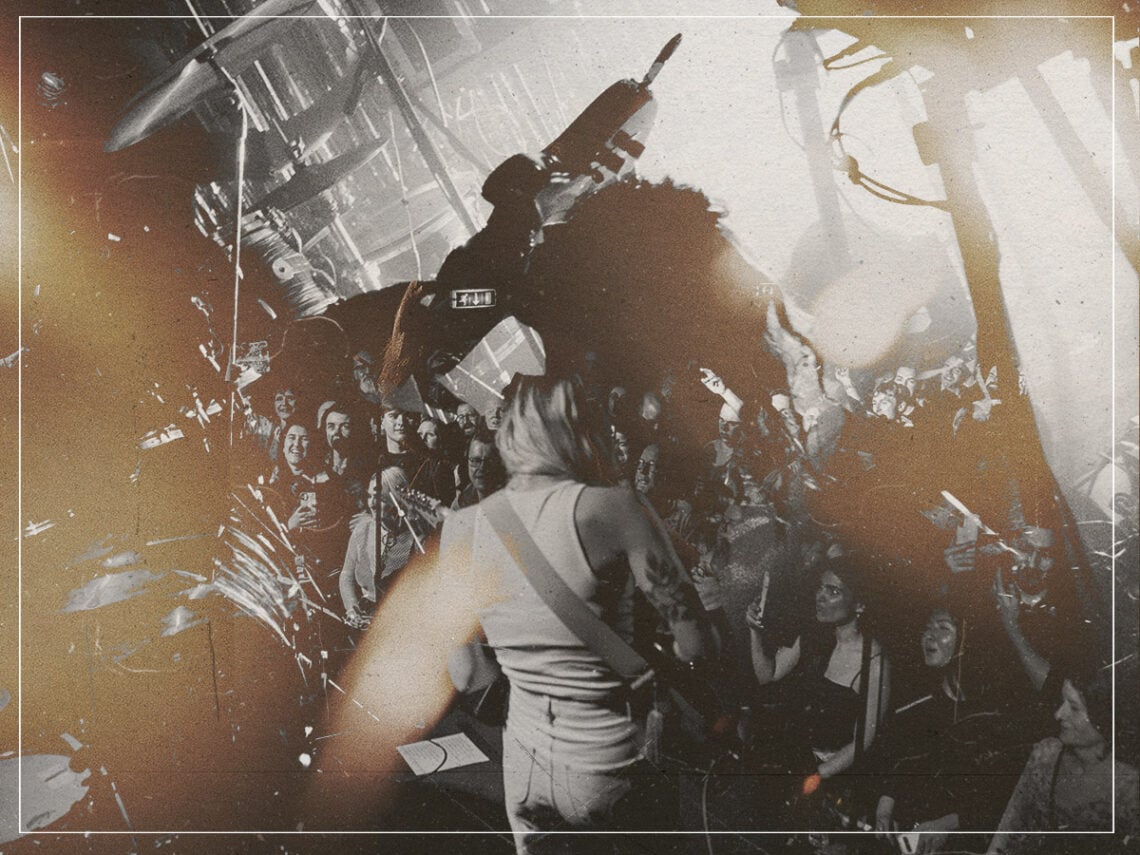
Bands are catering towards this desire for live music. When you look at many new bands doing well, they carry with them a punk sound and hold the fact they climb stages, making audiences crouch down and walk through a stream of punters while performing in very high regard. Fat Dog, Deadletter, and Lambrini Girls are all bands steadily ascending festival line-ups, and all are bands loved for their live show more than their work in the studio. This brings us to the second reason why people might love live music more.
The words “record deal” used to prick up the ears of every musician within a five-mile radius. It was the end goal, as once a band had a record deal, the hard work had paid off, and it was now time to get into a studio, be amongst all the bells and whistles, make something, and watch the money tumble in. However, our attitude towards the record label has changed in modern times.
Firstly, we have been subject to the horror stories of labels, both because of small independent artists and global megastars. Taylor Swift re-released her music with the title “(Taylor’s Version),” announcing to the musical world that she was censored; her work changed throughout the creative process, which made people look at labels in a new light. Small bands no longer need those alluring bells and whistles to make music and instead can do it in their room, thanks to the improvement of technology over time. The aim is no longer to get a record deal for many bands but instead to become the next “must-see” act in whatever scene they want to dominate.
We are living through a new era of pub rock, one in which global tragedies and changes in technology have been established. Artists no longer prioritise a number one single as much as they want to put on a good show, feel a connection with other music lovers and be respected as performers. Often, as is the case with the aforementioned bands, that doesn’t lead to music that warrants a listen when recorded, as the songs overlap, encased in energy, distortion and mess; however, it does create a sound that is enticing live and keeps punters coming back for more. Regardless of your opinion on the music itself, it’s a good time to be a gig-goer, so… who fancies a pint?
