


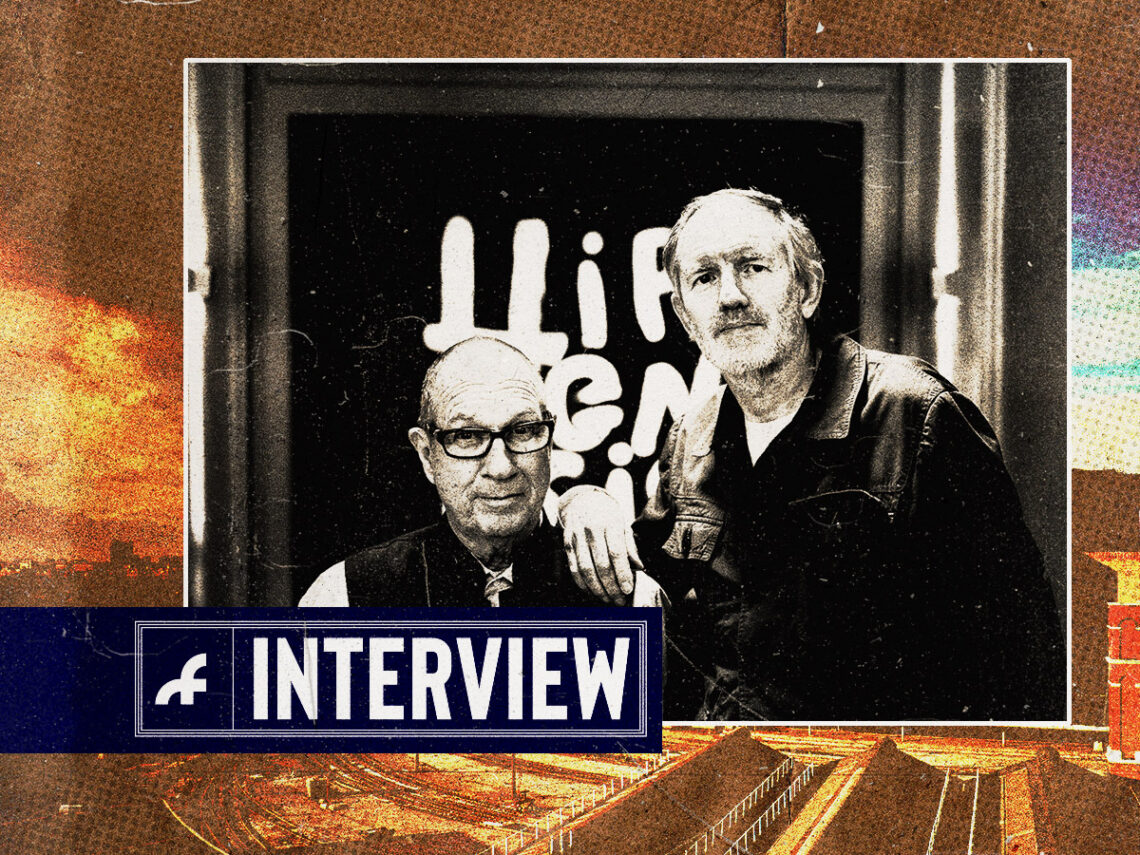
Anton Corbijn discusses album artwork with new documentary ‘Squaring the Circle’

From his inimitable and stylistic portraits of the world’s best musicians, the imaginative music videos for the likes of Nirvana and The Killers, and the kaleidoscopic and sensory concert films for Depeche Mode, Dutch photographer and artist Anton Corbijn has always been uniquely intertwined with the world of music.
He’s also no stranger to the world of film. His debut was the bleak yet tender Control, the critically acclaimed 2007 biopic of Ian Curtis, frontman of Joy Division, whom Corbijn had intimately photographed on multiple occasions. Since then, he’s helmed three further Hollywood features that saw him direct the likes of Philip Seymour Hoffman, George Clooney, Rachel McAdams and Robert Pattison with 2010s The American, A Most Wanted Man in 2014 and the James Dean biographical drama, Life, in 2015.
Corbjin’s ninth feature-length film is his first-ever documentary, and it makes perfect sense that the subject of his movie would draw him to this new medium for the first time. Squaring the Circle shines a light on the history and work of Hipgnosis, the art design group responsible for the album covers of almost every iconic album produced between the 1960s and 1980s. An intersection between art, design, photography, film and music, the new film from Corbijn is the ultimate marriage of his interests and passions.
At the heart of the story are the founders of the group, Aubrey ‘Po’ Powell and Storm Thorgerson, but the rich array of musicians that Corbijn speaks to is staggering. Interviews with the likes of Paul McCartney and Noel Callagher are a testament to the enduring legacy of Hipgnosis, and Corbjin’s decision to shoot in black-and-white means the flourishes of colour that come with the artwork makes sure that the work of the group is always centre stage.
Far Out caught up with Corbjin to chat about making a first documentary and how one specific album cover sparked the whole film.
Far Out: What was your first introduction to the work of Storm and Aubrey? Was there a particular piece of artwork that you remember seeing first?
Corbijn: It was an old sleeve, I think, for Pink Floyd’s Atom Heart Mother. I love that album, and I love the cover, and I still love the cover. I think it’s maybe my favourite ever piece. It’s hard to tell, because I think they [Hipgnosis] didn’t do much work on it. Because it’s just the picture – but it works so very well.
Excluding your work with Depeche Mode, which is more like concert cinema, this is your first-ever formal documentary. What about the work of Hipgnosis made you want to tackle this new approach?
I didn’t think I was going to do one. But then there’s so much interest that overlaps, like with photography and design, things I’m obviously interested in and participate in. And there’s just so many good stories out there, and all these interesting people with first-hand experience with them [Storm and Aubrey], that I just thought, “Let’s go for it.”
What were the first major steps in getting the project off the ground?
Well, Colin Firth’s production company [Raindog Films] hired me to do it. But health was not great at the time – it was the middle of Covid. Everyone was hesitant because most of these guys and these musicians are approaching 80. They were reluctant to leave their homes, or have to let somebody into theirs. So there was a bit of manoeuvring to do. But we finally found a way to keep the intrusion as minimal as possible, and once we committed to keeping it as singular interviews in the studio, we were off.
You’re well-versed in narrative features by now. Were there any challenges transitioning into the world of documentary?
Yeah, some things were really difficult. Finding archive footage, for instance, from the 1960s and 1970s. Because so many films have been made about that period, all the interesting bits have already been used. Also, to make things look interesting whilst still fit in with the story – that was the greatest challenge. In the end, that’s why I decided to shoot the film black-and-white, to give it a more interesting but cohesive unity. And, of course, so that the records themselves remain the highlight of the film.
It’s a wonderful way of letting the artwork speak for itself. From a technical standpoint, the film is presented fairly straightforwardly. It couldn’t be further from your film with Captain Beefheart [Some Yo Yo Stuff, 1994].
No way – that’s a mental little film.
Was that always the intention – to simply let the story take centre stage?
I mean, I do think Covid and those circumstances dictated it a little bit. There was no other way to shoot it than the way we did. But yes, the story spoke for itself.
What was your collaboration with writer Trish Chetty like?
Well, Trish is also one of the producers. And I’m not a natural documentary filmmaker, so I’m not good at asking questions. So Trish really helped write those, and also, as a woman of colour working on a very white, male film, she was the perfect person in our team to do it. She was very good at it.
What about your collaboration with editor Andrew Hulme? Presumably, editing a documentary is very different to a regular film.
Oh yes. Andrew and his assistants combed through this archival material. Andrew has actually been my editor on three films now, Control, The American, and now this. We both knew, with this project, that there were such fantastic personalities and identities that all we needed to do was keep the storyline in mind – but it’s really the people that sell the story.
Was there a moment when the shape started to come together, or was it all well planned out from the get-go?
No, there wasn’t really – we started editing before we had all the interviews and all those other things. I began with Po, which was the backbone of the film, in a way, the structure; the first images of him walking into the cemetery and going into the place where he tells the story, and then leaving again. He’s continuing with, you know, his past with all that weight on his back. There’s an image on Led Zeppelin IV of this old guy with all these brambles on his back. That reminded me of that – that’s how I came to that idea of Po walking.
Let’s revisit what you said earlier; you don’t think you’re a good documentary maker?
No. I’m not sure if I’m persistent enough. You know, you have to be curious and persistent – all these things. I think I’m slightly more of an observer rather than a participant, which is really what you need to be to make documentaries.
You have a background as an incredible photographer. As someone with such a basis in visuals, how was making this documentary for you on a visual level?
It’s difficult because you don’t have control over everything. And that’s hard. But I mean, I set up the lighting for the interviews, so it was not so, you know, ‘plain from the front’. It had some dimension and texture to it. Because there are so many interviews in documentaries that are just people talking, it’s hard not to have that. The only one I couldn’t change the lights for was Paul McCartney, although it was the same lighting set-up. And then, the artwork was projected on different screens behind, and broken up, as a reference. That’s where most of my skills went into because all the rest is archival stuff.
Do you think there was any translation of skills?
I think it’s such a different discipline. Making narrative films and photography, I find quite easy. I find this really difficult. There’s no natural transition in my eyes, you know.
Do you want to make another documentary?
(Long pause) As long as one comes around, that doesn’t expose my inability to make a great documentary.
Squaring the Circle is available in cinemas and on VOD now.

Never Miss A Beat
The Far Out Led Zeppelin Newsletter
All the latest stories about Led Zeppelin from the independent voice of culture.
Straight to your inbox.