


A language we are yet to unravel: Anthony Cudahy – ‘Conversation’

As my train emerges from the industrial no man’s land outside Paris, concrete and fog are replaced by vast swathes of skeletal farmland. It’s late April, and the rain has only just started to ease. Buzzards perched on barbed wire fences stare hungrily into identikit fields of rapeseed, while some 20 miles east, their feathered kin circle the skies above neat medieval towns. I eat my second pain au lait of the morning as we pass through Dijon, where low treeless hills dotted with pebble-grey cattle begin to rise up all around us. Jura, a department of Bourgogne-Franche-Comté, is famed for producing some of France’s most celebrated wines and cheeses, which explains why the cows look so nervous. It’s also home to the charming town of Dole, where the Musee des Beaux-Arts is currently hosting the first museum exhibition of American artist Anthony Cudahy, to which I’ve been kindly invited.
Defined by the artist’s taste for acidic colour palettes, Cudahy’s work is an amalgam of diverse influences. In the past, he’s relied on gay iconography, photography and the masterpieces of European art to generate unique yet highly reminiscent works. Cudahy is no stranger to citing specific moments from other paintings in his art, and this exhibition seeks to highlight the extent to which painters are in “dialogue with other paintings”. Following the success of his previous exhibits in Paris, The Musee des Beaux-Arts in Dole invited the Brooklyn-based artist to engage in a dialogue between his own works and those in the museum’s permanent collection, selecting 32 artefacts to place alongside his own paintings.
On being shown around the museum for the first time, Cudahy found himself drawn to works by anonymous artists. Though the exhibit brochure will tell you that Anthony knowingly chose to spotlight these unsigned paintings out of “compassion for works that are rarely or never seen”, my guess is that it wasn’t quite so deliberate. “I was surprised to find I’d chosen anonymous works,” the artist explains, recalling how he exhumed his selection of fragile (many are patched together with tape) works from the bottom drawers of the museum’s archive, only then realising that they were all unnamed.
Rather than focusing on a specific period or style, Cudahy chose to emphasise subject matter, allowing the artist to find thematic and symbolic correlations between his own paintings and those in the museum’s collection. In doing so, Cudahy has transformed the exhibition space of Musee des Beaux-Arts into a hall of mirrors where 18th-century allegorical paintings (Le Sommril et L’Amour), idealised landscapes and scenes of black magic (Scene de Sabbat) echo the artists’ musings on intimacy, queerness and the natural world. The first room we come to centres on a 16th-century sculpted wooden door salvaged from the old Dole parliamentary building. “I was thinking a lot about entranceways,” says Cudahy gesturing to Our Earth, an oil on linen portrait of the artist’s partner – the photographer Ian Lewandowski – peering through an open doorway, seemingly unsure of whether he’s leaving or inviting us to join him inside. His gaze rests firmly on another figure on the opposite wall. As I wander into the next room, the second of seven, I imagine him slipping out of his rose-rust world and gliding across the gallery floor.
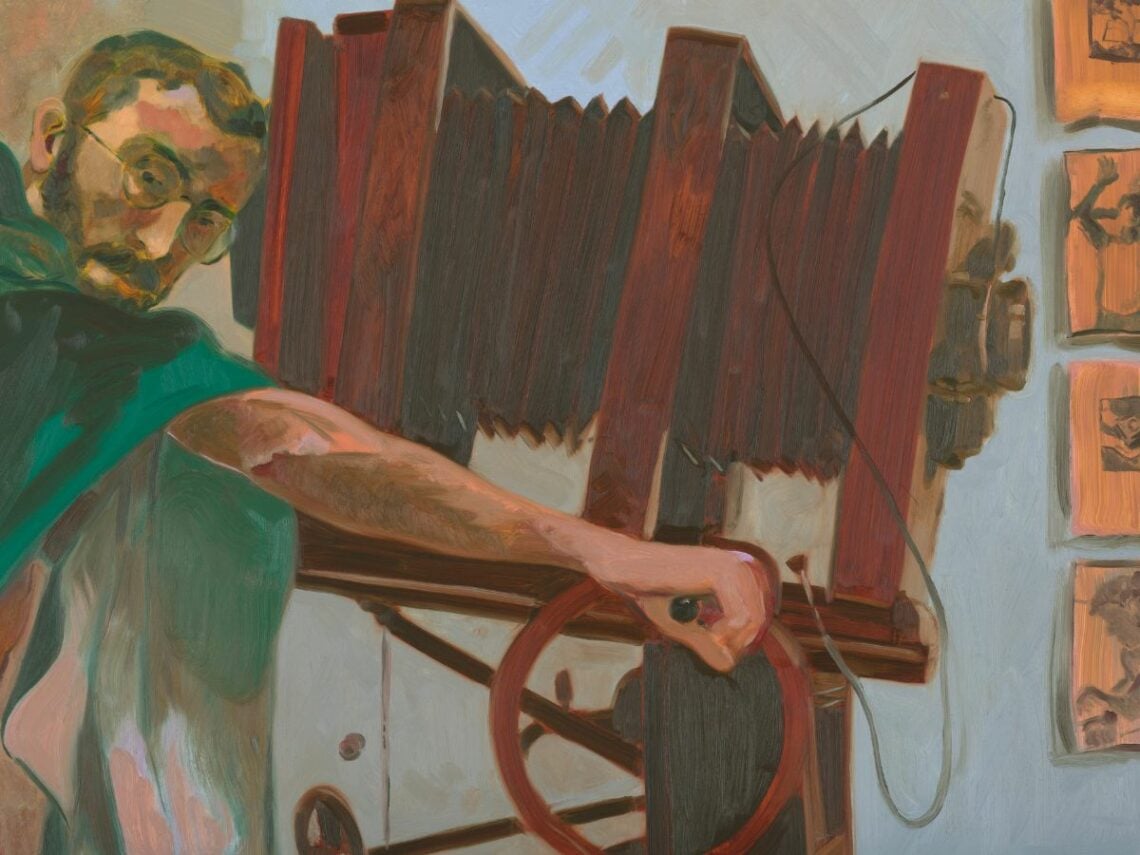
Lewandowski appears in dozens of the paintings throughout this exhibit, as do many of Cudahy’s artist friends. Alongside portraits of Lewandowski working with archaic, large-format cameras, we see sculptor Jenna Beasley inspecting one of her contemporary ceramics and the musician Nico Muhly writing one of his scores. “It’s from a song cycle he wrote in 2004,” Cudahy explains, pointing to a scrap of manuscript paper in the bottom left-hand corner. “The lyrical song structure comes from an old folk story in which one sister kills another, and then a third sister makes musical instruments from the bones of her deceased sibling.” I inspect the instrument Muhly clutches in his right hand – a bone flute.
Violence is ever-present in this intoxicating exhibit. For every pastoral landscape or intertwined couple, there’s a slain animal or sacrificed body. In the fourth room, for example, Cudahy includes two unnamed Spoil of The Hunt genre paintings from the museum’s collection, which the artist says he was drawn to for their dual “violence and excess”. The brutalised forms in these works are reflected in Cudahy’s own After Bosch, which shows a naked body hung from its feet, and Synder Cloud, in which a dog fallen on its back echoes the gutted mackerel in Nature morte au homard. None of this is to say that Cudahy is in any way obsessed with the macabre. Quite the opposite, in fact: Cudahy’s paintings capture a blissful, transcendent intimacy. Sometimes that intimacy is between young lovers, as in Twinned. Other times, it is between the subject and their environment, as in Drawing at the Table and Rest (past), in which a youthful couple sleep above a vibrant underland of symbols and stories. Connecting all these works are the flowers and vines that grow between the cracks – the purple flag irises, cyclamen, and meadow rushes so often treated as mere ornaments by artists. In Cudahy’s hands, they are divine spirits speaking a language we are yet to unravel.
‘Conversation’ will be showing at the Musee des Beaux-Arts in Dole, France, until September 10th, 2023. Admission is free. The museum is open every day from 10am to 12pm and from 14pm to 18pm except on Monday and Sunday mornings.


