


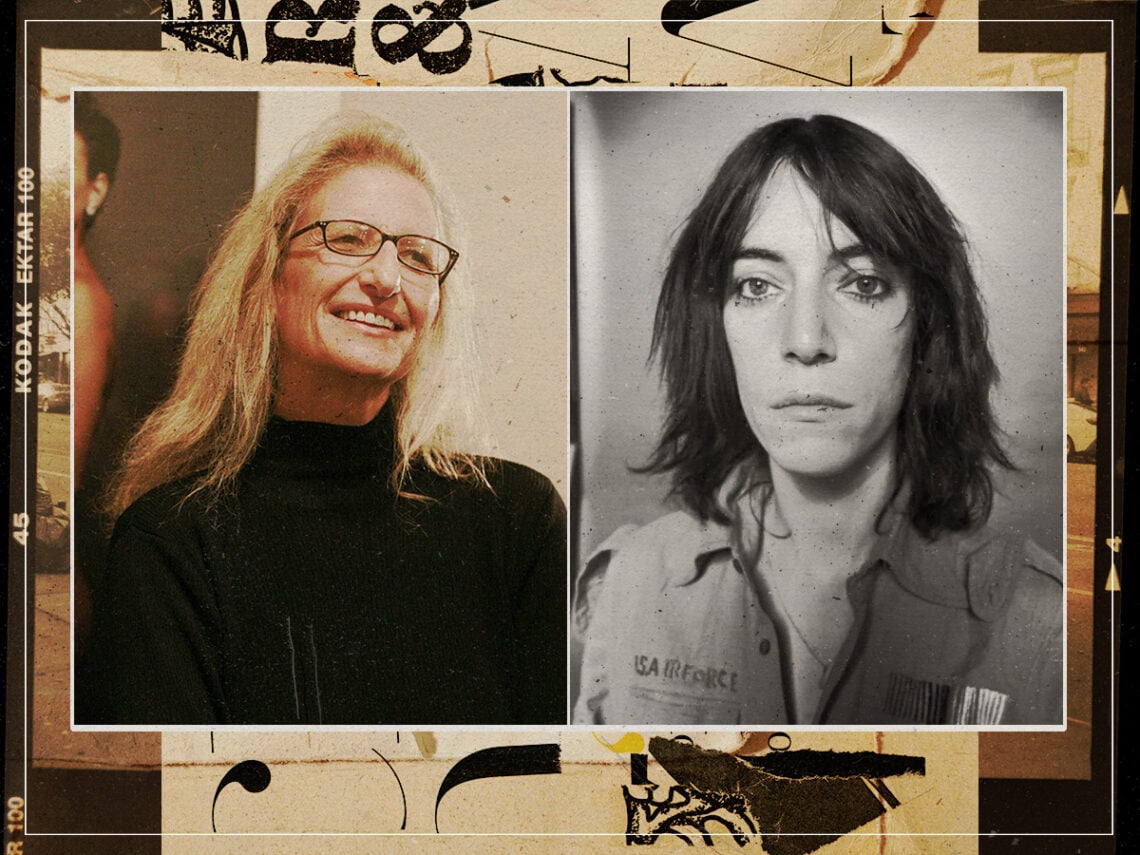
“She grew into that person in the picture”: how Annie Leibovitz uncovered Patti Smith’s punk side

Patti Smith doesn’t care much for vanity. Throughout her career, the punk poet simply charges up on stage, hair messy, face bare, and wows the crowd. Even now, as one of the most respected names in music, her tour wardrobe consists of nothing more than trusty jeans, old suit jackets and sturdy boots to carry her through her travels.
Still, photos of Smith back in the 1970s have endured as some of the most iconic and powerful portraits in music. Most famously, Annie Leibovitz seemed to translate all of the musician’s fire and spark in just one shot.
While Smith has never been one to care too much about appearances, the art attached to her music and writing has always been of vital importance. As a way to further translate the spirit and energy of her albums, she always called in someone reliable for the job. For most of her career, that was Robert Mapplethorpe, her creative soulmate. As Smith and Mapplethorpe lived and survived their early artist years together, his portrait, which is used on the front of Horses, seems to embody both of them. The simple black-and-white image is fuss-free, androgynous and striking.
As she kicked down the doors of the music industry, the simple yet now iconic image feels like a statement of intention that Smith would be seen and heard and would stand her ground to stake her place as an artist of her own making. Even when label execs tried to change the image, she refused.
She remembered that shoot as Mapplethorpe “took, like, twelve pictures, and at about the eighth one, he said, ‘I have it.’ I said, ‘How do you know?’ And he said, ‘I just know,’ and I said, ‘Okay.’ And that was it.” Since their relationship was so solid, Smith knew she could take her friend’s word for it.
However, when it came to expanding her artistic circle and standing in front of someone else’s lens, it meant opening herself up to how someone else might see her. With Mapplethorpe, he saw the musician on every level, intimately at home in her truest sense, as a writer, a friend. He’d seen her begin to make music and figure out the position she’d take in the world. They’d talked at length about the type of artist she wanted to be, so he knew what type of artist to capture.
But when someone else was behind the camera, external perception was involved. In one shoot with Annie Leibovitz, it seems that Smith had to confront the way others saw her.

To Leibovitz, that was a good thing. She was commissioned to shoot Smith for Rolling Stone in 1978, right as her track ‘Because The Night’ had shot her from cult status to a hit-making star. The song had started as Bruce Springsteen’s, but when The Boss couldn’t find the right words, it somehow ended up in Smith’s hands. The combination of his anthemic chorus, paired with her poetic abilities, proved to be a huge success. When Smith released the piece, it also proved her potential to go beyond the punk poet and become an all-out rockstar. That’s how Leibovitz saw her, so that’s how she captured her.
The image was snapped in a warehouse in New Orleans with the line “Desire is hunger is the fire I breathe” being taken literally as Smith is surrounded by flames. “It was summer and 110 degrees inside the warehouse already,” Leibovitz recalled of the shoot, “But we decided that the only way to get a flame to burn long enough was to set fire to barrels of kerosene. In those days, you could do things like that. We didn’t think about getting fire department permits or anything.”
In typical fashion, Smith shrugged off any level of glam or prep. Instead, she walked onto the set in her own clothes and bare face, contrasting with the impactful, high-production-value set-up surrounding her. But despite looking like her most natural self, the photos shocked the musician.
“She thought, ‘Is that what I look like?’” Leibovitz remembered. Whether it was the intensity of the backdrop or a touch of imposter syndrome from the fact that she was suddenly on the cover of magazines rather than at CBGB or any of the underground New York clubs she was used to, the image seemed to capture someone different.
The photo is very much a portrait of a rockstar. It’s rough and dangerous, slightly seductive but still striking. Smith’s stance is candid, with one hand in her hair, but still powerful and statuesque, much like the Horses cover. But as the flames roar in the background, it’s clear that she’d come a long way from that first photoshoot in Mapplethorpe’s partner’s apartment.
Smith looks like herself, but she also resembles the fearsome artist that the world was beginning to know her as. “She came to understand many years later that the person I had seen when I took the photograph wasn’t someone she was consciously aware of then,” Leibovitz said, “That she grew into the person in that picture.”
Really, Leibovitz uncovered the Smith that’s heard in her music. Wild, powerful and fuelled by pure artistic fire.
