


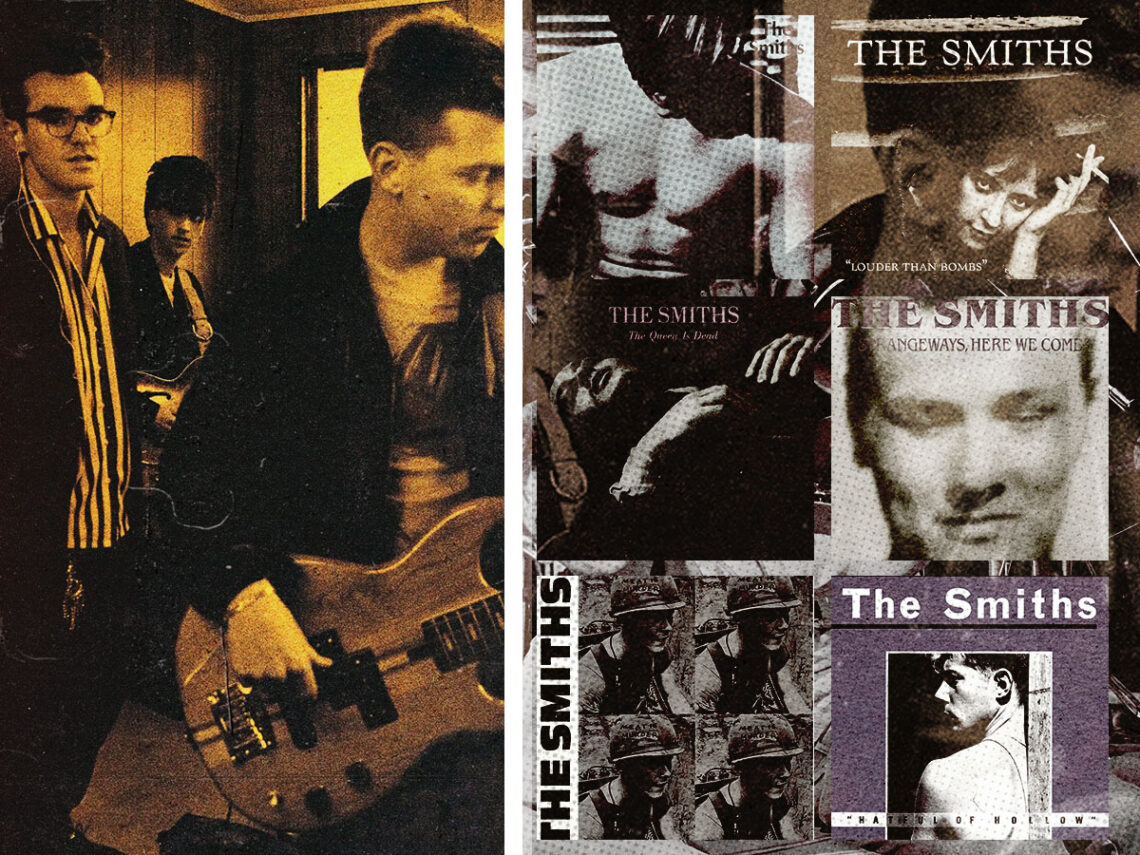
Andy Rourke: The underpinning melody of the indie revolution

As we face the tragic loss of Andy Rourke, the time has come to reflect on the singular impact this gifted bassist had on popular music during the 1980s and beyond. Rourke left an indelible mark on the musical map as a member of The Smiths from 1982 to ’87. In this transient period, the band released four bulletproof studio albums and a generous scattering of singles that countered the coeval synth craze and paved the way to the more comprehensive Britpop takeover in the 1990s.
Born on January 17th, 1964, in Manchester, Rourke’s musical journey began at age seven when he was gifted an acoustic guitar. His innate musicality and passion for creating captivating and colourful rhythms rapidly set him apart. In 1982, he joined forces with vocalist Morrissey, guitarist Johnny Marr, and drummer Mike Joyce to form The Smiths. This five-year chapter constituted just one-twelfth of his cruelly truncated life but ultimately defined it.
Rourke’s bass style was characterised by a deeply melodic approach that tesselated with Marr’s jangly guitar lines in magnetic harmony. Often, bassists can become eclipsed in the mix by the more superficial adornment of vocals and guitar tracks. Of course, Morrissey and Marr were more limelit thanks to an equally progressive approach to composition and a more potent media presence. However, on a purely musical level, Rourke’s innovative basslines never failed to protrude as a sturdy and crucial fourth pillar.
Actively avoiding the more traditional supporting role, Rourke’s playing stood out thanks to its intricacy and harmonising chemistry. His melodic basslines became integral to The Smiths’ signature sound, infusing each song with depth, texture, and a sense of melancholic beauty intrinsic to the band’s aesthetic.
Most memorably, Rourke provided a funk-inspired bassline adorned with head-bobbing hooks for ‘Barbarism Begins at Home’. The popular track appeared on The Smiths’ second album, 1985’s Meat is Murder, and, thanks to a solo bass excursion at the track’s close, remains Rourke’s most distinctive groove. Pitching a bass solo in this realm was not the norm; this act of innovation felled boundaries and gave rise to a new era.
“Andy is, quite rightly, proud of that bass line,” Marr commented in Simon Goddard’s book The Art of The Smiths (1982-87). “The bass line’s a killer,” Joyce concurred in Johnny Rogan’s Morrissey & Marr: The Severed Alliance. “It’s interesting to see how Morrissey got his head around it. We’d be playing, and when we’d stop, Andy would often continue with a Stanley Clarke bass line. It’s incredible the way he can shift into that.”
Rourke’s melodies courted Marr’s signature guitar voicings to create the immortal organism we now refer to as indie rock. Alongside Peter Hook, his Joy Division/New Order counterpart and Freebass bandmate, Rourke redefined the bounds of bass guitar, influencing an incalculable mass of musicians over the past 40 years, whether directly or indirectly. “He was an inspirational musician with a style that made so many of us pick up a bass guitar,” Charlatans frontman Tim Burgess wrote in his tribute tweet to the late bassist.
Despite The Smiths’ untimely breakup in 1987, Rourke’s impact as a bassist had already blazed an adamantine trail. After The Smiths disbanded, Rourke embarked on various musical endeavours, collaborating with artists such as The Pretenders, Sinéad O’Connor, Ian Brown and Badly Drawn Boy.
“The Smiths were easily the most important band of my teens,” Badly Drawn Boy wrote in a tweet. “I was beyond honoured when Andy played bass with me on tour for 2 years. He was the coolest, kindest funniest person, a joy to tour with. Probably the best natural musician I’ve ever seen. Loved him. Gutted.”
“Andy will be remembered as a kind and beautiful soul by those who knew him and as a supremely gifted musician by music fans,” Marr added in memoriam of his late friend and collaborative.
“Not only the most talented bass player I’ve ever had the privilege to play with but the sweetest, funniest lad I’ve ever met,” Joyce added. “Andy’s left the building, but his musical legacy is perpetual. I miss you so much already. Forever in my heart mate.”
Beside a towering oeuvre, The Smiths were emblematic and representative of the prospering underdog. The morose themes and beautiful tragedy imbued by the band’s sound resonated with a generation of misfits. The Smiths played to nobody else’s tune but their own, and a quiet half of the world duly followed.
As the music video for ‘Stop Me If You Think You’ve Heard This One Before’ illustrates, by 1987, these trendsetters had garnered a broad and obsessive following: the four-piece resided in a demimonde of style that became commonplace in just a few short years.
“Going on Top Of The Pops with ‘This Charming Man’ was another big deal,” Rourke recalled in a 2022 interview with Record Collector. “I’d grown up listening to the Top 20 on the radio with my mum, and it had been everything to me, so I was overjoyed, we all were, but we were all nervous too.
“We went down to the studio. It was very surreal, and we weren’t prepared for the total fakeness of it – the miming, the fake audience dancing. We went into the make-up room, and we’d bought Marks & Spencer sweaters for the occasion, and they said, ‘What are you going to be wearing for the show?’ and we were like, ‘This is it.’ We went on in our black jeans and sweaters. We definitely stood out.”
Andy Rourke will forever be one of Far Out’s most cherished bassists. Technical ability and creative innovation brought him to our hearts, but the words of his peers attest to a warm personality that must be affixed because both patently coloured the tempered playing of his singular, revolutionary bass.
