


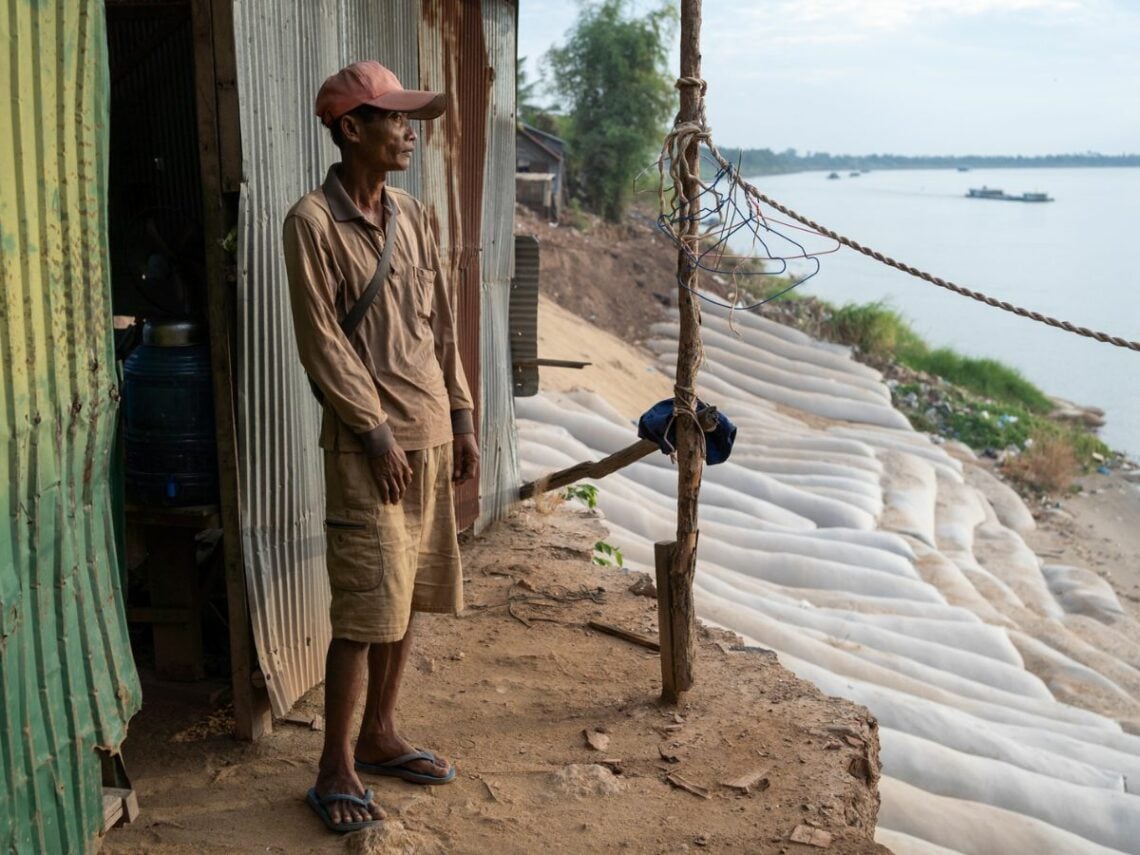
Lost Lands: Andy Ball photographs the devastating impact of sand mining in Cambodia

Our photography features take a varied trip through time and space; this week, we’re taking a journey to Cambodia in the modern day, but not for leisure. In recent years, the country has become well-established as a holiday destination, especially among thousands of Western gap-year students looking to immerse themselves in an unfamiliar culture. Like its neighbouring country Vietnam, Cambodia was developmentally hampered by civil unrest over the 20th century, chiefly during the Cambodian Civil War and the subsequent rule of the ruthless Khmer Rouge leader Pol Pot.
Between 1975 and 1979, the Cambodian genocide led to around two million deaths. Following Pol Pot’s subsequent expungement, it took many years for the country to return to relative peace. Over the past four decades, Cambodia has managed to realign itself within the global community thanks to widespread industrial development. Recently, capital injection from Cambodia’s blooming clothes manufacturing and tourism industries has given rise to advanced urbanisation and gentrification.
For this week’s collection, I spoke to Andy Ball, a British photographer and videographer currently stationed in Cambodia, where he looks to use his lens to explore the country’s vibrant culture amid meteoric industrial development. Today, we’re excited to introduce his ‘Lost Lands’ collection, which highlights the negative impacts of Cambodia’s burgeoning sand mining activity.
“Cambodia’s capital Phnom Penh has undergone rapid development over the last decade. As part of this, many of Phnom Penh’s surrounding lakes and wetlands are in the process of being filled in or already have for development projects using sand pumped from the Mekong River,” Ball recently told me of the project’s focus. “It’s a controversial topic in Cambodia that’s created a lot of violent conflict between the communities that rely on these lakes and wetlands, the developers and the government.”
“When I arrived in 2019, I took an interest in starting to document what was happening at Beoung Tompun, Phnom Penh’s largest lake, that’s being filled in for a satellite city,” Ball continued. “Around 1,000 households rely on the lake for housing, farming, and fishing. Over the last few years, many of these communities have been evicted or inevitably will be in the future. What’s happening on the lake is a microcosm for Cambodia’s modern-day land conflicts, as communities all over the country grapple with displacement for various development projects and concessions. I think that’s what makes the filling in of Phnom Penh’s lakes and wetlands so interesting to document”.
He added: “Whilst photographing the lake, I started to take an interest in Cambodia’s sand mining boom. Over the last few years, there’s been a dramatic increase in sand mining operations on the Mekong in Cambodia, especially around Phnom Penh, to keep up with the rising demand for sand. Sand is a key ingredient in cement production, so it’s also being extracted to keep up with the capital’s construction boom. The sand mining operations are poorly regulated, resulting in extraction rates far higher than sand can be replenished naturally. This has devastating consequences for communities across the entire supply chain, from where it’s being extracted from along the river to the sites where it’s used, such as on the lakes”.
Following his work on the social disruption on Beoung Tompun Lake, Ball conducted further research and duly pursued his interest in the devastating impacts of sand mining. “I reached out to Julian Leyland at the University of Southampton, who’s been working with a group of researchers from the UK, Cambodia and Vietnam to look into how sand mining operations are disturbing the balance of the Mekong River. I was fortunate enough that Julian agreed to support the project, and over the last year, we’ve been collaborating to produce this photo series and a documentary,” Ball said of the project’s conception.
“The collaboration has been about putting a human element on the research that the team has been doing, such as how riverbank collapses are exacerbated by the mining and what that means for communities living along the Mekong’s banks. I think there’s a lot of value in examining both the scientific and human story elements together, as it presents the issue to a wider audience and shows people what’s at stake for those who rely on the river.”
The following photographs were collected and published as part of an ongoing collaboration with researchers at the University of Southampton. The full exhibition is published in the Royal Geographical Society online collection.


