


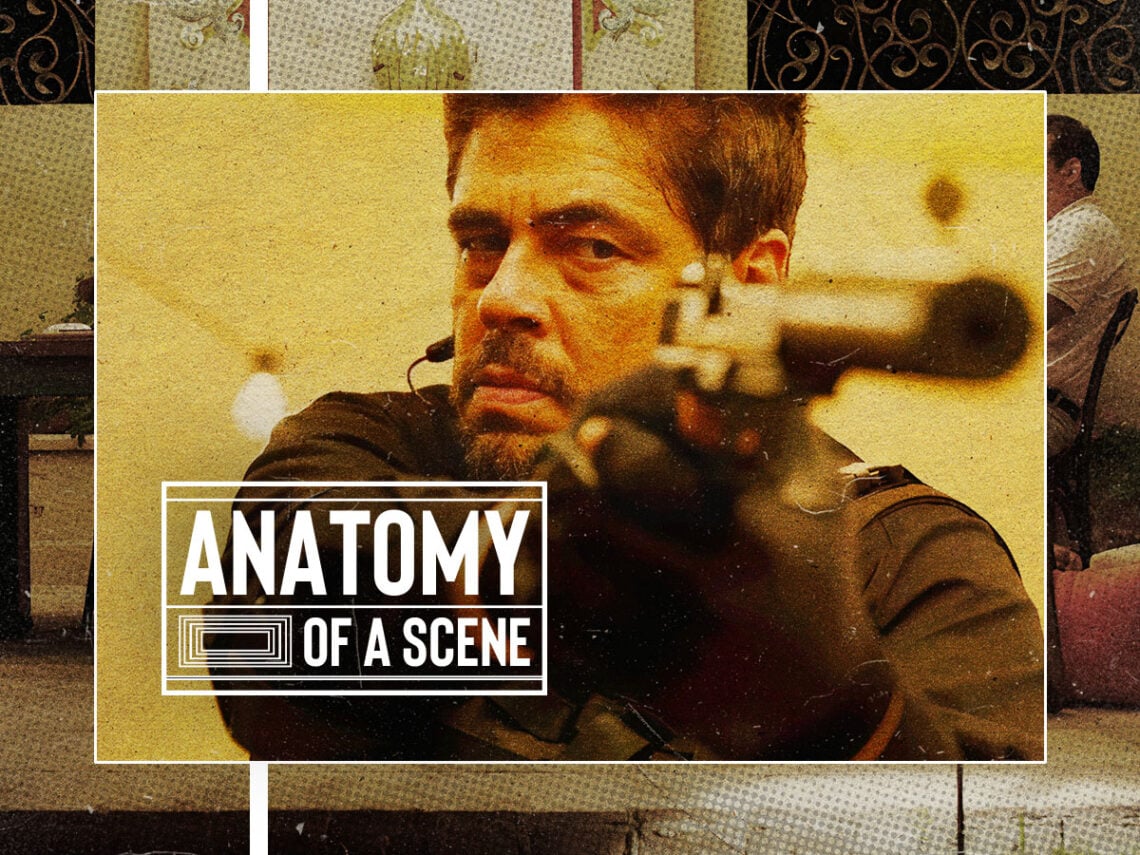
Anatomy of a Scene: Denis Villeneuve and time to meet God in ‘Sicario’

The 2015 action thriller Sicario, directed by Denis Villeneuve and starring Emily Blunt, Benicio del Toro, Josh Brolin and Julio Cesar Cedillo, tells of an FBI Special Agent who is tasked with capturing a high-ranking, ultra-powerful Mexican drug cartel leader Fausto Alarcón and is undoubtedly one of the Canadian director’s most memorable movies.
There are several intoxicating moments in Sicario, but few are as shocking as the climactic scene of Alarcón finally being brought to justice. Alarcón had previously had the family of Alejandro Gillick, a CIA-trained assassin, executed when Alejandro was working as a prosecutor in Mexico. Today, we’re going to provide a closer analysis of this highly intense moment of cinema.
With Roger Deakins on cinematography, it’s no surprise that every moment of Sicario is gorgeously shot, but this comes into particular focus in the climactic dinner scene. Alejandro arrives at Alarcón’s luxury villa, having taken hostage Fausto’s underling Manuel Diaz, and instantly, the tension is ramped right up, the nighttime setting providing an anxious sense of quiet.
He makes quick work of the gate guards and makes his way into the villa, the chiaroscuro lighting beautifully hiding his movements. The villa, as one would expect, looks like something straight from the most luxurious palaces of ancient civilisations, but Alejandro is not here to admire Alarcón’s wealth; he’s here to take care of business and deliver justice.
A guard goes down with two silenced shots. No need to check to confirm the kill; Alejandro is a lethal marksman. He spots Alarcón having dinner with his family across the courtyard, sparing the terrified-looking servant. Again, it’s the lighting here that provides the real nuance and tension.
Alarcón idly chats with his family as Alejandro approaches, but Alejandro does not sneak in and takes them out silently. He wants Alarcón to see the face of his eventual killer; he wants him to know that Alejandro has had his revenge. “Stay calm, or we’re dead,” he tells his family, not knowing that they’re likely dead anyway.
Upon discovering that Alarcón’s children do not speak English, Alejandro decides to converse in that language. Perhaps this is to instil a fear of the unknown in them or to perhaps save them from what is surely to come with them having a certain degree of innocence. He urges them to eat, but not one of them budges a fork.
Alejandro takes a seat at the opposing head of the table, marking a striking sense of equality between the two men; he dressed all in black, Alarcón in a pink/white polo shirt, the degrees of good and evil ultimately reversed. Thinking of the injustice served to his own family years ago, Alejandro says, “Every night you have families kill, and yet here you dine. Tonight should be no different.”
The tension is just about as high as it possibly could be; certain death awaits, and yet Alarcón himself urges everyone to eat, perhaps to try and calm them. The cicadas screech in the distance as Alarcón tries to talk his way out of his certain death. “It wasn’t personal,” he says of killing Alejandro’s wife and daughter, but for Alejandro, “it is” personal.
The scratching of cutlery at crockery as Alarcón begs not to be killed in front of his boys. Del Toro then delivers one of his best-ever lines, “Time to meet God,” amplified by the way Villeneuve and Deakins portray what comes next. Without showing what happens on screen, the camera focuses solely on Alarcón and Alejandro; three silenced shots ring out, and bodies are heard hitting the table, then falling to the floor.
“Not in front of my boys,” Alarcón had asked, and well, Alejandro accepted. But he turns the tables, this indeed is personal, and he wants to bring about as much emotional torture to Alarcón before he meets God. The camera then captures the whole scene; the two men sitting opposite one another in perfect symmetry, Alarcón’s family dead on the floor.
Alejandro takes a deep breath, having waited years for this moment, and tells Alarcón to finish his meal. Strings rise for just a moment before Alejandro can’t wait for another second. He shoots Alarcón once. The cartel boss falls to the floor off-screen. The second shot sounds, and then we cut to black.
The dinner scene in Sicario is certainly one of its best, perfectly shot and considered cathartic in the sense that justice is finally brought after we have witnessed the horrors of the previous hours of the film. Del Toro displays a kind of patience in Alejandro that does not allow his emotions to get the better of him. It’s a simply unforgettable moment in a truly excellent film.
