


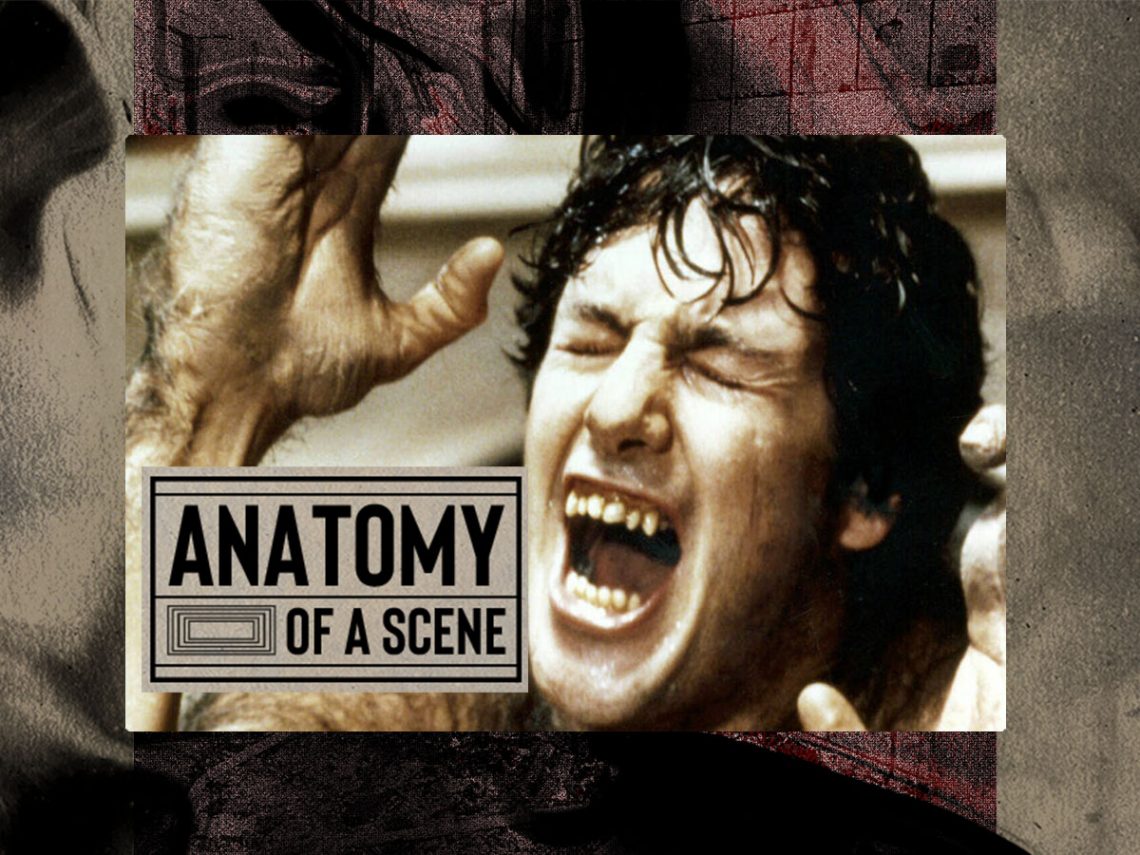
Anatomy of a Scene: The wolfman transformation in ‘An American Werewolf in London’

David and Jack are two polite American college students backpacking through Britain. After popping into a pub (The Slaughtered Lamb) and spotting some strange satanic imagery in the form of a pentangle, they decide to leave, having been warned to stay off the road. They walk the hills for a few hours, only to be attacked by a large wolf. Jack is brutally killed, but David survives with a bite. So begins one of the most brilliantly conceived horror films of the 1980s: An American Werewolf in London.
Of all the memorable scenes in John Landis’ jocular take on the werewolf myth, the one that immediately comes to mind is the transformation scene. After David heals in the hospital, he finds himself plagued by strange dreams in which a mutilated David warns him that he is becoming a werewolf. He considers committing suicide, but it’s too late – the full moon is already upon him.
Discussing the making of the transformation scene with The Guardian, Landis said: “My inspiration was the old 1940s horror movie The Wolf Man starring Lon Chaney, in which – unusually – the werewolf was portrayed as a victim. Films tended to show the transformation from man to wolf through dissolves, but I wanted to capture how painful the entire process would be – and make it painful to watch. Although the film did have a lot of comedy, I wanted to treat the violence realistically, to make it as terrible as violence always is.”
The transformation is indeed violent. At first, David just seems a little feverish – his face red and glistening with sweat. “I’m burning up!” he screams before pulling off his clothes. Naked and wild-eyed, he stares at his right hand, which begins to extend before his very eyes. The sound of David’s bones expanding inside his skin is unbearable. The slow crunch of his body filling up and exploding plays without psychology. The body is normally a stable entity, but here it is something amorphous and violent.
Things get even more grisly when David is forced onto all-fours by the sheer weight of his new spine. The brutality of Landis’ body horror reaches new peaks when David, now covered in a thick layer of hair, shifts onto his back, giving the impression that he is giving birth to a new set of legs. At last, his jaw extends, pushing his nose and mouth into a snaggle-toothed muzzle. His eyes explode, and the transformation is complete.
Landis’ visual effects shine through. In 1981, CGI was still a fledgling art form. As a result, the transformation scene was achieved using carefully sculpted prosthetics, stop-motion animation, animatronic devices and a hell of a lot of grease paint to get David’s body hair to stand on end.
Within a few years, computers would go from beginning expensive toys to affordable tools, allowing for the development of CGI-heavy films like Tron. Some would argue that such scenes look cheap and corny in comparison, but I would disagree. I think the transformation scene in An American Werewolf In London still stands up as one of modern cinema’s most brutally realistic depictions of metamorphosis.
Check out the scene below.
