


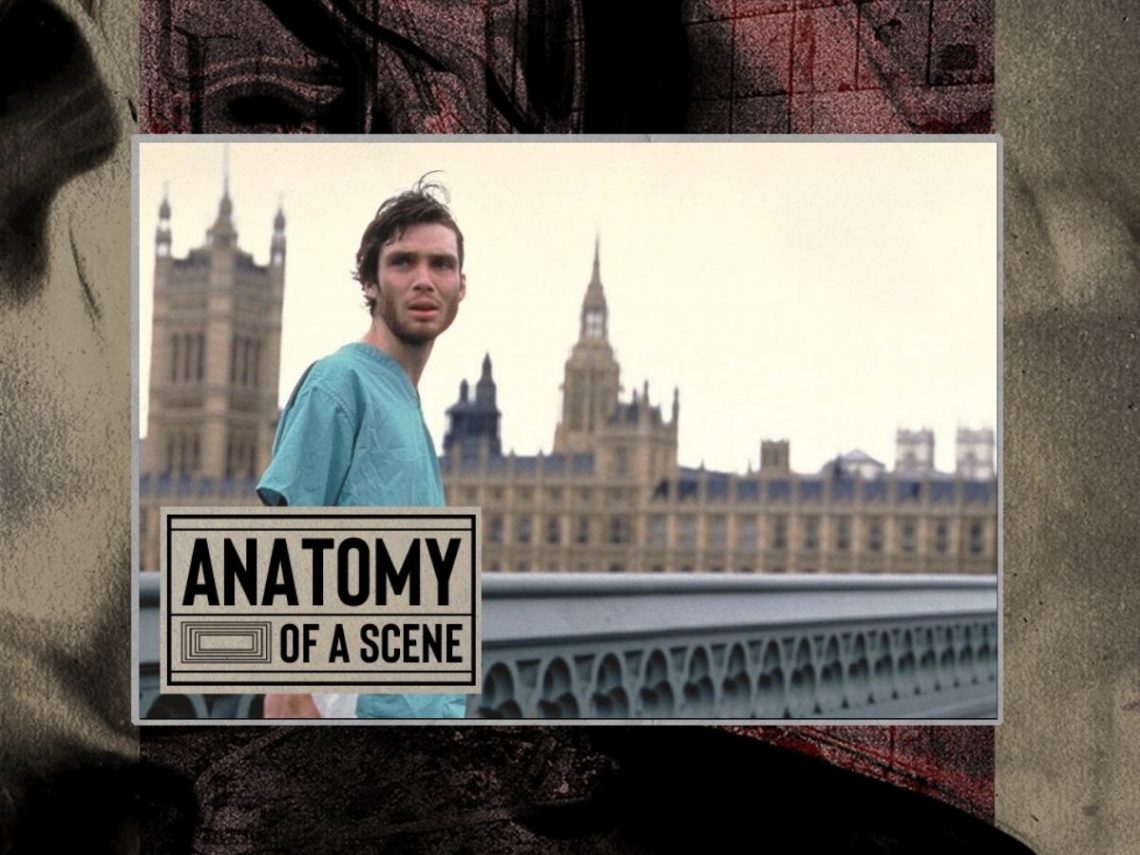
Anatomy of a Scene: Vacant London in ’28 Days Later’

The day the British government announced a nationwide lockdown in the spring of 2020, I was sat in an Uber headed for Liverpool Street Station. “Blimey,” the driver said, peering out at the empty streets. “This is like bloody 28 Days Later or something.” He was right, and there’s a reason he reached for that reference.
Few films have captured the bewildering emptiness of post-apocalyptic London quite like Danny Boyle did in that 2002 zombie flick. It was an eerily prescient vision of a city devoid of habitation. Well, human habitation, at least.
The iconic bridge scene comes after Jim – played by Cillian Murphy – wakes from a coma in St Thomas’ hospital. Unaware of the apocalyptic events that have unfolded in his absence, he wanders through a deserted London, pacing across a litter-strewn Westminster Bridge towards The Houses of Parliament, through the Horse Guards, down past the Cenotaph and towards St Paul’s Cathedral.
Having decided to replace the lumbering oafs of George A. Romero’s Night of The Living Dead with terrifyingly fast brain-eaters, Danny Boyle was keen to make London look as post-apocalyptic as possible – no easy task in a city packed with people and traffic from sunrise to sunset. Speaking to Time Out, location manager Alex Gladstone said: “We shot on a weekend and got there super-early to capture that moment. We had to film everything in a morning, which added to the frenetic rawness. There were a few people wandering home after a late night out, but we had police helping keep them out of shot. There were angry drivers beeping at Cillian too, but we edited the noise out.”
The effect is one of bewildering isolation. As Jim trudges along, he echoes the solitude of Walter Gripp in Ray Bradbury’s short story The Silent Towns and Robert Neville in I Am Legend, both men who find themselves the last human inhabitants of once-populous towns. Boyle was also (perhaps unknowingly) tapping into a long tradition of British writers depicting London as the epicentre of various apocalyptic scenarios. Take H.G Welles’ War of The Worlds or John Wyndham’s The Day of The Triffids, the latter of which takes place in a post-apocalyptic version of London infested with man-eating plants.
The four-day shoot required no small amount of cooperation between production supervisor Andrew Macdonald, London local councils and the police: “We were able to shoot for an hour or so before the city got too busy for us to hold back the traffic. It was very exciting, and when you see the whole of Westminster Bridge and the embankment all closed for you, and the traffic stopped, and you can’t hear anything, it was thrilling but strange as well.”
That sense of strangeness was exactly what Danny Boyle was hoping for: “We wanted to see Britain as a mythic landscape,” he later explained. “Unfortunately, it’s a relatively small place, and we tend to be over-familiar with it through background shots from even a few days of television. We felt it was important to try and make it unfamiliar, so audiences could look at it in a slightly different way, a bigger way than they do in their normal lives.” Today, Boyle’s vision stands as an eerily prescient vision of something that did eventually come to pass, a once-buzzing city reduced to a silent wasteland. Minus the zombies, of course.
