


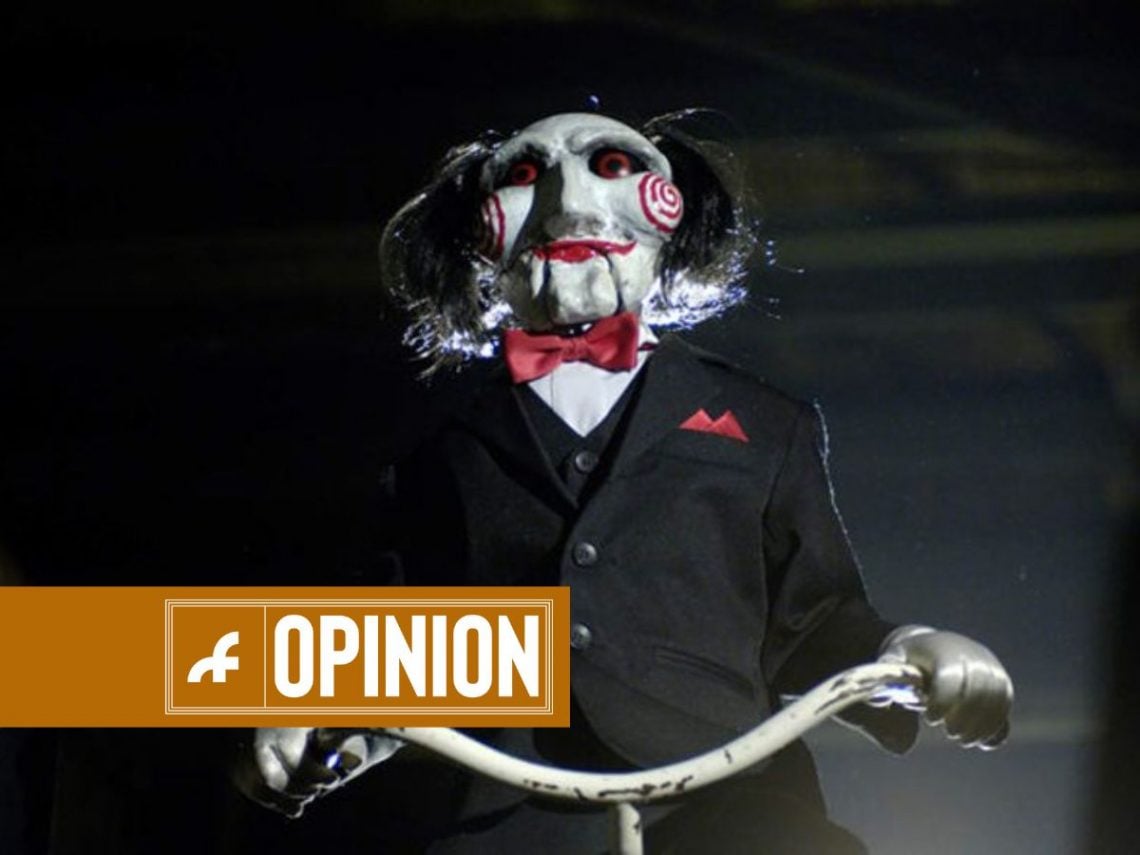
Analysing the ‘Saw’ franchise: torture porn or philosophical case study?

Cited as a staple in 21st-century horror, the Saw franchise consists of nine films released between 2004 and 2021, with the first eight features depicting the kidnaps and murders of serial killer John ‘Jigsaw’ Kramer and the ninth following a copycat killer. The series’s premise involves victims finding themselves either in one trap or a series of traps they must solve, either on their own or in a group. The malicious games are designed to align with a flaw or sin the victim has engaged in, as, unlike most bloodthirsty killers, Jigsaw’s motive resides within philosophical outlooks on the value of life, with the victim often having to make extreme choices to avoid death.
The franchise was created by Leigh Whannell, who stars in the first film as a victim called Adam, and James Wan, with the first instalment being released on Friday, October 29th, 2004. Saw grossed $100 million worldwide and became one of horror’s most profitable features, sparking the later sequels supported by a niche yet dedicated following.
Speaking to Collider about how the series had changed from a low-budget thriller to a full-blown franchise, Whannell shared: “It’s a very strange thing to have other people take something you’ve created and take it in another direction. I always compare it to having a child and raising a child and letting them go off and become their own person. It’s a strange feeling to be driving down Sunset Blvd. and see a billboard to a film that is a sequel to something you created. It all started with us, and now someone else had taken over.”
The Saw films, upon first reading, blend philosophy, psychology and extreme physical carnage as their hybrid source of horror. However, many readings of the franchise’s content and execution cite the films as ‘torture porn’, meaning an almost celebration of extreme themes and images of gore and graphic violence such as torture or murder. This label dismisses the films as shallow depictions of bloody acts intended only to shock audiences through their gruesome visuals. These types of films are compared to earlier horror movies from the ’60s and ’70s, primarily emphasising detail, tone and terror, exhibiting genuine tension to unnerve and terrify audiences rather than just shocking them with cheap gore.
The Saw movies fell victim to this citation through their frequent carnage, with the traps resulting in bodies being torn apart and murders taking centre stage, distracting from any other explored elements. Extreme torture porn features were a vital part of 2000s horror, with the Saw films being accompanied by Eli Roth’s grizzly Hostel films and other squeamish titles. These movies became synonymous with a ‘watch if you can’ category, with audiences expecting each film to outdo the last in blood and carnage.
The franchise’s creators respond to this label with an objective outlook while proposing some counteraction. “The fact that Saw is called “torture porn” is something… I think the film got that label from the sequels as they got more and more gory,” Whannell explained. “The first one is more about the idea.”
He adds: “And I think that “torture porn” is a phrase that the mainstream press glommed onto. But you know from having worked in the genre for so long that these kinds of gory, intense movies have been around for so long. They were just never successful in the mainstream like this one was.”
Fans of the series reject the ‘torture porn’ label, arguing that the movies maintain a deeper meaning that is overlooked as the gorier aspects are all critics pay attention to. Behind the dismembered limbs and bloody rooms, the Saw franchise presents some heavy metaphysical content.
Jigsaw’s motive and backstory, consisting of being diagnosed with terminal cancer and losing loved ones causing him to realise how society doesn’t value life, provide the philosophy. This element prompts questions and discussions about the sanctity of life through the design of his traps and the reasoning for his selecting victims. Audiences are invited to analyse Jigsaw’s antics, questioning the morality of his actions and their alliance with the victims. Upon a surface viewing, audiences should feel sympathy for a victim chained in a room being forced to severely injure themselves or another in order to save themselves, even being forced to choose between their own wellbeing or another person, as an extreme test of character and humans’ need to survive.
This last part is a vital part of Jigsaw’s goal, carrying out his violent traps as an experiment to see how far people will go to survive and what they will sacrifice to save themselves.
However, the sympathy audiences feel towards the victims is negotiated with the reveal that the person has a broken moral compass, which is why they are subjected to the trap. Jigsaw’s victims range from murderers, those who fled prosecution, sexual offenders and bigots; thus, this information about their past causes a conflicted alignment with their agony. As the exposited information is paired with the gruesome visuals of these victims suffering as a consequence of their immoral actions, audiences are left with a series of questions: Should we feel sorry for these victims? Is Jigsaw justified in his actions?
Audiences also find themselves looking at some of the ugliest parts of society alongside the extreme lengths civilians will go to survive, elevating the subject matter beyond the graphic surface imagery.
Essentially, the Saw movies transcend the torture porn category as they provide challenging dialogues about morality, justice and humanity — this is far from watching the extremes of life purely to see how far the world of cinema can go. Furthermore, the games that align with the victims’ actions or sins elevate the subject matter through attentive symbolism. One example of this is in Saw IV, where a woman in an abusive relationship she was unable to leave out of love is attached to her partner via arrows inserted through the vital arteries. If she removes the bows, she lives, but her partner dies, with the trap being titled ‘Cupid’s Arrows’. There is also the extreme ‘Horsepower Trap’ in Saw 3D, where a racist man is forced to peel his skin off to survive as a punishment for judging others based on their complexion.
Those who survive the traps do so with a new ‘outlook’ on life, claiming that Jigsaw helped them discover how valuable life is. As a result, they live it with a new, appreciative and morally equitable approach, prompted by Jigsaw’s congratulating speech: “Congratulations, you are alive. So many people are ungrateful to be alive, but not you. Not anymore.”
Even the spin-off movie Spiral, starring Chris Rock and released in 2021, posed a thorough landscape of institutional corruption within the police force and saw dirty cops undergo extreme punishments for abusing power among the innocent. Still, the torn-off fingers and tongues distracted audiences from this socio-political exploration and further submerged the series into the shallower citation. However, it was still thrilling to see murderous police officers see a twisted hand of justice.
Given the philosophical and symbolic value hidden within the Saw franchise, to tie it down with a facile label such as torture porn seems unfair and irrational, as if those who propose it do not watch the films. Instead, they allow the occasional gore to overwhelm the explorations of humanity and thought experiments. The Saw franchise exhibits psychological and philosophical studies against a harrowing backdrop of carnage, appeasing horror fans through thrilling, gory visuals and intense cognitive engagement.
See more of Saw’s underappreciated philosophical tones below.
