


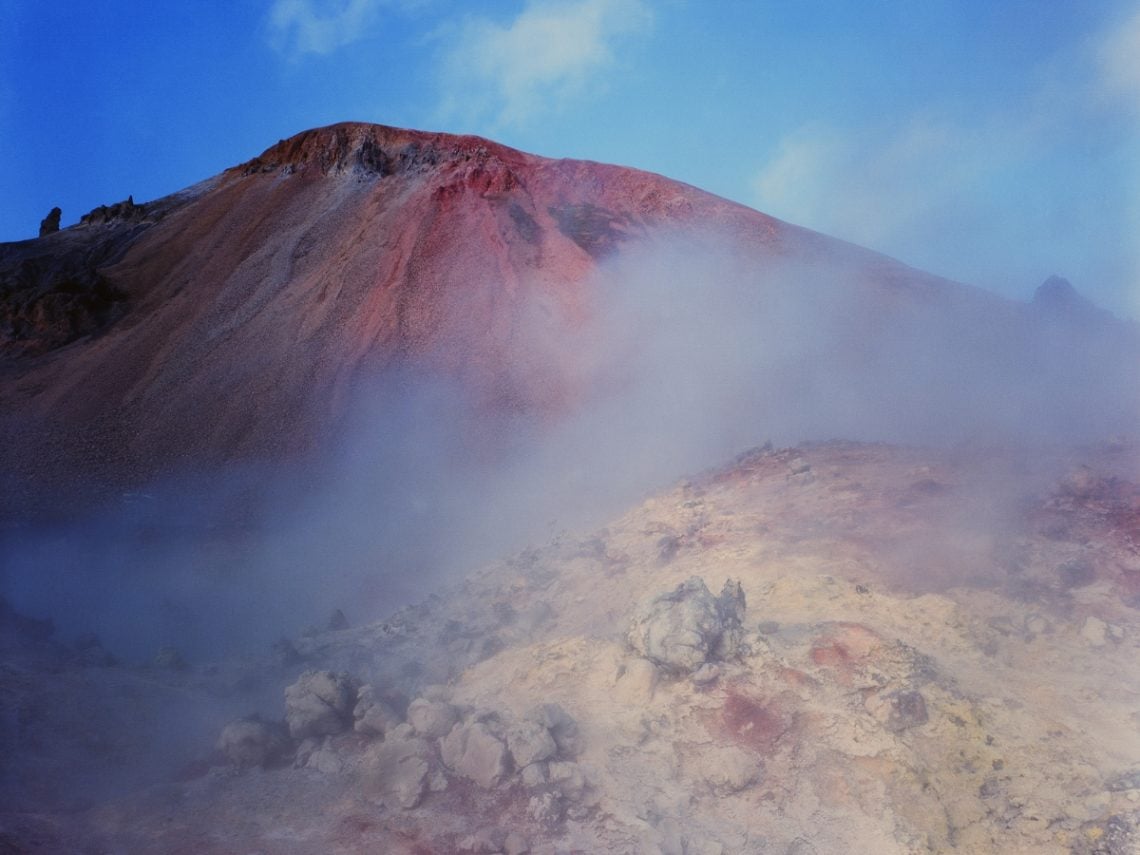
“Walking is healing”: Milo Reid’s photos capture the regenerative power of solo travel

“The idea behind this book was that someone might look at it and immediately want to go for a walk,” says Milo Reid of his quest to place the nonhuman world at the very centre of Are We Always Outside. A fashion and still life photographer by trade, Reid had his “nose to the grindstone with studio photography” when he learned of his father’s death in 2013. The news ignited something that had been simmering away for some time. “I just had this very intense desire to travel,” he says. “To have some recollection of my dad.”
With that, Milo set about organising a series of adventures: trips to the frozen plains of Iceland, the mangrove swamps of Cambodia and the translucent seas of Australia. This collection is as much a meditation as it is a travelogue. Though the project started out as an attempt to capture the tranquillity of nonhuman environments, Reid soon found himself drawn to notions of family, home, and the “nurturing aspects of humanity”. By moving through unfamiliar landscapes and allowing himself to be remoulded, Reid managed to distil his belief that “walking is healing.” And as he so neatly puts it, “sometimes you just really need to go for a walk.”
Are We Always Outside seeks to capture the world on its own terms. Some images are so textured they could have been woven by hand. “You’ve only got composition, lighting, colour, texture,” Milo observes, describing how his experience as a still-life photographer informed the tactility of these photos. Though Reid’s images are filtered through the lens of human experience, they evoke something beyond humanity – a world in which everything from shards of glacial ice to fingerfuls of butterfly eggs exudes sentience.
Published by Duende Print, Are We Always Outside is available from Duende’s online shop or from Milo Reid’s website. Featuring a cover inspired by his father’s gift for mathematics, each of its 48 pages has zero white space, allowing Reid’s vision of a slower, greener world entry into our own.
Milo Reid on Are We Always Outside:
Far Out: To begin, what made you pick photography over other visual mediums?
Milo Reid: “My first introduction to visual art was as a teenager in Bath. I was into hip-hop and graffiti and turntables and that kind of thing. We used to go and do pieces in town. I remember getting arrested twice doing that, and that was enough to be like: ‘okay, this is not very fun.’ I really feel the council could have supported me. Instead, they tried to scare me and give me a criminal record. And so that put me off that form of visual art.
“When I started my GCSEs, I was lucky enough to have a really solid photography teacher who inspired a lot of other people. That was where my love of fashion photography started. I’ve been hardwired into photography since then, so it was the only choice for me, really.”
What did you want to achieve with the Are We Always Outside?
“The first book that blew my mind was William Eggleston’s Guide [by John Szarkowski.] It blew my mind then, and I still think it’s incredible. Though I don’t absorb photography books in the same way – seeing books that would change my perspective and my viewpoint – I’m hanging on to the idea that I might produce something someone else might have that kind of reaction to.
“Another thing was my dad passing away about 10 years ago. He died in 2013. At that point, I had my nose to the grindstone with studio photography, and I was really not photographing anything outside at all. So, those things intersected. I just had this very intense desire to travel, to have a recollection of my dad and to meet new challenges. In a studio setup, nothing moves, and you control everything. This was supposed to be the antithesis of that: everything is moving, and you’ve got short periods of time to capture it.”

Humans are absent from this collection, and yet their presence is still felt. Were you looking to express anything about humanity in particular with your photos?
“There’s the odd image that I think is purely utopian. A lot of the other photos concern the nurturing side of humanity. There are also a few that touch on some of the darker sides of humanity. But ultimately, I’m an optimistic person, you know, and part of this project was me imagining my own version of the world where things are more peaceful and less stimulating. Initially, I was trying to capture scenes without any trace of humanity – that was the very beginning. I didn’t have this picture of talking about utopias or the nurturing aspect of humans; it started out somewhere else. That came as the pictures developed, and I saw more things.
“There’s also an emphasis on domestic and external spaces. This project came about pre-Covid, but during the pandemic, when we were being told ‘inside, inside, inside’, I started thinking, ‘can you ever be inside?’ Take my image of the troglodyte caves in Malta, for instance. I kind of think our houses are like those caves. But we’re led to think that somehow we own these things. It all seems like a bit of an illusion to me.”
Were there any particularly profound moments during your travels?
“In Nepal, I went to this Sadhu funeral. I was thinking a lot about my dad at that time, and there was a burial going on. There was a moment when I heard this popping sound, and it was the skull of the person being burnt bursting. Before that, there had been a really beautiful ceremony in which the deceased’s wife and children wrapped up the body. In a way, that was my funeral for my dad. In the end, all of the [photographs from that trip] got stolen in Cambodia. That was a challenge, and sometimes it still hurts. I can still remember a bunch of the pictures. It was about eight roles of film, so 86 exposures.”

I’m fascinated by your shot of the two horses in the Brecon Beacons. What’s the story behind it?
“I was pottering around in the Brecons on my own. I was going to spend my first night wild camping, but I realised that I’d left my beer in the car. The weather was coming in, and some people coming down the mountain had warned me that it was about to get very harsh. Basically, I bottled it. Anyway, I was heading back to the car when I came across these wild horses. The blurriness was a total accident, but when I saw it, I just loved it. interpreting the image, it’s definitely a parent thing. I think of a mother and child, but it could be a father and child too.”
Finally, why did you decide to remove human subjects from this collection?
“I think that people could do with a bit of a reduction in stimulation and over-consumption of people’s identities. I think, generally, previous cultures didn’t identify in the same way we do now. There’s so much emphasis placed on people’s appearance and being up to scratch. There doesn’t seem much space for eccentricity or misfits anymore.
“When I first started earning money as a photographer, I was just on tonnes of portrait shoots and fashion shoots. I’d see these young girls getting their feet squashed into shoes that didn’t fit and photographers saying really horrible stuff about them. It just created a mental block. Then there’s the state of Instagram. A lot of people aren’t conscious of this, but if you look through any Instagram feed, it’s just countless photographs of people. My images punctuate these pictures with something inanimate. I think it’s really important to create these interventions and just live and breathe and just be in the world”.
Thanks to Milo for taking the time to talk about his new book, Are We Always Outside.


