


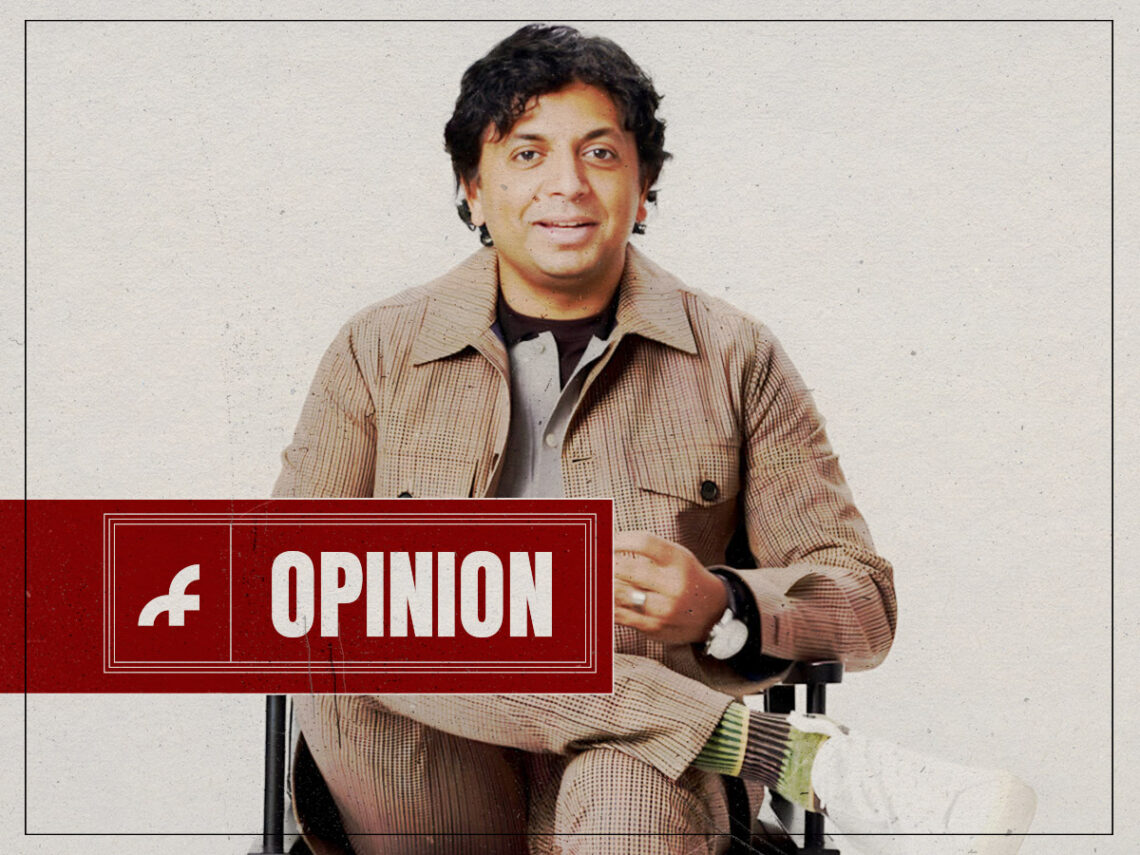
Hear Me Out: Almost destroying his own career was the best thing that happened to M. Night Shyamalan

Having to sift through the charred remains of your career to salvage any pieces worth picking up isn’t an ideal scenario for anyone, but as bizarre as it sounds, coming dangerously close to torpedoing his own livelihood was the best thing that could have happened to M. Night Shyamalan.
Looking back, there was nowhere else to go but down after The Sixth Sense, which endures as one of the most impressive breakthrough movies any young filmmaker has ever made. Released in the United States on his 29th birthday, it became one of the highest-grossing horror movies in history after netting $673million at the box office before earning six Academy Award nominations, including ‘Best Picture’, ‘Best Director’, and ‘Best Original Screenplay’.
Unbreakable and Signs continued his hot streak of critical adulation and runaway commercial success, hewing closely to the subversive formula of The Sixth Sense and relying on what quickly became his signature twist ending. He could keep that up only a finite amount of times without the gimmick overstaying its welcome, and the cracks didn’t take long to start showing.
The Village split opinion straight down the middle with a divisive ending that seemed to exist for the sake of executing a twist. At the same time, Shyamalan toyed with the possibility of disappearing completely into his own hubris when he cast himself as the man with the power to save the world in Lady in the Water before he thought Mark Wahlberg talking to plants in The Happening was a sound basis for an environmentally-conscious thriller.
After three misfires in a row, Shyamalan decided it was time for a change and went about it in the worst possible way. The Last Airbender and After Earth significantly upped the budgetary ante, only for the filmmaker to reveal himself as being woefully ill-equipped at helming either effects-laden blockbusters or stories developed by other people, with each of them a cataclysmic flop that easily sits among the worst big budget offerings of the 21st century.
Things got so bad in between those two projects his name was suspiciously omitted from the marketing of the supernatural thriller Devil despite the fact he’d produced and crafted the story, casting him back out to the fringes of Hollywood. His signature style of chamber piece genre films had faltered, and his IP-driven forays were disastrous, which left Shyamalan with no other choice but to take it upon himself to rehabilitate his reputation.
The Visit may have carried a twist, but it was deployed midway through for a change, and returning to his smaller-scale roots in what was the cheapest film he’d ever made by far ignited a creative reawakening. The generational nightmare recouped its $5million budget almost 20 times over from cinemas, and the renaissance was on.
Split was the single most profitable release of 2017 after turning its $9million production costs into $278m in ticket sales and generated even more attention after holding off on its biggest reveal until the end by reintroducing Bruce Willis as Unbreakable‘s David Dunn. Glass was another box office bonanza, but a disappointing one that remains indicative of Shyamalan’s second wind at large.
It’s comfortably the weakest feature he’s made in the post-After Earth years, and that’s because he was trying too hard to indulge himself and appease a pre-existing fandom at the same time. Those are among the reasons why his career ended up in the shitter in the first place, so it’s not a coincidence his star-studded trilogy-capper stands out as a rare recent misstep.
Old and Knock at the Cabin were inexpensive, inoffensive, and the work of a filmmaker freed from the shackles of pressure and expectation, with Trap set to follow along similar lines. Shyamalan is now in the position where he writes, directs, produces, and self-funds every single one of his movies, and with the last four all having opened at the top of the domestic box office, it’s a self-sustaining model that gives him complete creative autonomy.
That wouldn’t be the case if he continued making films on the scale of The Last Airbender and After Earth, and it became clear very quickly that he didn’t belong in that arena in the first place. He’s found his groove. It’s been incredibly fruitful for all parties, and it wouldn’t have happened at all had he not found himself within a whisker of being incarcerated in the director’s jail without the chance of parole.
