


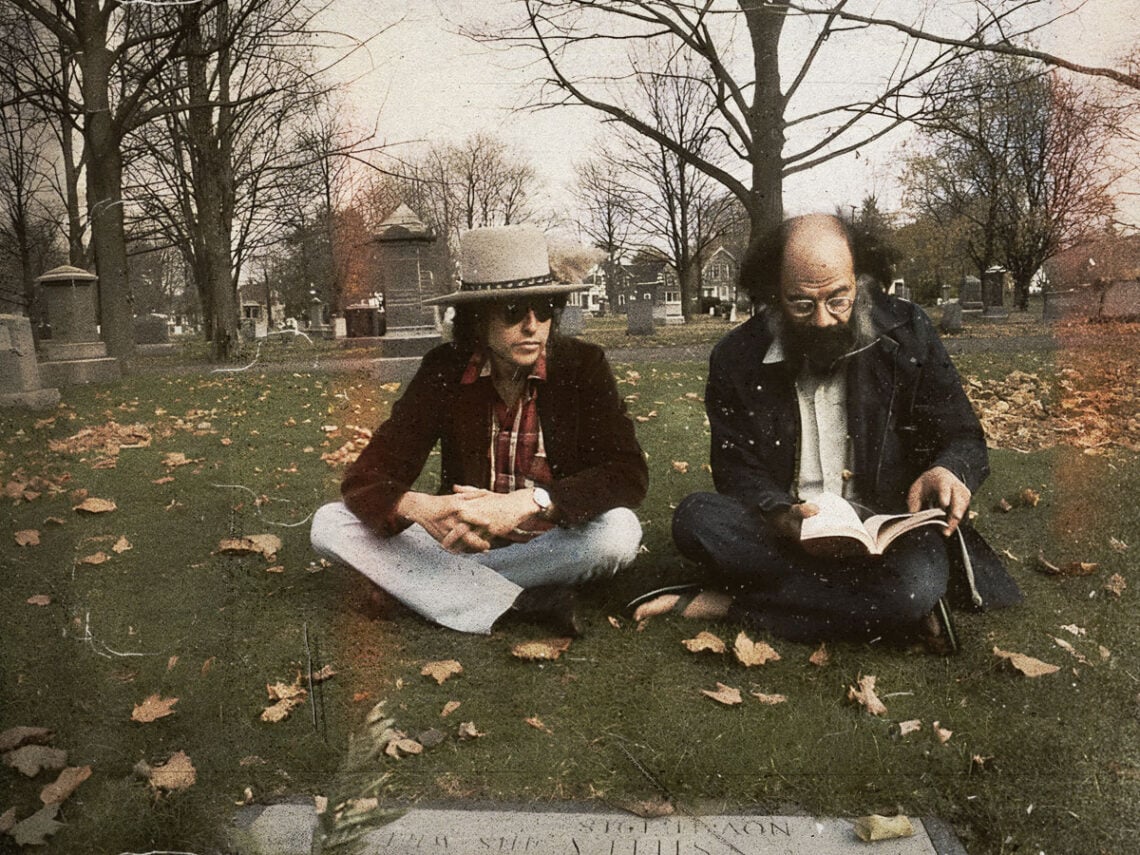
Allen Ginsberg teaches the art of meditation with Bob Dylan on bass

Bob Dylan is, of course, best known for his solo work, but beyond his legendary individual career, he has also ventured into more collaborative associations from time to time. Not only was he a member of The Traveling Wilburys, but he also attempted to join the Grateful Dead around the same time, and he has also served as a sideman on several other projects throughout his career.
In fact, Dylan’s first time in a recording studio was playing harmonica as a backing musician for Harry Belafonte during the sessions for The Midnight Special. At his second studio session, he was backing Carolyn Hester, again on harmonica, where he was spotted by legendary Columbia Records A&R man and social justice campaigner John Hammond and subsequently signed to the label as a solo act.
From then on, throughout the 1960s, Dylan was the star of his own show and wouldn’t need to support another singer to support himself if he didn’t want to. Late in the decade, he lent both his lyrics and his artwork to his band, The Band, but didn’t contribute in person to their seminal album Music From Big Pink.
By the early 1970s, he had taken a step back from the spotlight and was enjoying the freedom of his relative anonymity. He began contributing as a session musician more often again and can be heard playing the harmonica on David Bromberg’s 1972 ballad ‘Sammy’s Song’, as well as on the Booker T and Priscilla Jones track ‘Crippled Creek’, as well as on Roger McGuinn’s ‘I’m So Restless’ a year later.
Elsewhere in his long and storied career, Dylan has added touches of harmonica, guitar and vocals to songs and albums from artists as varied as Leonard Cohen (backing vocals on ‘Don’t Go Home With Your Hard On’), Kurtis Blow (vocals on ‘Street Rock’), Warren Zevon (harmonica on ‘The Factory’) and Carlene Carter (singing backing vocals on her 1996 cover of his own ‘Trust Yourself’) among others.
Perhaps the craziest contributions he has made to someone else’s songs came whenever he worked with the poet Allen Ginsberg, though. First, as a bandleader, vocalist, guitarist and harmonica player in 1971, and then later playing bass – not an instrument he is too often associated with – on Ginsberg’s 1982 song ‘Do the Meditation Rock’.
His relationship with Ginsberg went back to a time before they first met in the mid-1960s, with both poets having long since become acquainted with and appreciative of each other’s work. While Ginsberg is more famous for his written word than his music and lyrics, the Beatnik poetry tradition that he was one of the founding fathers and major spearheads of was so inextricably tied to jazz and music that it is really a musical form as much as a prose or poetry style, anyway.

Ginsberg’s poetry was written to be performed aloud as much as it was written to be read. Owing to his infatuation with Dylan, The Rolling Stones, the Dead, The Byrds, and other bands from the era, he dabbled in recording music as early as 1969, releasing an experimental album of folk, jazz, and poetry in 1970 called Songs of Innocence and Experience.
A year later, Dylan stopped in at a recital at the Loeb Auditorium in New York and caught Ginsberg and his gang improvising a long piece of poetry. “We spent half an hour making up tuneful words on the spot,” Ginsberg remembered. “I didn’t know 12-bar blues; it was just a free-form rhyming extravaganza. We packed up, said ‘goodbye’ to the musicians, thanked them and gave them a little money, went home, and then the phone rang.”
He added: “It was Dylan asking, ‘Do you always improvise like that?’ And I said, ‘Not always, but I can. I used to do that with Kerouac under the Brooklyn Bridge all the time.’ He came to our apartment with [David] Amram and a guitar. We began inventing something about ‘Vomit Express’, jamming for quite a while but didn’t finish it. He said, ‘Oh, we ought to get together in a studio and do it’, then showed me the three-chord blues pattern on my pump organ. A week later in the studio, Dylan actually did the arrangement, told people when to do choruses and when to take breaks, and suggested the musicians cut a few endings on their own to be spliced in.”
The songs they wrote together, ‘Vomit Express’, ‘September on Jessore Road’ and ‘Jimmy Berman’, went unreleased.
Ten years later, and having travelled together on the legendary Rolling Thunder Revue in 1975, the pair found themselves recording together again. According to Steven Taylor, a guitarist who was working with Ginsberg in the early ’80s, the poet arrived in Los Angeles looking to book some studio time. Dylan lent his Santa Monica studio space and his bass playing to his old friend on the condition that Ginsberg pay for the musicians. It’s said that the group jammed together for ten hours, during which time they recorded a new song, ‘Meditation Rock’.
Based loosely around a riff borrowed from The Clash’s cover of the old Sonny Curtis blues ‘I Fought the Law’, and inspired by the Buddhist teachings of his mentor Chogyam Trungpa Rinpoche, Ginsberg’s intention with his lyric was to “knock all the poets out with a sugar-coated dharma”.
He explained of the song that “I figured that if anyone listened to the words, they’d find complete instructions for classical sitting practice, Samatha-Vipassana (Quieting the mind and clear seeing). Some humour in the form, it doesn’t have to be taken over-seriously, yet it’s precise”.
So, if you want to learn how to meditate, to quiet the mind and start to see clearly, simply listen to Allen Ginsberg and Bob Dylan’s recording. You’ll find that it’s never too late to start.

Never Miss A Tale
The Far Out Bob Dylan Newsletter
All the latest stories about Bob Dylan from the independent voice of culture.
Straight to your inbox.