


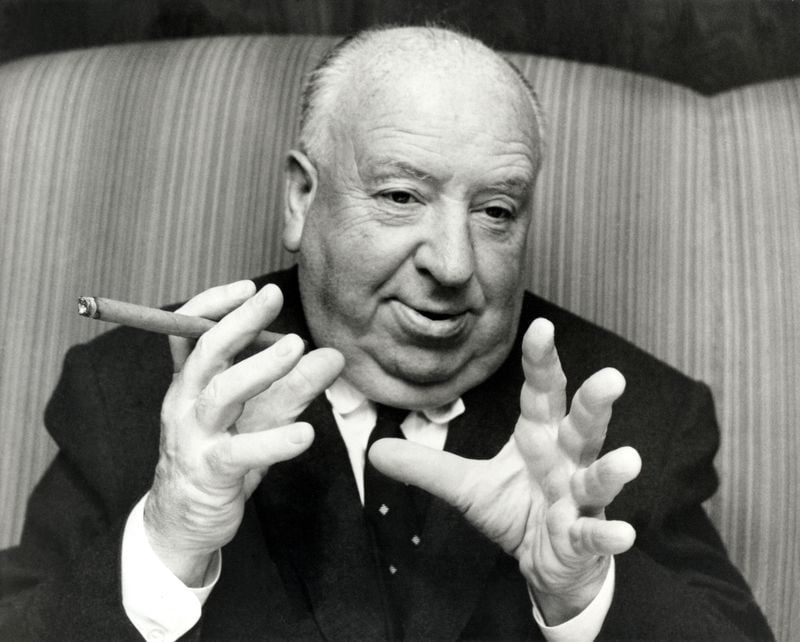
Alfred Hitchcock’s obsession with dead bodies: “If I did Cinderella, they would be waiting for the body to turn up”

“If I had not been what I am,” Alfred Hitchcock told Roger Ebert in 1969, “I think I would have preferred to have been a criminal lawyer.” The one thing stopping him, Hitch went on to reveal, was an innate and incurable phobia of the police. “I have such a dread of the law,” he said. “I did not drive a car for eleven years after coming to this country for fear of being stopped and given a ticket.” Thankfully, Hitchcock found another outlet for his morbid fascination with murderers and their victims: the cinema.
Throughout the 1930s and ’40s, Hitchcock developed a reputation not only as a master of suspense but as a master of the macabre. By the time he made Vertigo in 1957, his name was synonymous with big-screen murder, immediately evoking the shadowy image of a limp corpse in the cellar. When asked whether his technique had changed since 1932, the director was quick to dismiss the suggestion. “I think, you know, the cobbler should stick to his last,” he began. “Know you’re own limitations. I’ve become a specialist. People expect it. If I did a story or, say, a musical about Cinderella, they would be waiting for the body to turn up – if my name were on the picture. You know the audiences are still looking for the body.”
It’s unsurprising that Hitchcock chose to use Cinderella as an example. He was, after all, fascinated not simply by lifeless bodies in general but by the lifeless female body. This obsession with the female form is evident in films like Psycho, in which the body of a naked Janet Leigh (actually, it’s the body of her stunt double) is stabbed numerous times and left slumped in the shower. When Ebert asked Hitchcock if he’d ever thought about murdering someone in real life, the director shook his head soberly. “Too scared. But I do believe the perfect crime is being committed at this minute,” he said. “It would have to be, of course, totally without emotion. So few crimes are. We all of us have emotion stirring about there somewhere.”
Was Hitchcock’s obsession with dead bodies, particularly female ones, an effort to alleviate some repressed emotion? he certainly seems to have regarded fear – that essential Hitchcockian ingredient – as somehow liberating. As Cullen Edwards observed, peril was the director’s “speciality”. “I think it’s probably because I’m a very nervous fellow,” he replied. “We all have fear in us and we like to enjoy a vicarious, shall we say, toe in the water of fear. I think audiences like a little touch of fear. After all, they go on a rollercoaster and scream.”
Hitchcock clearly believed in the power of the dead body to evoke horror and tranquilise it in the same instance. To put a dead body on the screen was, for Hitchcock, to tease death – to be near the point of danger but safe from harm. “There’s humour in a graveyard,” he told Edwards, reminded of a story about “a famous comedian” called Harry Tate, who died “and was being buried and at the graveside were all his fellow comedians, including one very old man named Charles Coburn. And a rather brash young comedian, just as the coffin was being lowered into the grave, leaned over to him and said, ‘How old are you Charlie?’ And this old old comedian said, ‘Oh, I’m 89.’ The young one said, ‘hardly seems worthwhile going home, does it?'”
