


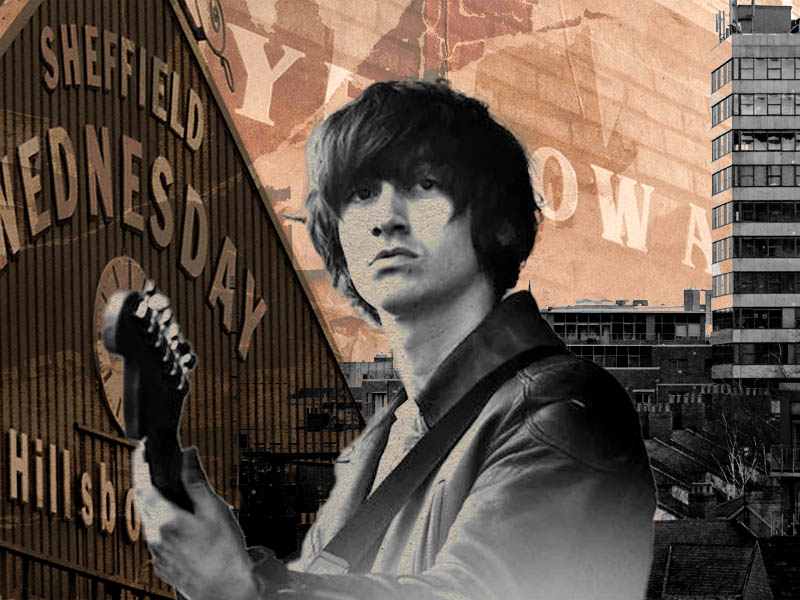
Alex Turner from boy to rock star: A life in evolving influences

A few days before his 37th birthday, Alex Turner took to the stage with the Arctic Monkeys in an unseasonably chilly Melbourne. What followed was fanfare and pandemonium that seemed to have departed the province of alternative music a few decades ago. As he earns his stripes as the consummate frontman, it becomes more apparent than ever that he may well be one of the last of his kind.
In the audience, you have a strange mix of teens being welcomed into the wider cultural world by their heroic poster boy and burly builders whose posters have now been downscaled to hip keyrings. Everyone, however, is enamoured equally by the draw of his machismo artistry. With his matinée idol charm and the substance to bolster his swaggering style, he is fit for the old rock ‘n’ roll epoch of an icon.
He only wanted to be one of The Strokes, and now it would seem that he has surpassed that. That autobiographical reference is a pertinent quote when looking back at his legacy so far. “There is always that one band that comes along when you are 14 or 15-years-old,” he once said, “that manages to hit you in just the right way and changes your whole perception on things.” For Turner, that was, indeed, those scallywags from New York.
Prior to that music had been something his dad played in the car. Fortunately, for Turner – whose dad was a music teacher – he happened the like the tunes his old man belted out. “We’d listen to Pet Sounds in his car,” Turner recalled. “I remember sitting there and being quite moved by it.” Thus, as a boy, he was already aware that there was a depth to music beyond merely colouring a room with a bit of noise.
He would also be indoctrinated in the rebellious nature of rock ‘n’ roll from an early age too. As a nipper, he says he was by the bat phone, and spent his time “devoted to climbing trees and being Batman. But I used to hang out with my neighbour growing up, and his dad loved classic rock.”
Turner added: “He would play Deep Purple on this boombox in their back garden. I can remember playing Batman and Robin to Hush on Saturday afternoons. My neighbour was a bit older than me, and he was allowed to chew bubblegum– I couldn’t do that as a five-year-old. Why? It’s fucking dangerous, you can choke! He was allowed to wear hair gel, too. I wanted to be him a little bit.”
So, although he was a kid, the allure of the 1960s notion of rock ‘n’ roll, greased back locks, a swinging jaw and liberating society were all in place. It took seeing local bands to establish how this fantasy could materialise in reality. “It weren’t a famous band or anything,” Turner recalls regarding his rise to the stage. “It was just a band in our area who had got it together. Nick O’Malley played in them before us.”
Around the same time that he came to the realisation that making music was actually plausible, his artistic world was being expanded by the poetry of John Cooper Clarke. This guiding hand revealed to him the poetry to everyday life and these forces collided to usher Turner towards creating an indie band who would occupy an artistic space of reverie to brighten up the dismal daily lives of the proletariat.
It is this that birthed Alex Turner as an indie vagabond and to some extent, it is still this abiding factor that encapsulates his output today. There are those that might think he has picked up the handbook and clambered onto the hipster bandwagon, but the truth is the polar opposite. As the novel that inspired the word on that debut record decrees: “All I’m out for is a good time – all the rest is propaganda. I’m me and nobody else; and whatever people think or say I am, that’s what I’m not because they don’t know a bloody thing about me.” His driving instructor offering up The Smiths’ brooding Hatful of Hollow added to this too.
Turner knew this from the start and his evolution has been one that is signposted by the artistic evolution of expression. John Cooper Clarke, local bands and Alan Sillitoe’s novel, Saturday Night & Sunday Morning illuminated the importance of being yourself and knowing where that stands in society from the get-go and his individualism has shone through the glut of the rut like an assegai of quirky creative inventiveness.
As David Bowie proclaimed: “Never play to the gallery… Never work for other people in what you do. Always remember that the reason that you initially started working was that there was something inside yourself that you felt that if you could manifest in some way, you would understand more about yourself and how you co-exist with the rest of society… I think it’s terribly dangerous for an artist to fulfil other people’s expectations.” As a Bowie fan, this inspiration clearly struck Turner as an important message, and he quickly began to follow it when fame found the Arctic Monkeys.

At this time, Turner looked to expand his tastes in music and literature. One line he discovered, in particular, seems to have been influential. In an interview with Kevin Perry in Time Out, Perry writes: “We sit and chat about books, and as befits the sharpest lyric writer of his generation he’s the sort of reader who can quote his favourite novels. He’s a fan of [Joseph] Conrad and [Ernest] Hemingway, but above all [Vladimir] Nabokov. He recites a line about internalised anger from ‘Despair’: ‘I continued to stir my tea long after it had done all it could with the milk.’”
It’s the sort of line that Turner has been conjuring ever since. Its concision offers up a punch and implies there is more waiting in the wings of the simple sentence. As he croons in their new single ‘There’d Better Be A Mirrorball’, “So if you wanna walk me to the car.” There is weight to those words that lies beyond a casual stroll, just as Nabokov’s tale of absentmindedness implies a lot more than excessively stirring a brew.
On both counts, these simple everyday acts gone awry are relatable gateways into the bigger picture. Sometimes, a walk to the car is just a walk to the car, other times it’s a heavy-hearted long goodbye; sometimes, over-stirring the tea implies your mind has simply wandered to last night’s painful football result, but other times the tea ripples with heftier reverberations than that. On both counts the concision proves cutting, the words have inherent melody, and the picture they swirl to the surface adds a lustrous cinematic depth.
And cinema is important to Turner too. He says that “cinematic” is a word that has always rightfully been applied to his output. The medium proved a vehicle through which he could expand his songwriting beyond indie clubs. In some cases, this was shown via cinema in a literal sense. As he explains: “When I was writing this record, I was turned on to these three Jean-Pierre Melville films – Un Flic, Le Cercle Rouge, and Le Samouraï – that all star Alain Delon and have this jazz lounge club at the centre of the story.”
He added, “The clubs in these films were often very obviously film sets, which is something that interested me as well. At the end of Le Samouraï, for instance, there’s a shot that zooms out from one of these clubs almost to the point where you see the film lights. So when I would sit at the piano and play these types of chords, I was thinking about those Melville interiors a lot.”
This expansive worldview helped him to establish his growing style but also assert himself as a songwriter in the true sense. As such, he began to take note of the most respected names in his field early on. “I pay quite a lot of attention to songwriters as good as Bob Dylan,” Turner explains. “In fact, I’ve gone through phases where I’ve listened to his music quite a lot. When I was in New York, I used to listen to Desire quite often, and I really got into that song, ‘One More Cup Of Coffee’”.
It took Turner a little time to really delve into Dylan’s catalogue, but when he did, he never looked back. The Arctic Monkeys singer went on to describe how he’d “never really got into that album (Desire) – years before, I’d listen more to the likes of Highway 61 Revisited or the other early albums, which I’m very familiar with. But that Desire album is something else. But, yeah, a brilliant songwriter, no question.”
With that in mind, at the midpoint of his Arctic Monkeys journey, he had established himself in the field and he decided to look back. He took the cinematic and literary stylings of the likes of Nick Cave and placed them alongside the visceral rocking beginnings of the band. “Hip-hop has always been an influence, but I think we’ve worn that influence more on our sleeve a bit more with this record (AM),” he once said.
Adding: “Me and [drummer] Matt [Helders] sort of grew up together, and there’s this one record called Run Come Save Me by Roots Manuva that’s a kinda soundtrack to those years,” he told GQ in 2011. “I still think he’s great; I love his way of talking about the mundane and the everyday, but always with a weird angle.”
These early days and influences have never left Turner and that much is clear in how he relishes the notion of the audience having a knees up as he steps out in front of stadiums these days. His latest inspirations might be tied to the chansonnier stylings of French classics and orchestral arrangement, but his makeup is always grounded in the sticky carpets of the pubs that first enamoured him, and every engulfing influence thereafter.
