


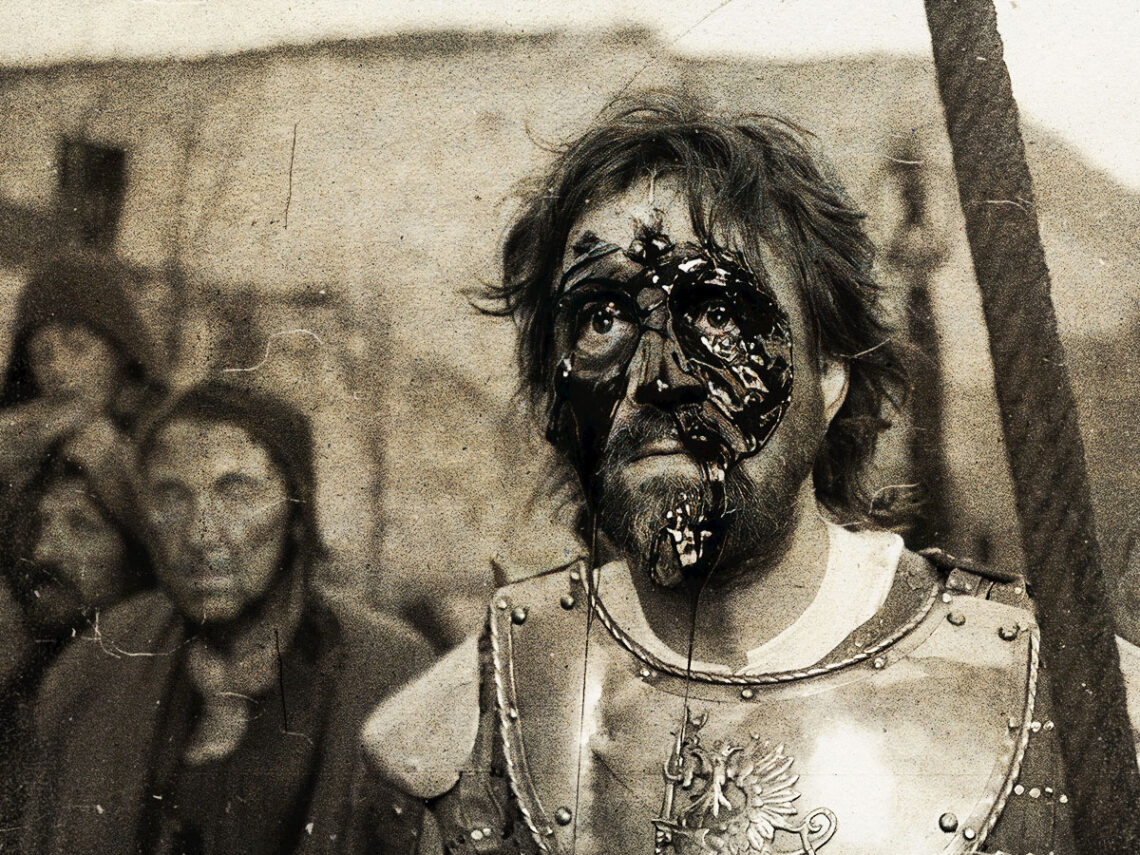
Aleksei German – ‘Hard to Be a God’

Many filmmakers have changed the way we understand cinema as a creative medium, from the surrealism of Luis Buñuel to the new-wave innovation of Jean-Luc Godard, yet such feats feel few and far between in the contemporary space. Yet Aleksei German’s Hard to Be a God is a reminder of the potency of the cinematic experience, transporting audiences out of the comforts of their front room and into an extraterrestrial world of visceral filth and gorgeous immersion.
Made over the course of seven years, German’s film, based on the 1964 novel of the same name by Arkady and Boris Strugatsky, is a three-hour monochrome odyssey set in a distant future on an earth-like planet named Arkanar, a land stuck behind in the technology of the Middle Ages. A team of scientists are tasked with gathering information by working undercover but are ordered not to interfere with the community, which chooses to execute anybody deemed intellectually superior.
One of the scientists, Rumata (Leonid Yarmolnik), finds it difficult to become a bystander in this world, stepping in to stop these executions whilst becoming a god amongst men in the process.
Still, this brief description suggests that Hard to Be a God has some sort of robust narrative when, in actuality, the opposite is true. German’s film is a marvel of production design, crafted like a coded warning from another time or dimension where the message itself is unclear, muddied by copious amounts of bodily fluids, sick, urine and excrement, which the filmmaker thrills in bathing his set with.
Hard to Be a God largely refuses to abide by the rules of filmmaking at all, capturing the location much like a roving documentarian, diving into the back alleys and squirming through the crowds, with many of the townsfolk staring right down the barrel of the camera as if they have no idea what they’re looking at. Eradicating any idea of the fourth wall on a regular basis, German’s film certainly does feel like a documentary or, more appropriately, a tape of found footage that was discovered floating through the cosmos.
The director’s ability to organically capture what looks and feels like an uncanny reality is spectacular, crafting a feeling of immersion that few films in the history of cinema have been able to match. With thousands of extras and a meticulous approach to production design, Hard to Be a God is a feat of sensory overload that transports the viewer like a nightmarish virtual reality experience.
Indeed, German’s film shares little with traditional cinema, being something more akin to an art installation where the relationship between sound and image is explored in a landscape of eerie authenticity. In what it lacks in narrative weight, Hard to Be a God makes up for in visceral pleasure, creating a cinematic odyssey that takes the human race the closest it has ever come to the feeling of extraterrestrial contact. With textured frames that bulge with breath and a soundscape extracted from beyond the ether of our galaxy, Hard to Be a God is a psychedelic trip in every sense of the word.
