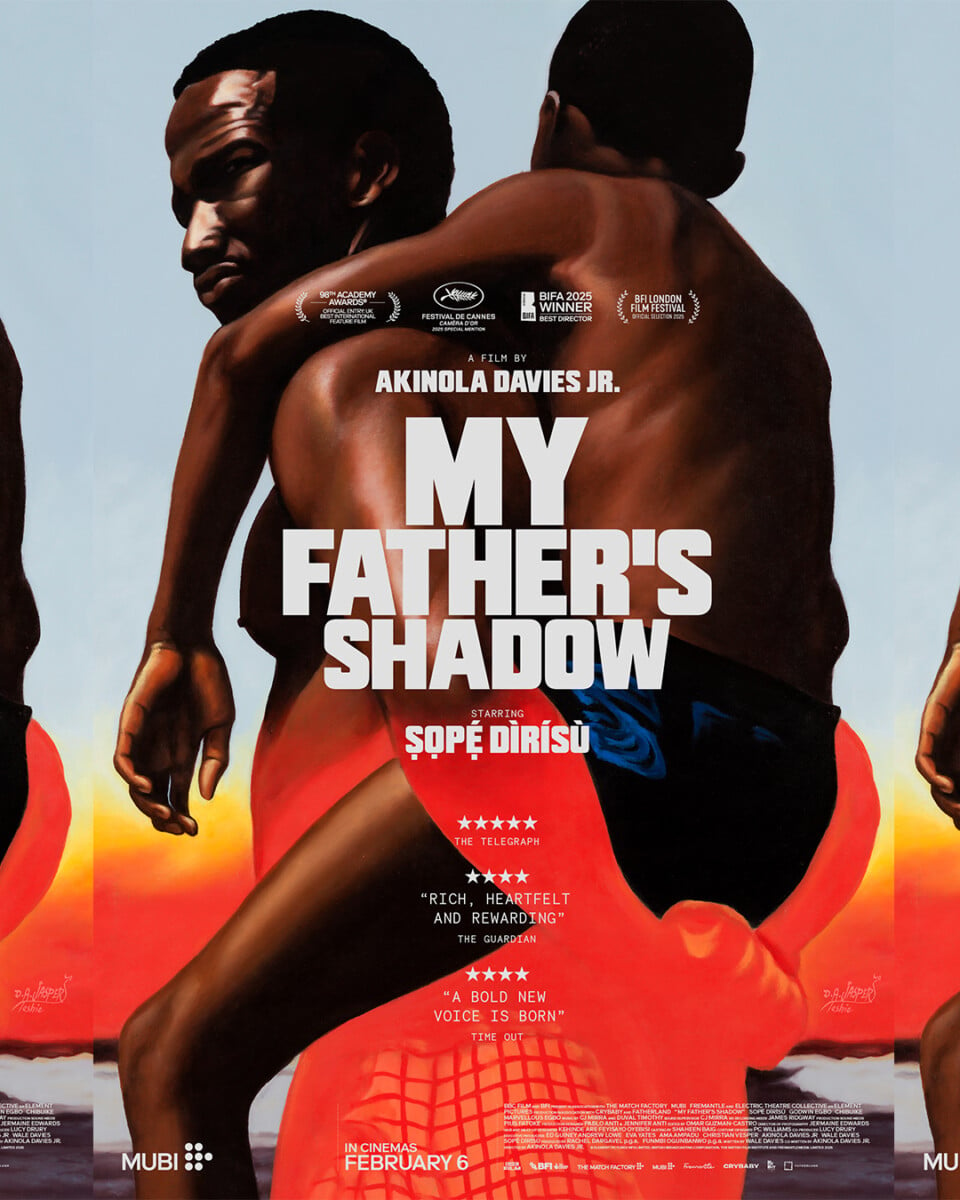
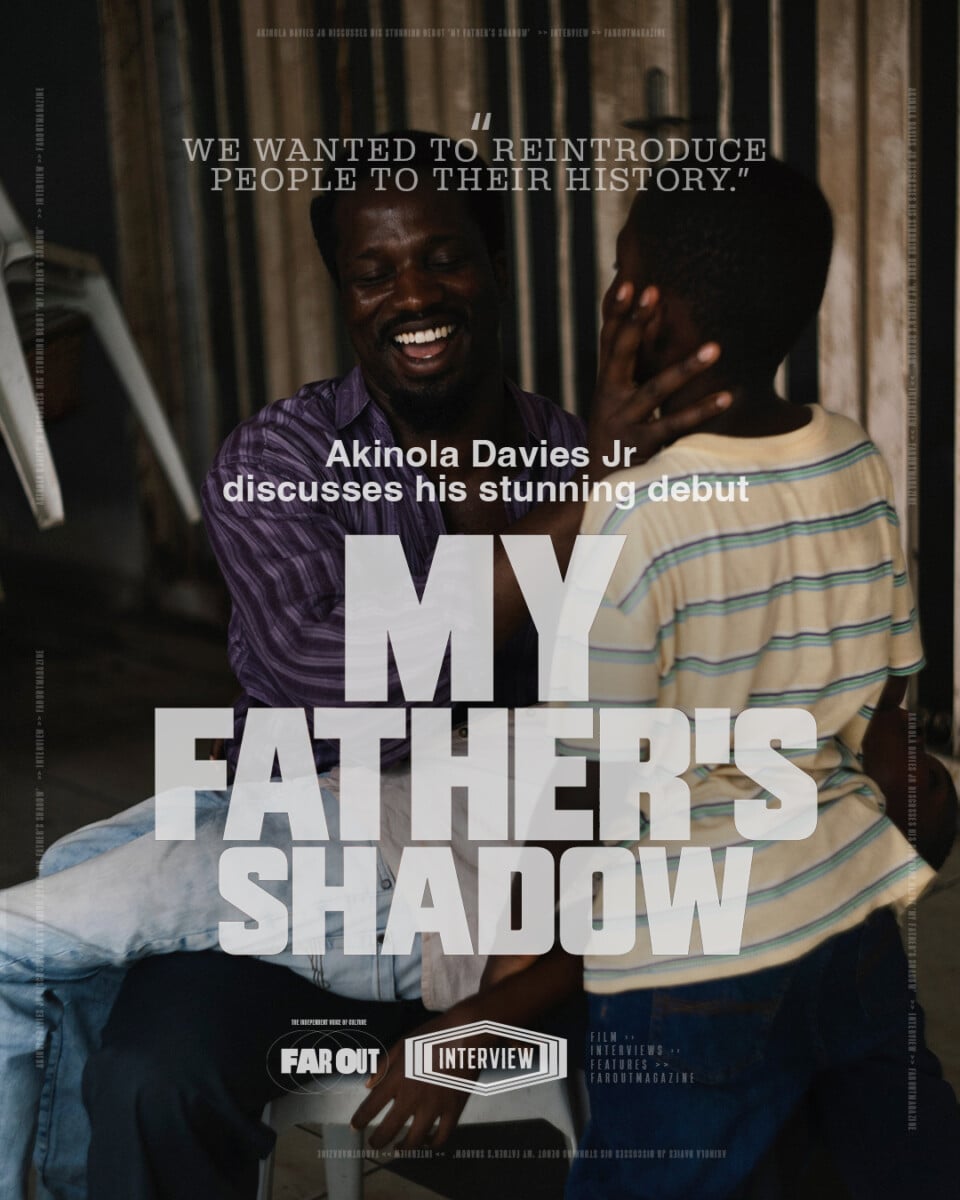
Akinola Davies Jr discusses his stunning debut ‘My Father’s Shadow’: “We wanted to reintroduce people to their history”

Great cinema often comes from the darkest depths of a filmmaker’s life, and for Akinola Davies Jr, it was the death of his father when he was a child that inspired his debut feature, My Father’s Shadow.
Written alongside his brother, Wale Davies, the film draws heavily from their personal experience, with the narrative centring around two brothers living in rural Nigeria who embark on a trip to Lagos with their father on the day of the 1993 presidential election. They learn a lot about their dad, closely observing their surroundings as chaos eventually erupts around them when it is announced that the election has been annulled. Davies blends the political and the personal here, creating a stunning depiction of a child’s exposure to the brutality of the real world.
Grief and violence intersect with innocence and tender moments of discovery and love, and unsurprisingly, the film has already scooped up some impressive accolades, like the ‘Caméra d’Or’ prize at the Cannes Film Festival. Talking to Far Out over Zoom, the director revealed how the film was initially conceived before he’d even made his award-winning 2020 short film Lizard, having first emerged in the mind of his sibling.
“My brother was working for Nigerian TV, and he had a prompt of writing a letter to a bereaved friend or family member. And I think that’s when he wrote the short version of My Father’s Shadow. And that was a long time ago. He sent it to me, and I read it and just broke down in tears, and it didn’t have everything it had in there, but it had the beach scene and the bit at the beginning,” he explained.
It might not have been the idea he had in mind for his first feature, but Davies knew that he had to make this film, noting, “With the success of Lizard, we realised we’d get to make a feature, and we really wanted it to feel like something we’d be happy to commit our time to, be a lot more introspective, and really put ourselves onto screen. We just went away and wrote a script, and it kept on evolving and evolving from there.”
It’s a hefty task to direct a film that includes a funeral sequence – one inspired by your own father’s death, no less – and Davies admits that he “pretty much just cried all weekend,” following the shooting of that emotional scene. In the end, though, the film proved to be cathartic, albeit “subconsciously”. When you’ve got a whole cast and crew to direct, there isn’t much time for catharsis, but after filming, these feelings rose to the surface.
Davies recalled, “It’s not very often you get to bury your father all over again, the edit was tough, because that’s when I realised how much I was still grieving… There’s a version of the film that I want, but I think there’s a version of the film which is what everyone has, which is the best version, which is for everyone. Those two things were in conflict for a little bit of time, but I think I was compassionately encouraged to see that side of things.”
Challenges naturally arose when Davies made the film, and he notes that there were two 360-degree shots that proved to be the biggest hurdles, yet they inevitably paid off, adding to the fluid and deeply personal visual language that My Father’s Shadow harnesses. “There’s two 360 shots in the film – one is when the dad’s like, ‘Let’s go, go get ready,’ and they’re in the room, and he’s like, ‘Why are you taking the money?’… That was a fun one, but the other one, in the car, when everything’s kicking off, and there’s a burning car, was my favourite to shoot, I mean, I don’t want to say no one believed, but no one believed we could do it, you know?”
Davies added, “I was like, ‘No, I have a vision of the shot… I think we should do it like this, and they were like, ‘Oh, it’s going to be really hard because you’re dealing with choreography, you’re dealing with light, we can’t have the car burning for so long, it’s a health hazard,’ we only had four takes on that, and we were losing light, and every time it just looked better and better. So, I was just really happy about that. I stuck to my guns on that one.”
Other techniques that become prominent features of the film are close-up shots and an emphasis on gaze, with Davies telling me that he is “one of those firm believers that the human face is probably the most interesting thing.” By focusing on the minute details of a person’s expressions, we’re able to understand the film from a child’s perspective, because so much of being young and trying to navigate the world involves silently observing.
Davies explains, “I think the way we communicate is completely so dynamic and unique. Obviously, you can speak with words and you can speak in metaphor, but there’s a lot of unspoken conversation being had through body language, through expression, through face. And I think there’s nowhere – at least to my understanding – more prevalent than that in a sort of Nigerian context, where people completely express everything they feel with their face. They’re not trying to hide anything. As a kid, you remember the uncle who had whiskers on his ear, and you make them larger than life. I think we wanted to stay really close to people’s faces, because we felt those faces had so much story in them.”
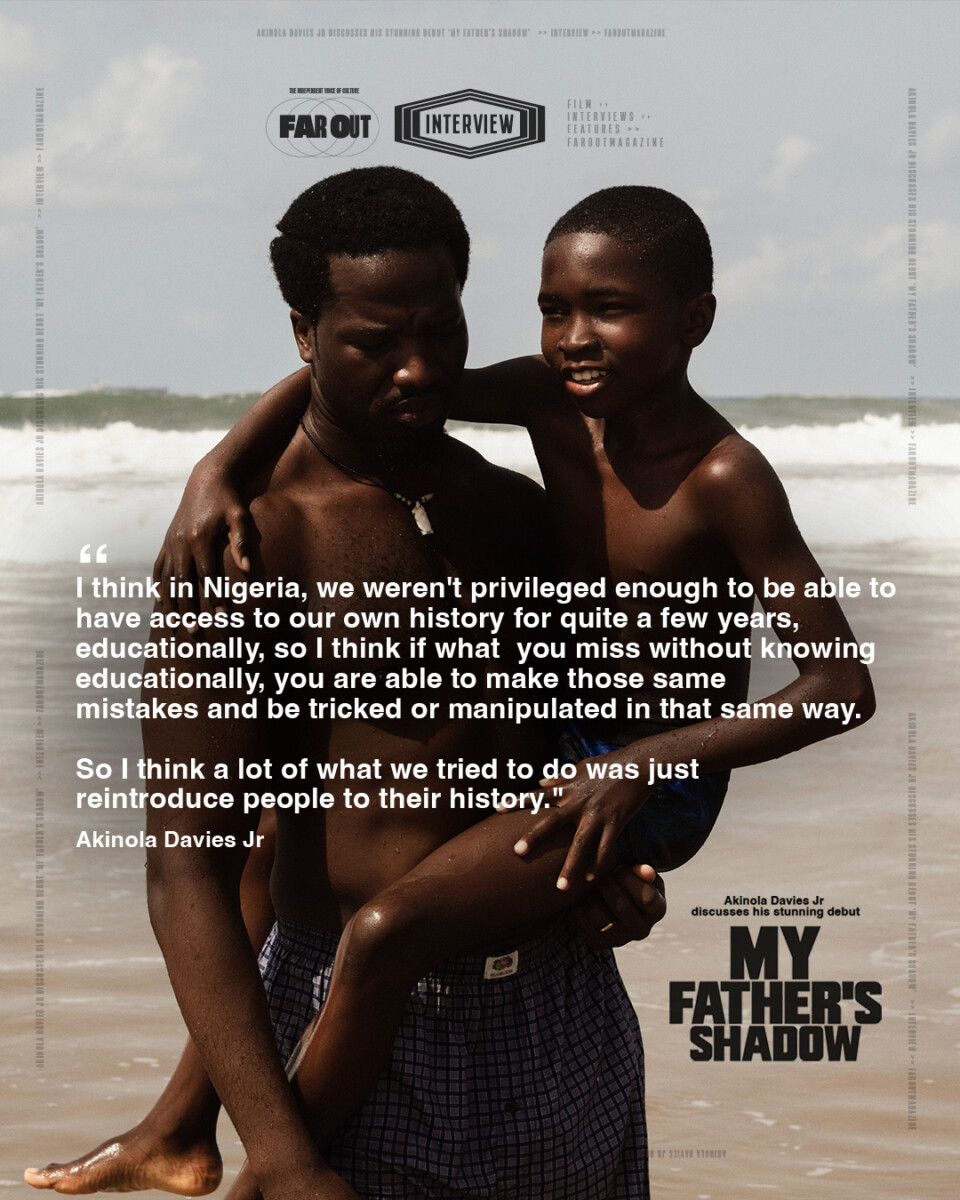
So, while the film feels deeply personal, Davies also wants the political aspect to reach those who might not be familiar with this moment in history, as the director explains, “I think in Nigeria, we weren’t privileged enough to be able to have access to our own history for quite a few years, educationally, so I think if what you miss without knowing educationally, you are able to make those same mistakes and be tricked or manipulated in that same way. So I think a lot of what we tried to do was just reintroduce people to their history.”
At the same time, there’s a timelessness to the film’s depiction of themes like grief and masculinity, which Davies wanted to explore with “nuance.” He tells me, “I think at this point in our modern zeitgeist, trying to have a more contextual and nuanced conversation about a certain type of masculinity is important because maybe in generations past, it has been a lot more difficult to express those.
Davies elaborated, “I think sometimes, with an absent parent, it feels like there’s a necessity for neglect, but actually, there’s more nuance in understanding that an absent parent is maybe absent because of this idea of obligation and providing. And sometimes nuance and context aren’t quite explicit on screen, especially in the zeitgeist of conversations around an absent black father. So, we wanted to use art to try and challenge that and give a representation of that while still holding that accountable to a certain level.”
My Father’s Shadow is truly a gorgeous debut that balances an intricate and introspective perspective with careful depictions of a tense political climate that still feels woefully relevant today, and with movies like Mustang, Capernaum, and Shoplifters setting the tone for Davies’ decision to make such a poignant and deeply human film, there’s no doubt that his next project will be just as special. For now, though, he’s still basking in the success of his debut, which he admits is such a privilege to have been able to make. “All of these things, I really don’t take for granted.”
My Father’s Shadow is in cinemas from February 6th.