


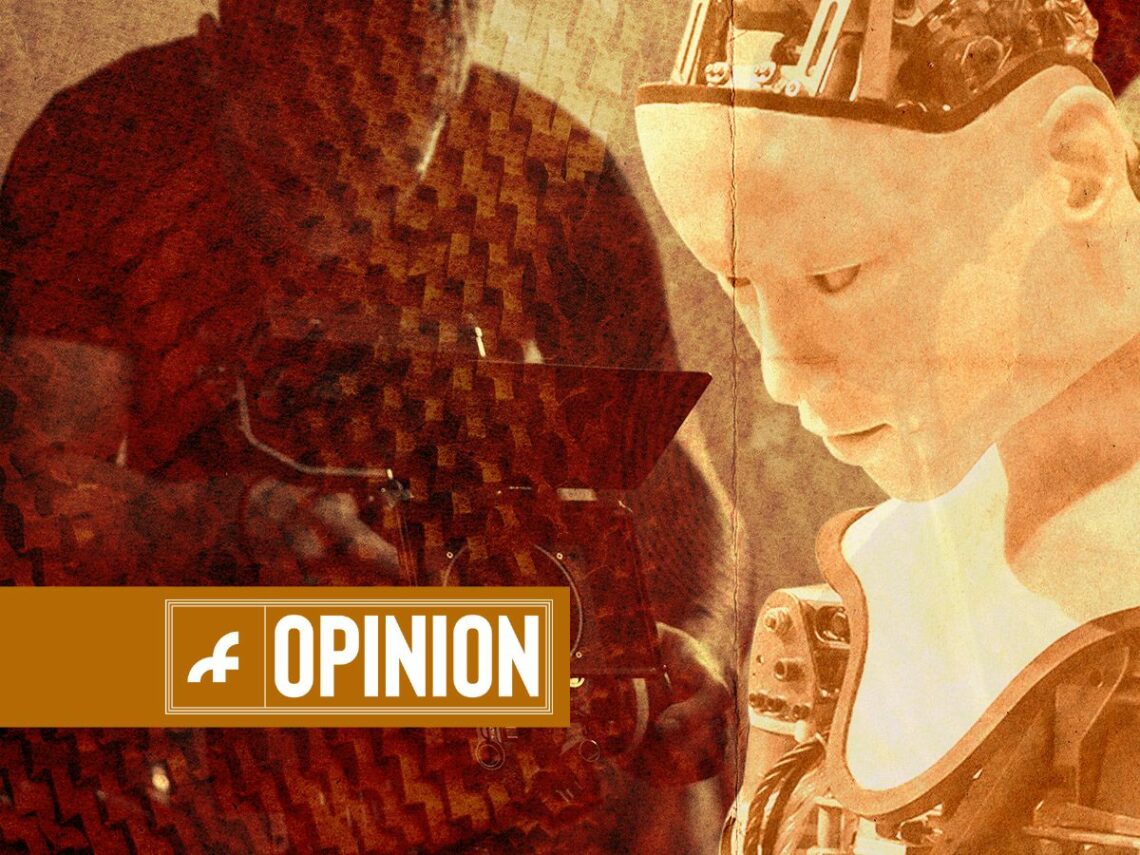
Are AI-written scripts the future of filmmaking?

In the 1960s, we were told that robots would make our lives easier. They were supposed to do all the cleaning and shopping, make our breakfast, and take out the bins. The idea was that, with these menial activities already taken care of, we’d be free to pursue our creative endeavours uninterrupted. Now, it looks like AI will be doing the creative stuff, and we’ll be doing…. well, exactly.
It’s becoming increasingly apparent that the possibilities of AI extend far beyond what any of us imagined. And it’s all down to AI software like ChatGPT. In February 2023, hundreds of books written by Chat GPT appeared on Amazon as users sought to cash in on generative artificial intelligence. Tired of books written by human authors? Why not try The star weaver’s lesson: Magical bedtime story or Make more money with ChatGPT. And it’s not just novelists who are worried. AI can be trained to make art, compose music, generate online content and even write screenplays.
The most frequent criticism of AI art is that it feels hollow, but some of it is worryingly good. The industries most at risk of being usurped by AI are what I’ll call non-charismatic industries. Examples of charismatic industry creatives include actors and popular musicians: performers whose visible humanity is essential to their success. Non-charismatic creatives include journalists, novelists, visual artists, poets and the like: people whose work represents who they are and what they’re interested in.
That puts screenwriters directly in the firing line, especially those working in writer’s rooms. Thousands of scripts have already been written and directed using ChatGPT. In January 2023, for example, Keith Schofield, a filmmaker known for directing music videos for The Ting Tings, Charlotte Gainsbourg and Death Cab For A Cutie, tweeted stills from a 1985 AI-generated David Cronenberg film called Galaxy of Flesh. He also sounded the alarm on the little-known Federico Fellini adaptation of Pac-Man, Michel Gondry’s take on Hellraiser and another ’80s action film called Chrome Lords – “a shameless ripoff of Terminator and Robocop“.
But it isn’t genre-mixing that’s making so many writers so nervous; it’s the fact that AI software can be used collaboratively. This allows directors to create plot ideas, narrative arcs and character motivations with ease, whittling months of work down to a single hour in some cases. In 2022 AI entrepreneur Aaron Kemmer revealed that he’s used “ChatGPT to WRITE and DIRECT a film in a weekend,” with the software producing “nearly 50 scripts for us in 1 hour”.
All Kemmer needed to do was give the bot a plotline like this: “Write a scene from a play starring a New York Times journalist and a Silicon Valley tech entrepreneur. They are arguing about free speech, and each passionately asserts the view associated with his profession and social circle.” He was then given 50 pages of finely-tuned dialogue that not only revealed aspects of the characters but also furthered the plot. Kemmer then requested a shot list from the bot, making it the defacto director for the short film. It gave him 18 different camera shots, which Kemmer then sent to his cinematographer for review.
From there, Kemmer worked with real-life creatives to bring the project to life, cutting out the need for writers. “I could easily see AI leading to personalised movies,” he concluded in a tweet, “where you can see any variation of any film you’ve ever wanted. Watch Tom Cruise play as Iron Man battling Darth Vader … or an infinite number (of) ideas.”
So where does this leave writers? It’s hard to say, but AI looks set to completely alter the writer’s role, with scriptwriters becoming more like operatives than actual creatives. Editors will probably stay pretty safe, and it will be their role to add a touch of humanity to the first drafts of AI-generated scripts, thus making it much harder to distinguish the difference between AI and human-generated narratives.
But there’s another way of looking at all of this, which is that AI will force us to evolve our understanding of creativity. For the last few decades, the act of creation has become less about inventing something wholly new and more about patching together pre-existing influences. It’s picking over the bones of a century of creation in a desperate effort to make something valuable. AI can do that with much more efficiency than any human. What it can’t do is develop its own understanding of what art is and what the function of the creative should be. That’s still up to us, and it will be an incredibly important question as AI becomes more and more pervasive.
