


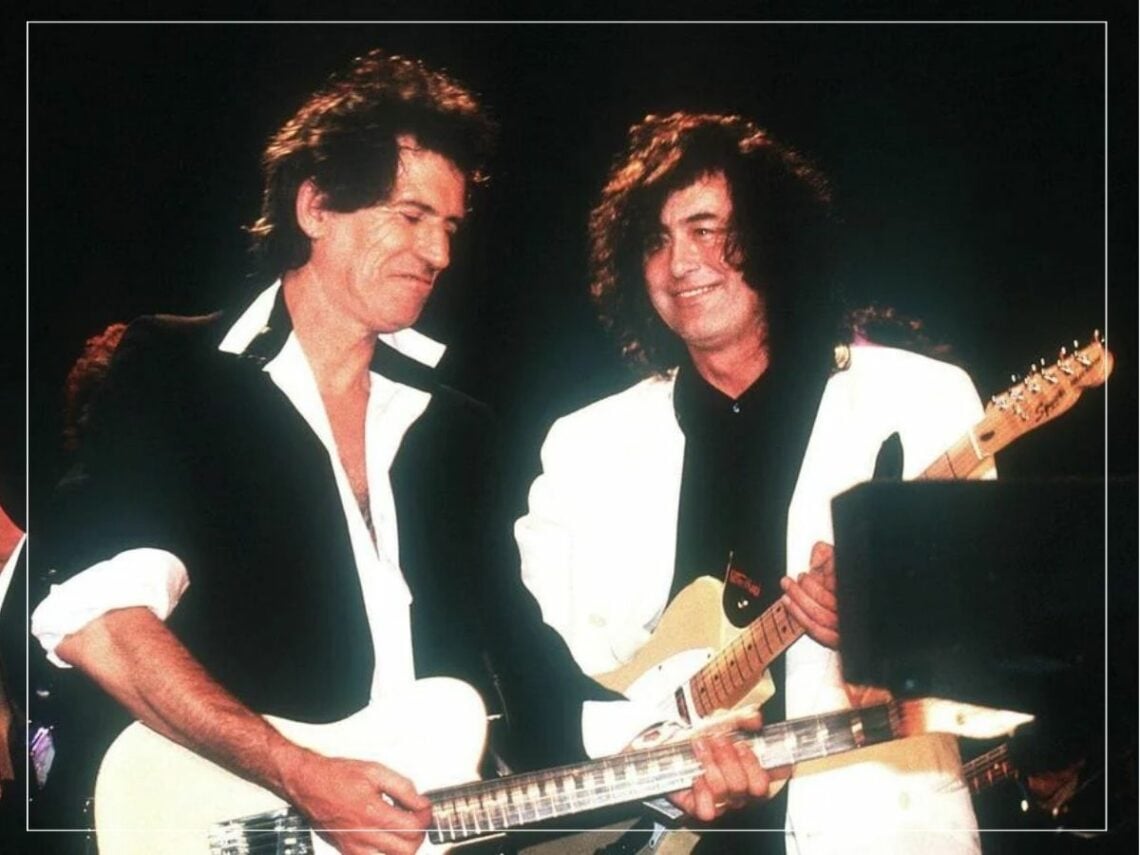
The three words of Keith Richards’ advice Jimmy Page ignored in 1977: “Quite amusing”

Few people are better placed in the music industry to give advice than Keith Richards.
Throughout his many decades in the rock world, Richards has witnessed it all, whether it is how to put on an iconic show at Wembley Stadium or dealing with the dark side of success. Most importantly, he’s also a guitarist of the highest calibre with a fluency of the blues that few can comprehend.
Since his grandad handed him his first guitar as a child, Richards knew it was his destiny. An unexpected encounter with his estranged childhood friend, Mick Jagger, at a train station was another pivotal moment in his journey to becoming a guitar hero. With The Rolling Stones, Richards has been the architect of countless riffs that are ingrained in the minds of the masses and has picked up all of the tricks of the trade.
That experience also gave Richards a uniquely practical perspective on live performance. Having spent years refining songs both in the studio and on stage, he understood the gap that can sometimes exist between a meticulously layered recording and what can realistically be reproduced in front of an audience. For Richards, part of being a great band was knowing how to bridge that gap without losing the essence of the song.
It’s this mindset that often informed his opinions on other groups. Rather than focusing purely on technical ability or studio innovation, Richards tended to value feel, groove, and cohesion above all else. In his view, the strongest performances weren’t necessarily the most complex, but the ones that translated most effectively in a live setting, where the connection between band and audience mattered more than perfection.

Before The Rolling Stones became world famous, Richards became aware of Jimmy Page. At this early stage, Page had yet to form Led Zeppelin, but his talent was evident for all to admire. In 2020, The Rolling Stones finally released ‘Scarlet’, a long-lost collaboration with Page, initially recorded in 1974. Twelve years later, Page was recruited by The Rolling Stones again to contribute to ‘One Hit (To The Body)’.
At the time of both recordings, Page was a world-famous guitarist. However, the opportunity to create magic in the studio with his old friends was too irresistible to turn down. Despite every putdown Richards has made against Led Zeppelin over the years, he views Page as a great, and the love is reciprocal.

Even when Richards speaks negatively about Led Zeppelin, he always compliments Page, once saying, “To me, Led Zeppelin is Jimmy Page if you wanna cut the story short.”
On another occasion, he divulged, “As a band, I felt aptly named, it never took off for me musically. At the same time, Jimmy Page is one of the best guitar players I’ve ever known. Bonham was a hell of a powerhouse drummer, although I think he’s kind of heavy-handed, myself — that’s when the ‘Led’ comes in.”
In his spare time, Richards is unlikely to listen to Led Zeppelin. Nevertheless, he attended many of their concerts purely to gaze at Page in all of his glory. While he enjoyed seeing him perform, the Stones guitarist believed Led Zeppelin shows would be bolstered if they listened to his piece of advice.
Due to the complex nature of their studio recordings, the band had certain songs in their arsenal that they couldn’t play live. As a result of this, Richards told him a simple way to circumvent the problem, yet it fell on deaf ears. “Then it becomes a challenge, a tough challenge in some cases,” Page told Trouser Press in 1977. “‘Achilles’ is the classic one. When Ronnie Wood and Keith Richards came to hear us play, Keith said, ‘You ought to get another guitarist; you’re rapidly becoming known as the most overworked guitarist in the business.'”
He added, “Quite amusing. There are times when I’d just love to get another guitarist on, but it just wouldn’t look right to the audience.”
Recruiting a second guitarist is a decision that almost every other band would make if they were in Led Zeppelin’s position. It offered up a simple way to relieve pressure from Page, liberate him during live performances to showboat and enhance their sound. However, in his stubborn eyes, the band was himself, Robert Plant, John Bonham, and John Paul Jones, and it would be cheating to bring somebody else in to do the dog work.
While reducing his workload would have made his life easier, Page didn’t want to dilute the image of Led Zeppelin in the eyes of the audience. Although most wouldn’t feel short-changed by the addition of a touring guitarist, it wasn’t a risk that Page was willing to take. Instead, he preferred to take on the monumental task of two musicians, which is a mindset that propelled him to greatness.

Never Miss A Beat
The Far Out Led Zeppelin Newsletter
All the latest stories about Led Zeppelin from the independent voice of culture.
Straight to your inbox.