


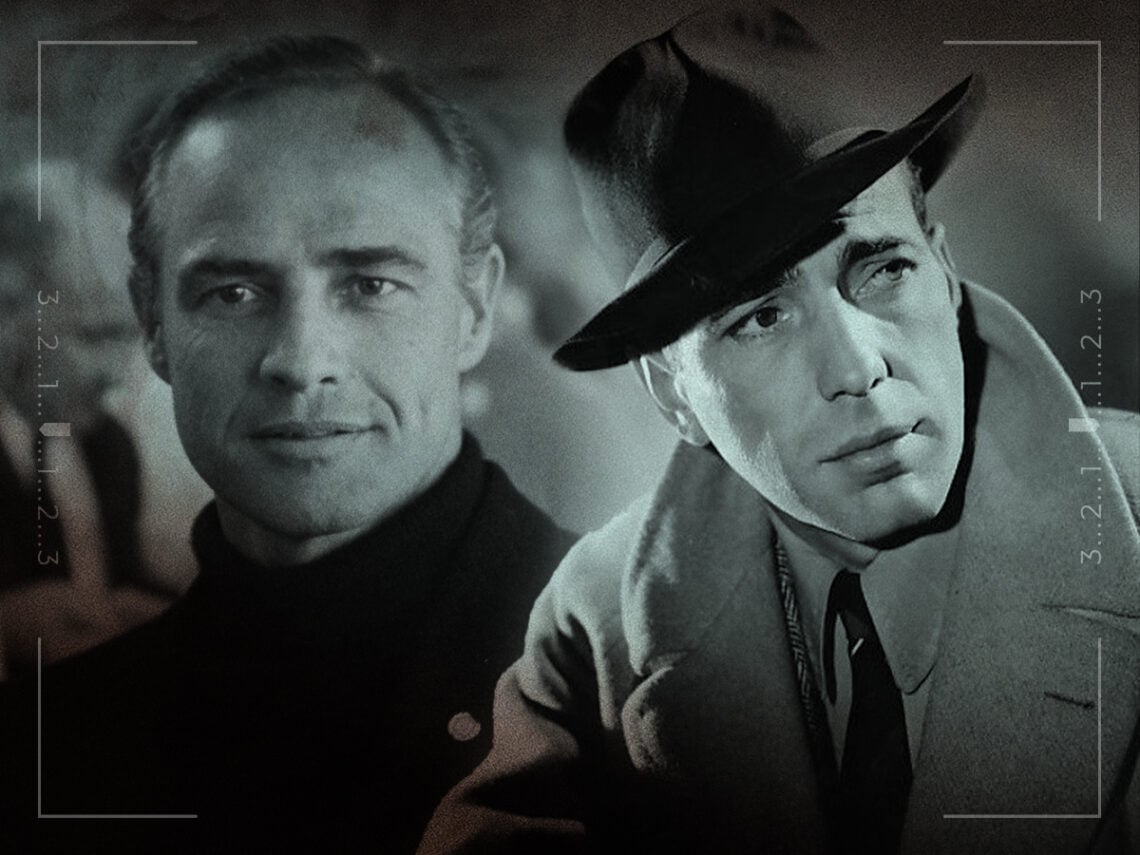
“The town drooled over him”: Humphrey Bogart wasn’t convinced by Marlon Brando

When Humphrey Bogart was born, narrative cinema was still in its infancy, and when he decided to become an actor, it was theatre that first took his fancy, making his Broadway debut in 1922.
He would then transition to feature films in 1930, just as talkies became the new trend, and it didn’t take long for him to become an icon of the silver screen, his ascent coming at a perfect time. Roles across the ‘30s built momentum for the actor, who then delivered a string of unforgettable performances across the following decade in some absolute classics, from The Maltese Falcon and The Big Sleep to Casablanca.
Take one look at a still from a Bogart movie and his appeal as an indelible star instantly becomes clear, exuding mystique and a smouldering power that made him the ideal leading man, standing suave and classic, usually pictured with a cigarette in his hand, smoke swirling around him like he had just materialised as this enigmatic noirish figure. He never had any training but simply took to the stage after his military service, proving to be quite the natural star.
Thus, when a new crop of actors emerged a few decades later, he couldn’t help but find himself confused by how Hollywood’s standards had changed, once saying, as noted in Tough Without a Gun: The Life and Extraordinary Life of Humphrey Bogart by Stefan Kanfer, “I came out here with one suit, and everybody said I looked like a bum. 20 years later, Marlon Brando came out with only a sweatshirt, and the town drooled over him. That shows how much Hollywood has progressed.”
Brando rose to acclaim when he appeared in A Streetcar Named Desire in 1951, playing the brutish Stanley Kowalski, and having already played the role on stage, he soon became a star of the silver screen, his training under the direction of Stella Adler helping him to master the kind of skill that instantly had him labelled one of the decade’s most vital, captivating figures.
His time training at the Actors Studio also proved to be transformative, and he came to adopt a controversial style of method acting, totally embodying his characters and delivering powerful performances as a result. With titles like On the Waterfront, The Wild One, and Julius Caesar, the ‘50s catapulted Brando to a level of stardom that was unprecedented, and he became more than just an actor but a cultural symbol, a figure of rebellion and a new era for cinema and young people.
While many people fawned over the star, Bogart wasn’t as convinced, and while he could recognise his talent (anyone who couldn’t was just stupid), he didn’t like the way Brando presented himself, finding him a little too mumbly and a little too influenced by his extensive training, which the former simply wasn’t familiar with.
“I think Marlon Brando is one of the best young actors in the business, and I think he’ll be great as soon as he gets that potato out of his mouth,” he said, “These Actors Studio types, they mumble their lines. I can’t hear their words. I miss the cues. This scratch-your-ass-and-mumble school of acting doesn’t please me.”
So, while Bogart could sense that Brando had real potential, he just wished he’d enunciate more, and he wasn’t the only person who had this same complaint about the actor. As his career went on, he mumbled on more and more, and the Oscar-winner ended up delivering some performances that certainly weren’t all that clear.
