


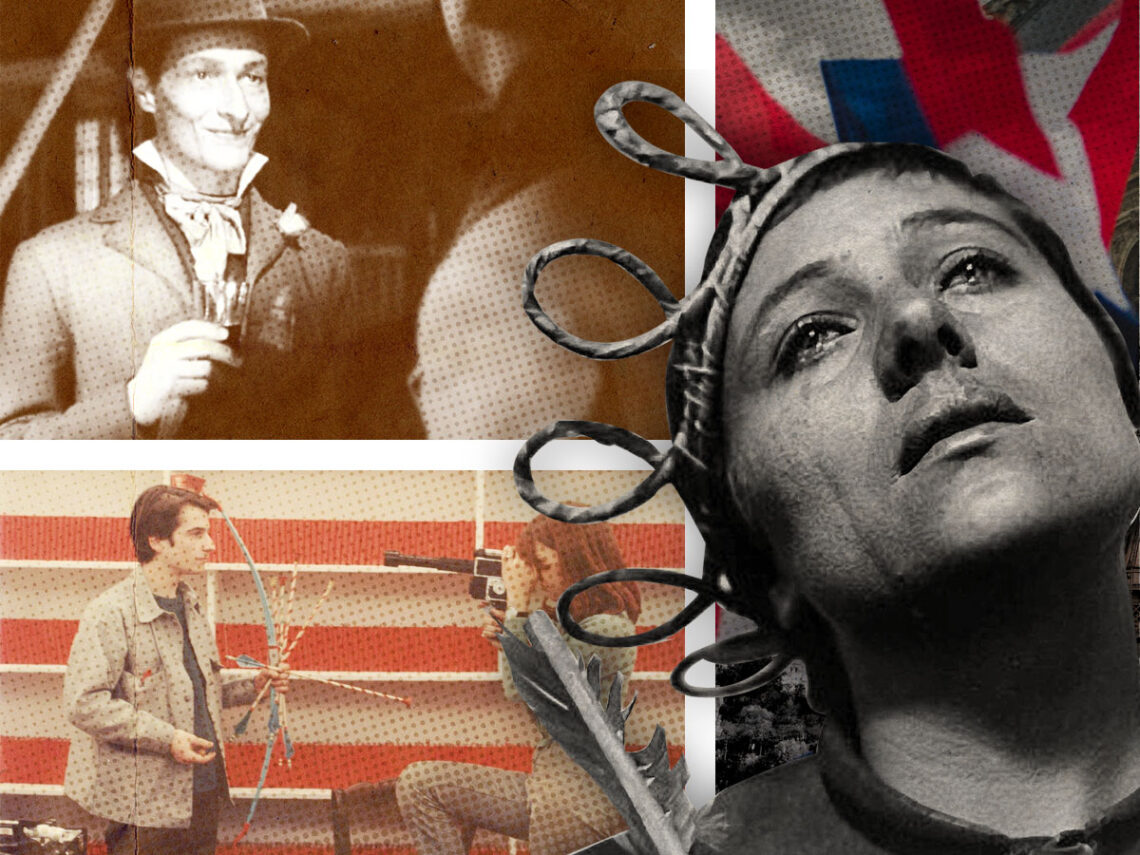
A history of France in five films

Before we start, I should first apologise to our American readers because I’m about to say something you’ll find rather disconcerting. Though the subject is up for debate, I’m going to nail my colours to the flag and argue that France is the birthplace of cinema. That being the case, what better way to explore the history of the nation than through film?
France has long used cinema to investigate its past, present and future – treating the camera as a sort of sociocultural mirror. As a result, movies like The Passion of Joan of Arc offer us a window into how the French perceive themselves, how they are perceived by others, and how contextual factors influence those perceptions.
Many are resistant to the idea of films being used to teach people about history – and for good reason. Any fan of American westerns will know that countries tend to use cinema as a way of confirming their national identities. Of course, a film can also be used to investigate and deconstruct those identities, something that is becoming increasingly commonplace.
In this list, we’ll be taking a hop, skip and jump through the history of France in five key films, from the medieval era right up to the 1960s.
A history of France in five films:
The Passion of Joan of Arc (Carl Theodor Dreyer, 1927)
There have been many films about Joan of Arc, but perhaps the greatest depiction of the ill-fated French warrior is Carl Theodor Dreyer’s The Passion of Joan of Arc. While French nationalists were a little uneasy about a Danish filmmaker handling the cinematic treatment of one of their country’s legendary icons, Dreyer’s film is today regarded as one of the most transcendent evocations of humanity’s relationship to the divine.
We could easily have selected Jacques Rivette’s Jeanne La Pucelle, which, with its austere cinematography – truly captures the brutality of medieval Europe. That being said, there’s something so wonderfully neat about one of cinema’s earliest epics being about one of France’s first national heroes. Yes, Charlamagne is certainly worth mentioning, but Joan was one of the first figures to truly crystallise French national identity. She remains an important foundational figure to this day, sitting alongside Liberty as one of the many powerful female allegories that dominate French culture.
Ridicule (Patrice Leconte, 1996)
One of the greatest historical films of all time, Patrice Leconte’s Ridicule is a witty, dramatic comedy set at the court of Versailles during the reign of Louis XI. Our protagonist is not the king but a young nobleman called Grégoire Ponceludon de Malavoy, who travels to Versaille to gain permission to drain the marshes of his home region.
He soon discovers that gaining an audience with the king isn’t as simple as striding in. He must “be witty, sharp, and malicious,” to impress the king’s courtiers and catch the monarch’s eye. As Grégoire is sucked into this war of wit and words, he begins losing sight of his original intention. Rude, beautifully shot and utterly immersive, few films capture the rituals of Versaille quite like Ridicule.
Napoléon (Abel Gance, 1927)
If you thought the last Lord of The Rings was a touch long, just wait until you see this five-and-a-half-hour silent film from Abel Gance. Released in 1927, Napoléon is just a fragment of the six-part epic the director intended to make. Sadly, he was unable to trace the entire life of the French military commander, Emporer and eventual exile because he blew the entirety of his budget on the first instalment. Classic.
That Napoléon is just a portion of what Gance hoped to achieve is a huge part of its charm. We are introduced to Napoleon as he overcomes his rivals and moves towards his destiny as emperor of post-revolutionary France. What we don’t see is what comes afterwards: his fall from grace and exile to the island of Saint Helena. As innovative and technically daring now as it was in 1927, Napoléon truly is unlike anything else. No wonder Stanley Kubrick called it “a masterpiece”.
Les Enfants du Paradis (Marcel Carne, 1943-1945)
Made under the German occupation and released at the time of the liberation, Les Enfants du Paradis looks back to the Paris of Balzac in an attempt to escape the harsh reality of a city torn apart by war. It takes place in the 1830s and centres on the occupants of Paris’s Boulevard du Crime – named not for its illicit reputation but for the number of theatres showing gory melodramas.
A mesmerising celebration of Paris’ theatre scene, the ‘Paradis’ of the title refers to the second balcony in a theatre, from where ordinary Parisians would heckle, laugh and bring atmosphere to performances. It tells the story of a beautiful courtesan and the four men – one mime, one actor, one criminal and an aristocrat – who love her. Marlon Brando once called it the best film ever made – and for good reason. Watching Les Enfant du Paradis is like stepping into a dizzying kaleidoscope of Parisian history.
La Chinoise (Jean-Luc Godard, 1967)
Released shortly before the tumultuous spring of 1968, this highly prophetic film tells the story of a group of bourgeoise French students who decide to form a Maoist commune in a grand Parisian apartment. Colourful, energetic and darkly comic, Godard’s film is essentially a selection of readings from Mao’s Little Red Book set to a soundtrack of ’60s pop.
Perhaps the most fascinating this about this particular offering is its ambiguity. While Godard makes a concerted effort to uphold his image as a progressive anti-reactionary, it’s never quite clear whose side he’s on and if these students are meant to be laughed at. It is, after all, based on Dostoyevsky’s anti-Leninist novel Demons. In most cases, Godard is everything all at once.
