


From Ava DuVernay to Raoul Peck: A decade of race on film

“Film is carrying a lot of ideology. It’s carrying an image. It’s forging an image not only of the rest of the world, but also of yourself, you know.” – Raoul Peck
Serious issues of race and racial injustice have been very much in the public eye in the past decade, including in popular film. While successful, big-budget films like Selma, BlackKklansman, Ava DuVernay’s brilliant 13th, Green Book, or Get Out have had tremendous impact, many lesser known films have also sent a very effective message.
“Racism is when you have laws set up, systematically put in a way to keep people from advancing, to stop the advancement of a people,” Spike Lee, one of the leading lights of Hollywood, a figure who has been actively vocal in his fight for equality and fair representation within Hollywood, once said. “Black people have never had the power to enforce racism, and so this is something that white America is going to have to work out themselves. If they decide they want to stop it, curtail it, or to do the right thing…then it will be done, but not until then.”
With Lee’s words echoing in our ears, here are a few of the more noteworthy, year by year.
2011
The Black Power Mixtape 1967 – 1975 (Göran Olsson)
In the 1960s, Sweden experienced a surge of interest in American Civil Rights activism, and a great deal of black-and-white television footage was produced documenting the phenomenon and interviewing key figures. Most of it was never used. Years later, Swedish documentary filmmaker Göran Olsson gathered the material and painstakingly edited it into a feature-length documentary. While beginning with the disclaimer that it does not attempt to portray the entire Black Power Movement, but “only show how It was perceived by certain Swedish filmmakers,” the film is a powerful overview that does not sacrifice intensity to objectivity.
Olsson pieces together interviews, news-style footage, and candid glimpses of key figures, along with pertinent quotes, and effective bits of voice-over narration and carefully chosen music, to present a fascinating summary of ten years of civil rights work and the people involved. Events are shown in chronological order, including both peaceful and militant leaders and organisations, significant race-related prison riots and public actions, and the backlash and often hostile response of police agencies, particularly the FBI under its notoriously racist former director, J Edgar Hoover.
Olsson’s deft management of the massive supply of material turns a hodgepodge of data into a clear, well-organised story that pulls the viewer into the hopeful turmoil of the era. It continues into the official suppression of the movement, including the deliberate spread of libellous rumours about many of its leading figures, and having them routinely arrested on false charges.
An intense and eloquent prison interview with civil rights leader Angela Davis marks the point where, in the filmmaker’s view, the movement began to decline. As the film moves through the early 1970s, it presents with great poignancy the failures of the movement and its suppression by the FBI, the disastrous effects of drugs introduced (purportedly by design) into Black neighbourhoods, the resulting increase in Black incarceration and further decline of their communities, the endless frustration of justice campaigns. The film concludes with a sense of desperation and futility, only partly offset by voice-over commentary by contemporary activists acknowledging the impact of earlier civil rights leaders.
2012
Free Angela and All Political Prisoners (Shola Lynch)
In a year where this category was dominated by Quentin Tarantino’s Django Unchained, screenwriter/director Shola Lynch produced a remarkable, award-winning documentary on philosophy professor and civil rights leader Angela Davis, once a member of the FBI’s notorious ‘Ten Most Wanted’ list. Lynch describes becoming fascinated by accounts of Angela Davis’ trial, describing it as “a political crime drama with a love story in the middle of it.” She prepared for the project by reading Davis’ autobiography but says that the most intriguing information came when she began speaking with Davis’ former associates. Lynch places Davis in the context of an era when hopes were high for imminent racial justice, and “young people at that time thought the revolution was around the corner.” How, Lynch mused, do you make that clear to a contemporary audience? This is what Lynch attempts to do in her portrayal of Angela Davis and the movement of which she was a leading figure.
The film focuses mainly on Davis’ more high-profile actions during the height of the civil rights movement, including her vilification by authorities, her fugitive period following charges of aiding a prison escape, her eventual arrest, and especially her 1972 trial. Davis’ legal case and ultimate not guilty verdict are central to the film, but her personal approach to racial justice and her impact on the US civil rights movement are also well documented. Lynch emphasises that the ingrained unfairness of the US legal and prison system were crucial to understanding Davis and her place in US history. Although criticised by some for Lynch’s perceived glossing over of Davis’ possible criminal activity, the film is a thorough, detailed documentary, mixing archival footage with both historic and contemporary interviews with Davis.
2013
Fruitvale Station (Ryan Coogler)
This debut feature by director Ryan Coogler (who went on to direct Creed and Black Panther) is based on actual events. Michael B Jordan plays Oscar Grant, a young Black man whose shooting death by police officers in 2008 caused an upheaval in his California community. Rather than concentrate on Grant’s fatal encounter with police, the film takes us through the homely details of his last day on earth, showing him as an imperfect but essentially good and well-intentioned man, revealing his concerns as a parent and his modest hopes for bettering himself.
The racial tensions and inherent discrimination that lead to his death are not over-dramatised, but revealed quietly and with great subtlety, a constant threat that is all but ignored as part of the landscape. Coogler’s understated portrayal humanises the victim, and shows the needlessness of his death, far better than a more sensational approach might have done; and performances by Jordan and Octavia Spencer bring the film to a higher level.
2014
Dear White People (Justin Simien)
Justin Simien’s unusual social satire deals with more personal issues relating to race, not necessarily dire or life-threatening but still serious. The story follows a group of Black students at an upscale American university that is recently, and rather uncomfortably, integrated. The ensemble cast represents a wide and surprising variety of conflicts, both personal and bureaucratic, beginning with the entertainingly outspoken campus radio host Samantha (Tessa Thompson) whose activism is a thorn in the side of school administration and conservative White students alike, and whose radio tagline provides the film’s title.
As each character struggles with issues of identity and ethics, the film lampoons the ridiculous or hypocritical in every attitude or point of view, sparing no one, not even the apparent heroes. The story, and the campus rivalries, all come to a head when the institution’s mostly veiled racism is exposed at a public event – one which is based on actual university events across the US, as glimpsed during the final credits. Dear White People was publicised through a series of satiric trailers which add content and commentary, and became popular in themselves. (It was later developed as a television series under the same title, which unfortunately did not live up to the film’s precedent.) A thoughtful and funny look at the confrontations and dilemmas faced by young racialised people, even the comparatively fortunate portrayed here.
2015
Dope (Rick Famuyiwa)
Rick Famuyiwa’s Dope is set in a tough Los Angeles neighbourhood with parallels to the one in Straight Outta Compton, but with a very different perspective and a cast of characters, as well as a sharp and ironic sense of humour. It is essentially a coming of age story, centred on young Malcolm (Shameik Moore), a nerdy intellectual growing up in a neighbourhood full of gangs and drug dealers. His dearest wish is to get into a good university and achieve an excellent education, something that often seems out of reach.
Over the course of a chaotic few days, bad luck and bad choices lead Malcolm and his friends into potential trouble, threatening to drag Malcolm into the fate painfully typical of young men in his community. In a satiric twist, Malcolm deviously finds a way to use his dire circumstances to achieve his goals, and to finally be himself, by consciously and rather cynically using conventional racial stereotypes to his advantage.
2016
I Am Not Your Negro – Raoul Peck
The late James Baldwin, the author of The Fire Next Time and Notes of a Native Son, was one of the most brilliant and influential American writers on race and justice. Raoul Peck’s documentary, I Am Not Your Negro, is based on his last, unfinished book, Remember This House, an account of the assassinations of multiple civil rights leaders of his acquaintance: Medgar Evers, Martin Luther King, and Malcolm X. The film mainly provides an overview of Baldwin’s deeply thoughtful views on race and racism, sharing some of the most considered and well aimed assessments of the issue ever produced.
At the film’s premiere at the Toronto Film Festival, writer and professor George Elliot Clark called Baldwin’s words “deathless” and “relentlessly relevant” because “although the author has been gone for almost 30 years… the underlying social, political, cultural, psychological issues he dealt with are still very much with us.” The film alternates between Baldwin in interviews or speaking engagements, and voice-over passages from Baldwin’s books accompanied by appropriate historic footage, carefully selected to illustrate and further the author’s message. Actor Samuel L Jackson narrates, in an intimate tone of voice seldom heard in his film roles, which adds a great deal to the production; and a well chosen musical score increases the impact as well.
2017
Whose Streets? (Sabaah Folayan)
When unarmed teenager Michael Brown is killed by police in 2014 following a jaywalking accusation, longstanding racial tensions erupt in massive public demonstrations in his home city of St Louis, Missouri, marking an upswing in reaction to official violence against African-Americans, one that has spread worldwide. What begins as a combination of vigil and demonstration expands into more pointed protests against discrimination and police violence, which authorities respond to by sending in the US National Guard, armed with battlefield weaponry, all of it captured on video. This is the situation that co-directors Sabaah Folayan and Damon Davis explore in this dynamic, emotional documentary.
Even beyond the obvious conflicts, the directors point out in a statement at the film’s release, is the significance of the media coverage given this type of situation. Michael Brown, although a well regarded young man in his community and a good student bound for university, was often referred to in news reports as a criminal, a suspect, or even a thug, a great deal of attention given to an earlier shoplifting incident. The directors’ statement continues, “The dehumanisation of Mike Brown was perpetrated by his murderer, perpetuated by the media, and reinforced by violent police repression of his community. This was a modern day lynching.” They add the warning that “how we are portrayed in the media encourages both conscious and unconscious racial bias.” Therefore, the film does not purport to be completely unbiased; it is claiming the right to re-tell the story that has, in the filmmakers’ view, been co-opted, but this time to tell it from the point of view of fellow Black Americans and activists, and to call for accountability.
Marshall (Reginald Hudlin)
Chadwick Boseman excels as lawyer and civil rights advocate Thurgood Marshall, who would go on to become the first Black US Supreme Court Justice, in this exciting and well crafted biography by director Reginald Hudin. The film deals with Marshall’s early career, beginning in 1940, when he begins work for a charitable organisation, providing legal representation to African-Americans who have been unfairly treated by the legal system. The central plot involves one of Marshall’s first cases, defending Joseph Spell (Sterling K Brown), a Black driver, against charges of raping a White woman. Marshall faces bias from the community and the court, fights local prejudice against his client and popular unease with the details of the case, and constant roadblocks from the judge overseeing the case. An entertaining dramatisation of an important figure in civil rights history, with excellent pacing and an impressive cast.
For a less dramatic but more comprehensive look at Justice Marshall’s legacy, see Mick Caouette’s 2015 documentary, Mr Civil Rights: Thurgood Marshall and the NAACP, which covers Marshall’s precedent-setting work in detail.
2018
Sorry To Bother You (Boots Riley)
Although other praiseworthy films dealing with racism were released in 2018, including sensitive young-adult drama The Hate U Give, and Spike Lee’s offbeat biography BlackKklansman, one that particularly stands out is the quirky dark comedy, Sorry To Bother You.
It is a remarkable, completely original story, most strikingly not about race or racism in any clear or obvious way, and yet at the same time about little else. Set in either a slightly dystopian near-future, or else an alternate version of the present day, in which de-facto slavery is cleverly marketed as a lifestyle choice, the film tells the story of a young man named Cassius Green (Lakeith Stanfield) who, desperate for employment, takes a horrible, underpaid telemarketing job, at a site which is a painfully funny, over-the-top parody of the modern minimum-wage workplace. His unexpected promotion leads into a half-real, half-mythical series of events, in which parody, nightmarish fantasy, and bizarre metaphor combine, providing commentary on race in an unprecedented way that is at once funny and frightening. An amazing debut from musician/director Boots Riley.
2019
Just Mercy (Destin Daniel Cretton)
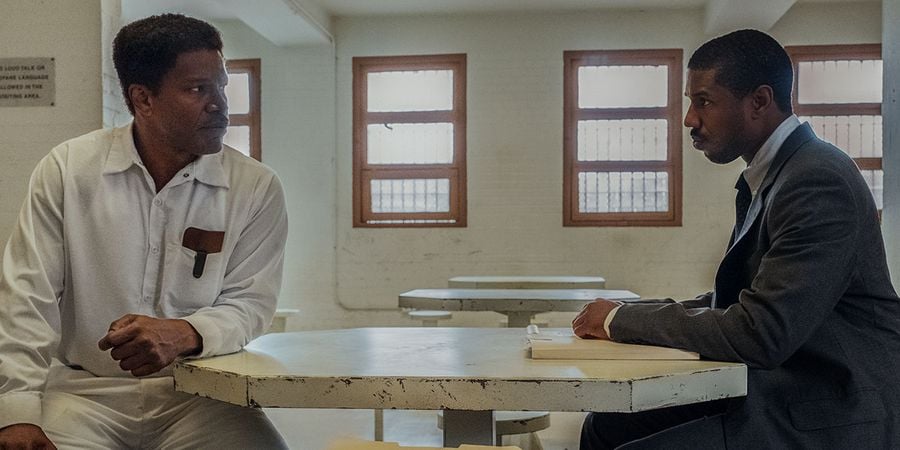
Real life injustice is dealt with in this dramatisation of the work of an attorney, law professor, and activist Bryan Stevenson, the founder of the Equal Justice Initiative, played in this film by Michael B Jordan. Director Destin Cretton gets the most out of his cast in a story that centres on a single case of wrongful conviction.
Harvard law graduate Stevenson chooses to forego more lucrative work in favour of efforts to help the under-represented. One of his first cases, and the focus of the film, is representing Walter McMillan (Jamie Foxx), a Black man sentenced to execution for murder in Alabama, despite strong evidence of his innocence. The racism inherent in the justice system, and its significance to the outcome of cases like McMillan’s, is quietly apparent in this engrossing, well acted legal drama.
When They See Us (Ava DuVernay)
Director Ava DuVernay’s follow-up to her 2016 documentary, 13th, is a biographical four-part series, released online worldwide. The biographical drama deals with a group of men who came to be known as the Central Park Five, and covers events over a period of twenty-five years. In 1989, a woman is attacked and raped in New York’s Central Park. Five Black youths are arrested for the crime.
They are finally exonerated after more than ten years in prison and go on to seek a settlement with the city of New York over an additional decade. The popular series provides background into the five men’s lives, the actions of the police, and the negotiations that resulted in their false convictions. Although strongly criticised for taking liberties with the facts, the production was well made and had a considerable impact.
2020
The Friendliest Town (Stephen Janis)
A film that begins with every appearance of a modest documentary about a minor, small-town incident gradually unravels into a shocking revelation of deep-seated racism impacting government, the justice system, and the police. The title is an ironic reference to the town motto of Pocomoke, Maryland, whose boundary is marked by a sign proclaiming it ‘the friendliest town on the eastern shore,’ a claim that becomes dubious as the story unfolds. In 2011, Pocomoke hires Kelvin Sewell as its first Black chief of police. The choice seems at first to be an inspired one: under Sewell’s guidance, crime in the town drops drastically, friendly relations between police and residents are encouraged by a series of reforms, and Sewell is well regarded by the townspeople, particularly the Black residents. Then, in 2015, he is suddenly dismissed. When the citizens of Pocomoke object, the (all White) mayor and city council refuse to provide a reason for their action.
At this point, journalists Stephen Janis and Taya Graham begin covering the situation. They encounter such a determined defence against any form of questioning of this abrupt decision, they investigate further, and gradually unearth, among other things, layer after layer of covert racist policy, enabled by a network of secrecy and inter-departmental collusion that infects the entire community. Janis and Graham were so astounded by their findings, they determined to co-produce a documentary on the situation, which was directed by Janis and made with the assistance of the town’s citizens. The film takes the form of a crime mystery, in which a superficially friendly and equitable town conceals depths of official and pernicious bigotry, slowly revealed in a style that enhances suspense while providing a clear and shocking narrative that exceeds its small town setting. It becomes disturbingly clear that Pocomoke’s situation could happen almost anywhere. The straightforward filming techniques, including simple one-on-one interviews and glimpses of the local landscape, serve as a perfect backdrop for the developing story, the imagery seeming at first innocent and unassuming, then, as facts emerge, ironic and faintly sinister.
2021
Coded Bias – Shalini Kantayya
Coded Bias deals, in part, with the surprising discovery that racism, unlike viruses, can survive outside the human body. Director Shalini Kantayya’s shocking documentary, largely based on the findings of MIT researcher Joy Buolamwini, demonstrates the tendency of technology, such as visual recognition software, to reproduce racial bias, and the social implications of that inherent flaw. The documentary examines the reasons for this apparent malfunction, other connections of AI technology to racism, and the chilling consequences for issues such as policing.
Long fascinated by science fiction, Kantayya chose to use sci-fi stylistic elements to tell the story of how racism is transferred to new technology. Contributor Cathy O’Neil (author of Weapons of Math Destruction) remarks in one segment, “We have all these algorithms in the world that are increasingly influential, and they’re all being touted as objective truth. I started realising that mathematics is being used as a shield for corrupt practices.” O’Neil calls out the extreme power imbalance involved in the commercial use of AI, its tendency to replicate existing inequalities, and the fact that it is virtually invisible and “there is no appeal system, no accountability.” While the documentary’s content goes well beyond racism in AI, a central concern is that AI, rather than introducing more objectivity, “merely replicates the bias so many people have put their lives on the line to fight.” The director has expressed hopes that her film will “inspire communities to spark new conversations about bias in the algorithms that impact civil liberties and democracy.” Meanwhile, Buolamwini’s research has inspired her to work toward new legislation in the US, in an effort to protect the public from bias built into security algorithms, and their potential for abuse, and the film ends on an optimistic note. An important and very watchable documentary.
