


A brief history of the impact of guitar pedals

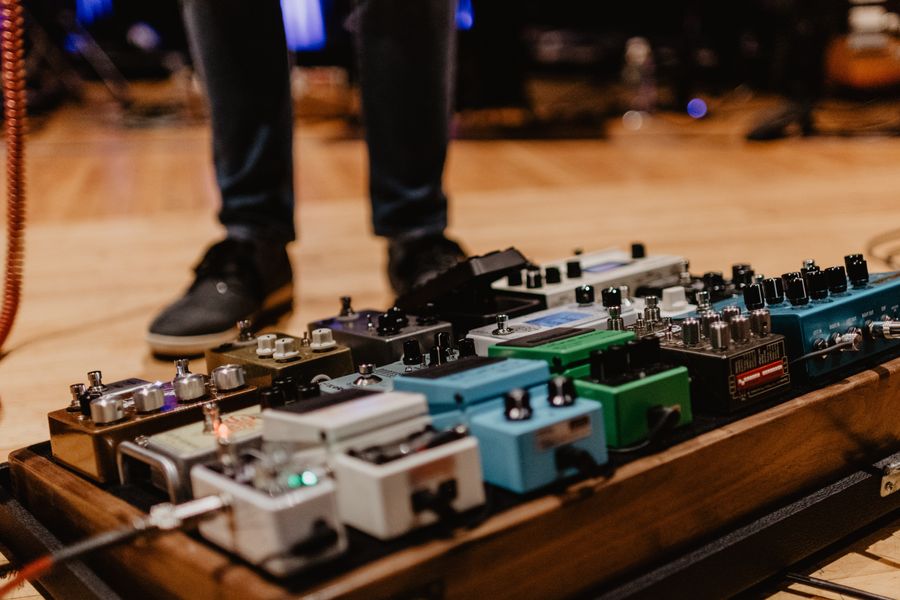
Since the advent of rock music, guitar players have always sought to alter the sound of their instruments. Today, any live performing guitarist has a swathe of effects pedals at their feet, from delay to reverb to distortion. Still, perhaps some of the ability to play the damn thing has been replaced by a reliance on pedals, but that’s a point of discussion for another day.
The initial interest in altering the standard clean tone of a guitar came back in the 1950s when several guitarists stumbled upon a distorted tone seemingly by accident. Gone was the clean jangle of the six-string, replaced by a dirty and raucous sound that came from beyond the instrument’s original expectations.
Some have said that Johnny Burnett’s Rock and Roll trio created the world’s first deliberately distorted guitar tone. Link Wray later claimed to have generated the distinctive voicing of his guitar by piercing a hole in his amplifier’s speaker.
Guitar manufacturers wanted to capitalise on this new sound that was gaining traction in guitarist circles. Glen Snoddy set about inventing a box that could be triggered to produce a distorted tone. The box came to be known as the Maestro Fuzz-Tone and was eventually sold by Gibson.
“It’s mellow. It’s raucous. It’s tender. It’s raw. It’s the Maestro Fuzz-Tone,” read the advert for the box. Eventually, the distorted tone was catapulted into fame when Keith Richards used the Maestro Fuzz-Tone on the Rolling Stones’ track ‘Satisfaction’. The song went to the top of the charts, and his delicious creamy fuzz tone went deep into future guitarists’ hearts.
Another iconic guitar pedal was being made around the same time, although this time, it was come across seemingly by accident. Brad Plunkett was tasked with finding a way to produce amplifiers cheaply whilst retaining quality. When Plunkett was replacing a mid-boost toggle, he noticed that turning it created an interesting change in pitch.
He took the mechanism, placed it in an older Vox volume pedal, put in a 9-volt battery and put it to the test. When Plunkett raised his foot up and down on the pedal whilst playing, the guitar’s frequencies fluctuated and created a ‘wah’ sound. The wah-wah pedal was born, and Dunlop released the Cry Baby pedal in 1966.
The decade after saw a swathe of effect pedals coming out of the new Roland BOSS subsidiary, including the DS-1 distortion pedal in 1977. A year before the DS-1’s release, Electro-Harmonix had finalised their hopes for a delay unit housed within a stompbox. The Memory Man delay pedal was released to the public and changed the course of guitar playing forever.
Guitarist of Wilco, Nels Cline, explained the allure of playing with guitar pedals. He said (via NPR): “I started dabbling with an electric guitar at age 11 or 12, and the first thing I wanted to do was play with fuzz to get away from the inherent sound of the guitar. To transform it, but also go back to it when I wanted to just by pushing down on a button on the floor.”
Cline added: “I started thinking about effects pedals as being like a palette with different colours — using delay, volume pedal, sometimes distortion but not a lot, just to sound like many different guitarists and different kinds of voices within the music.” That’s exactly why effects pedals are necessary for the arsenal of guitarists worldwide and across genres.
