


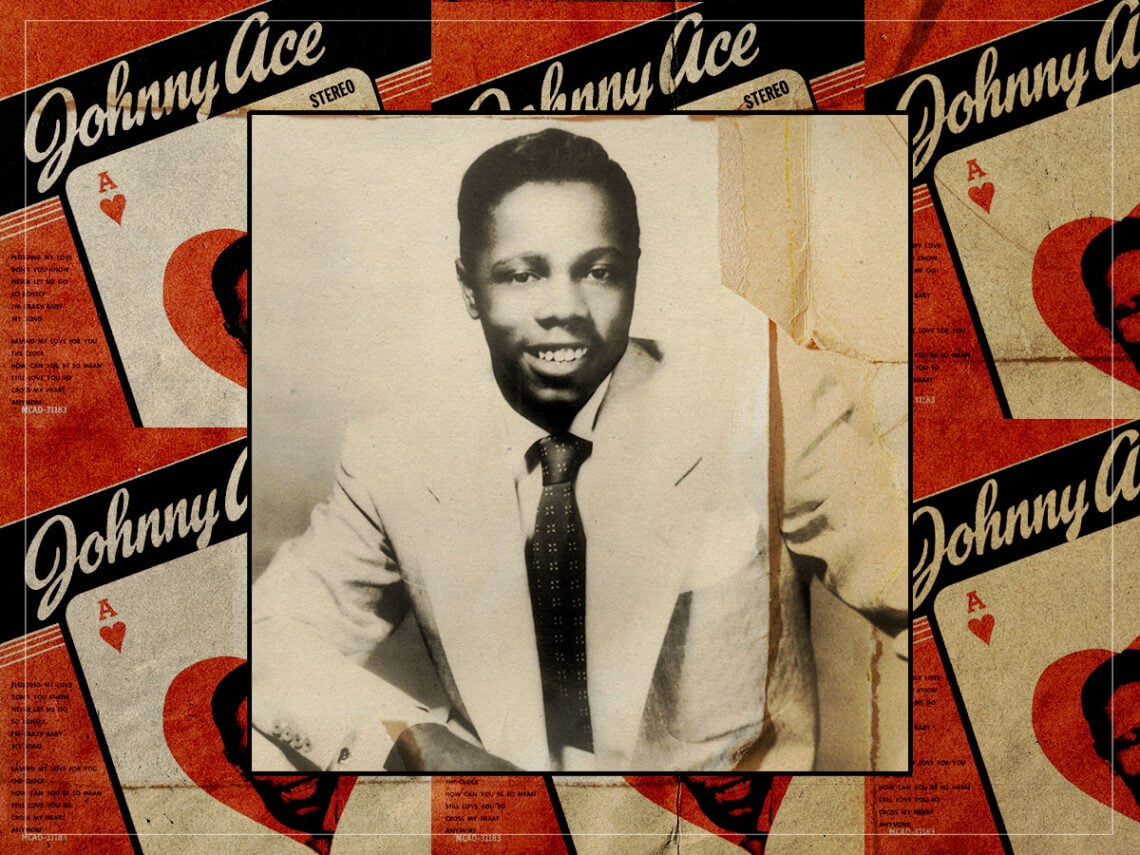
Johnny Ace: The game of Russian roulette that killed the true king of rock ‘n’ roll

The history of rock and roll has a number of examples of stars who have died far before their time. From ‘The Day the Music Died’, where the world lost Buddy Holly, Ritchie Valens, and JP Richardson in a devastating plane crash, to the premature deaths of Bobby Fuller and Eddie Cochran at 23 and 21, respectively, the movement that changed the course of musical history was marred by tragedy just as much as it was celebrated for its innovation.
While many notable names from the early rock and roll explosion who met their fate at a young age get discussed regularly, there are so many more figures who don’t get anywhere near the same amount of recognition and came to their demise in unfortunate circumstances. Among those whose story often gets overlooked is Johnny Ace, a Memphis R&B star from the 1950s who died at the age of 25 in an uncertain yet grisly fashion.
Ace died on Christmas Day in 1954, and legend has it that rather than playing a festive game of charades to celebrate the occasion, he found himself embroiled in a far more dangerous activity: playing Russian roulette during a concert. However, his death wasn’t quite as simple as this version of the story makes out, and his daredevil stunt could have proved fatal for anyone else in the room that night.
The singer and pianist had been making a name for himself in the early ‘50s as part of the Beale Streeters, a group of musicians that also included the likes of BB King and Bobby ‘Blue’ Bland. His first number one hit came in 1952 with ‘My Song’, and he would go on to chart with his next seven singles. As a result of his success, he was booked to perform alongside King, Big Mama Thornton and Johnny Otis at the ‘Negro Christmas Dance’ at Houston’s City Auditorium. Allegedly, around 3,500 people had flocked to the venue to see the performances, but Ace was somewhat out of sorts on the evening.
Having performed at another concert in Port Arthur, Texas, the night before, he arrived at his partner, Olivia Gibbs’ home in the early hours of Christmas Day and uncharacteristically began to imbibe copious amounts of vodka, despite not being known for being a heavy drinker. While intoxicated, he began to play with a pistol that he regularly carried around with him, although Gibbs attested that he used to enjoy showing off in this regard. Despite putting it away before the turkey lunch upon her instruction, the gun would reappear during the intermission of his performance later that day.
Ace was in a much more irascible mood in the evening, complaining of a toothache that he thought might prevent him from returning to the stage. Instead of wallowing in his misery, he instead chose to wind up the rest of his entourage by aiming his gun at others in the dressing room and pulling the trigger. The singer kept assuring people that only one chamber was loaded with a bullet, but that didn’t stop everyone from worrying that catastrophe was waiting for someone in the room.
Thornton instructed Ace to quit with his antics, and despite wrestling the gun from him and emptying the bullet, he would soon come into possession of the ammunition again and reload the pistol, resuming his unsafe hijinks. Band member Joe Hammond put his foot down, declaring to Ace that he should “try it on [himself],” which turned out to be a fatal mistake. Pulling the trigger and dropping to the floor, he fired the singular round into his head, killing him instantly.
His label, Duke Records, released his next single just days after his passing, and it landed him a spot at the top of the R&B charts for ten weeks. ‘Pledging My Love’ would become his biggest hit, but little else was done to preserve the legacy of the artist who could have become the next big star in rock and roll. His name is now more associated with the legend of his death rather than with his recording career, and sadly, we’re only left to wonder what could have been if his career had continued.
