


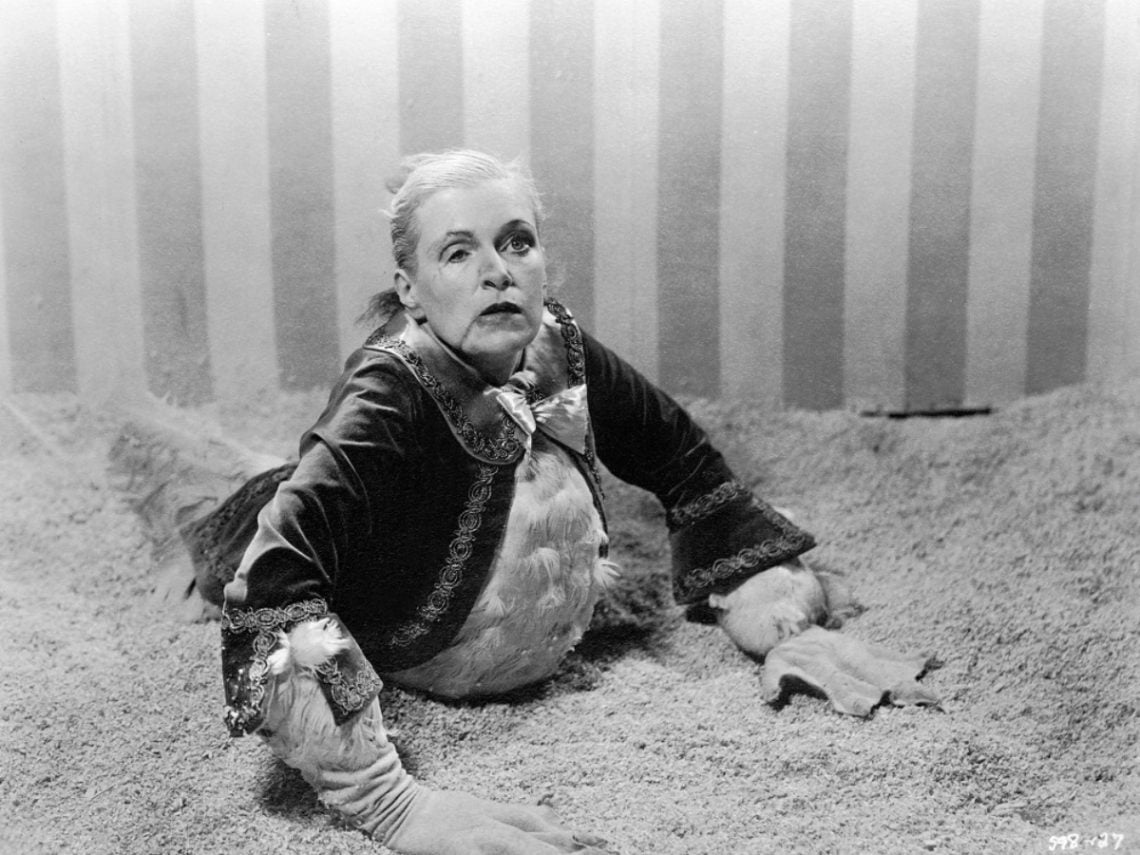
90 years of ‘Freaks’: Tod Browning’s deconstruction of the “grotesque”

Within the current climate of retrospective film criticism on the internet, revisionism is an essential tool of the trade. High audience engagement on social media and contrarian opinions are inextricably linked, paving the way for vitriolic comments and frenzied retweets. It’s fairly easy to pull it off as well, especially when it comes to “underrated/overrated” titles. But how does one even begin to force Tod Browning’s Freaks – a film that is simultaneously misunderstood and championed by modern audiences – into this algorithmic framework?
Browning’s 1932 work resists all the aforementioned categorisations, defiantly existing in a space of its own. Often mislabelled as a horror film, Freaks is a genuine curiosity. One of the most infamous American creations from the pre-Code era, Browning’s film was heavily censored and banned in the UK for more than three decades. Screenings were limited in states such as Georgia, and multiple reports noted how audiences ran out of the theatres. One woman even blamed her tragic miscarriage on Freaks!
American cinema will always be defined by the myth of the grand spectacle, evident in many of its genre configurations. That’s exactly what Browning achieved with his 1931 film Dracula, a work that is regularly cited as the progenitor of the modern horror genre. It’s definitely ironic that Browning’s only proper attempt at horror ended up delighting generations of fans, while Freaks, his striking allegory about the sociopolitical conflicts in Depression-era America, made people sick. In many ways, American audiences’ inability to process nuanced political commentaries about their own country sadly remains unchanged.
The opus of Browning’s foray into the talkies (which pales in comparison to his silent era output), Freaks is a fascinating subversion of the American spectacle. In fact, it’s an incisive critique of the voyeuristic impulse, which often dehumanises and degrades the subjects within the frame. This critique obviously becomes incredibly poignant because the subjects are individuals who have been dehumanised and degraded every single day of their lives – even in the absence of audiences or cameras.
Ranging from macabre to kitsch, multiple generations of film critics have used a slew of descriptions to capture the essence of Freaks, but it continues to transcend such feeble attempts. Of course, the primary reason why the film elicited such a visceral reaction from audiences was because they felt disgusted by the warm portraits of the little people, the outcasts, the conjoined twins and all the others who had been shunned. Interestingly, the way Browning films these subjects is still more progressive than many analogous modern depictions.
Many modern movies focus on the struggles of the disabled community, but narratives like that often let the disabilities of the characters define their identities. Browning is anachronistically radical because there are no disabled people in his film, only the differently abled. Without any judgement, the camera documents the movement of a man without the lower half of his body or a girl picking up a spoon with her feet. Although the scene featuring Prince Randian – the man with no legs and arms – lighting a cigarette is unnecessary, it is completely normalised within Browning’s framework.
The creation of such a truly alternative sphere is definitely one of Freaks‘ unimaginably incredible achievements. Browning’s conscious decision to film the daily lives of the carnival’s attractions instead of their acts completely deconstructs the “carnivalesque” machinations that are inevitably associated with such a space. Freaks beautifully highlights the domestic lives of the eternal ‘Other’, lives that are very similar to ours and are marked by the same concerns – love, lust, deceit, friendship and everything else that makes us feel alive.
Due to this brilliant neutralisation of a heterotopic sphere, Freaks has only grown more important in the nine decades that have flown by. The audiences who called Browning’s work a horror film are the same ones who were disgusted by the so-called “freaks”. However, the only horrifying characters in the film are Cleo, the trapeze swinger, and carnival strongman Hercules – the “normal” ones. This horror isn’t hypocritical because the monstrosity of Cleo and Hercules isn’t based on external prejudice but on their incessantly cruel actions and their unfounded hatred of the ‘Other’. There’s never any doubt as to who the real freaks are.
According to some critics, the conflict between the big people and the little people is emblematic of the rigid class divides during the Great Depression. Others have viewed Freaks as an insightful argument against the racist and supremacist conversations about eugenics. While Freaks is definitely all that, it is so much more. Browning touches on gender fluidity through the incorporation of a unique hermaphroditic character and even packs in some great gags, especially the marriage of the conjoined twins.
Modern viewers have even labelled Freaks as an exploitation flick, but none of Browning’s intentions are that way inclined. All he does is hold up a mirror, one that reflects the true horror of Western civilisation – the deep-rooted prejudice and intolerance present in each of us. That’s exactly why some people could not handle the glaring reflection, choosing to run out of the theatres rather than admit that human existence has endless variations and they are all valid. While this reaction of mainstream audiences in the ’30s is somewhat understandable, they aren’t any more culpable than the artists at MGM who forced the cast and crew of Freaks to move to a different cafeteria. Hollywood is guilty too.
I think it’s safe to say that even Browning couldn’t have predicted the subsequent impact of Freaks, thanks to the numerous screenings in the midnight movie circuit in the ’50s after its initial failure. From The Simpsons to South Park and David Bowie, Browning’s masterpiece has become an integral part of film culture and the medium’s history. Ninety years later, it stands out as an enigmatic document that must be preserved so that younger generations can understand that our rapid technological development is completely disconnected from our stunted social progress. We are not immune from the misgivings of prejudice simply because it seems like we’ve moved on.
