


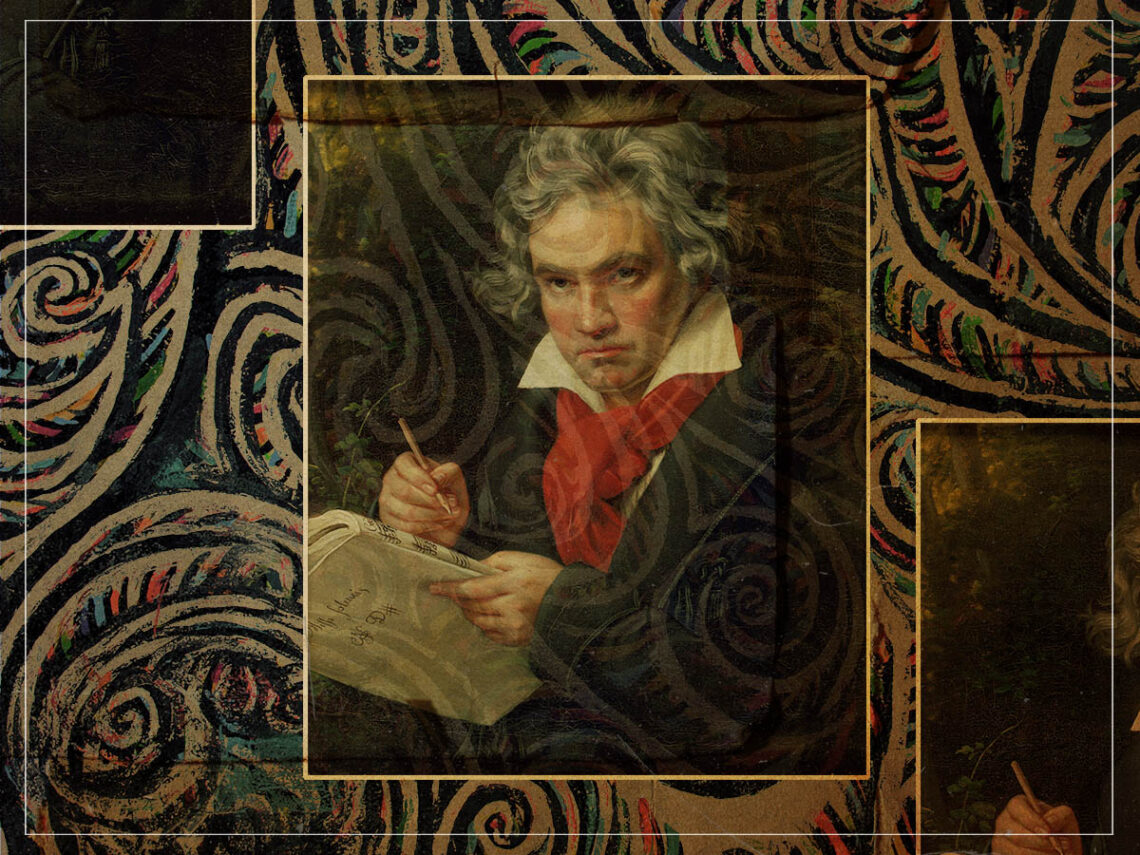
9 Beet Stretch: an avant-garde experiment in sound perception

It’s hard to remember the first time I heard Ludwig van Beethoven‘s ‘Symphony No. 9’. As a young flautist playing in concert bands, it was always on the roster. Known mostly for the final movement, which features a chorus of vocalists performing Friedrich Schiller’s poem ‘An die Freude’ – that’s ‘Ode to Joy’ to English speakers – it is perhaps one of the most widely recognised pieces of classical music ever made.
For instrumentalists, there are a lot of pitfalls in the misunderstood simplicity of the last movement; playing it at slightly different speeds makes it sound like a dissonant sludge of sound, it can be played too staccato, taking the piece and making it overly aggressive or you can rush through it in an attempt to get to the pub, as it is regularly the last piece played.
One thing that has rarely been an issue with ‘Symphony No. 9’, though, is that no one ever plays it too slowly. Beethoven wrote it slowly, and it took him over three decades of musing over the original poem to figure out exactly how it could work in a symphony before the fateful day of May 7th, 1824, in Vienna when his masterpiece was unveiled to the raucous applause of the audience that would quickly laud it as one of the greatest compositions of all time.
The piece is often held up as a symbol of classical genius, owing in part to Beethoven’s worsening deafness, which had become noticeable by 1798 and had almost claimed his hearing entirely by the time the symphony was performed, his overall decline in health and the fact that ‘Symphony No. 9’ would be his last. The place of ‘Symphony No. 9’ in the annals music history is undeniable, but the chronology isn’t finished, and there are those who seek to write the next chapter. Enter: 9 Beet Stretch.
9 Beet Stretch is a 2002 sound experiment created by Leif Inge; it takes ‘Symphony No. 9’ and stretches the entire symphony over 24 hours without distortion. The effect is ethereal, violins seem to sing like angels and brass enters the same musical space as an organ might. The 24-hour stream of the experiment began on March 26th, the same day Beethoven died, at sunset in Vienna. It’s as if Inge designed the experiment as a funeral composition, taking notes from the slow Requiem death mass composed by Gabriel Fauré – which was coincidentally also in D minor, the same key as ‘Symphony No. 9’.

The most extraordinary aspect of 9 Beet Stretch, though, is that none of the pitches have been changed, and there’s no distortion whatsoever. Created using Bill Schottstaed’s Common Lisp Music software and the Snd audio editor, the music is elongated over the 24-hour period from a recording conducted by Hungarian conductor and flautist Béla Drahos with the Nicolaus Esterházy Sinfonia and Chorus. Oscillating between tense and celestial, the sound seems to create a pressure that is never alleviated. The music is the same but completely transformed and unrecognisable, at times terrifying and almost consistently biblical.
As a performance, the installation is almost always presented in settings befitting the quasi-religious nature of listening: churches, industrial halls, and the bedroom of Brakstad Konsept gallery, where the experiment was entitled Bedchambermusic, paying tribute to the environment. Inge relays the ghostly, meditative aspect of 9 Beet Stretch by presenting the piece in such locations, a bedroom for intimacy, an industrial hall for the mechanical fear, a church, well, for obvious reasons.
As far as musical experimentation goes, it is radically avant-garde. “This trance feeling, letting the sound just go on without trying to expect anything, is really the way to listen to it,” Inge told The New York Times in 2004. “You get away from the idea of music having a definite start and a definite end”.
There is something to be said for the art of unease in music. We listen to music and expect to find comfort in the melody, groove in the bass, outlets for our intensity in the drums. With 9 Beet Stretch, Inge takes away the security blanket of comfort in sound and bathes the listener in uncertainty. It goes against the expectation of what music should be and instead presents an idea of what music could be.
Perhaps one of the most beautifully tragic parts of the experiment is that Beethoven himself, if he were alive to hear it, could not. As his hearing deteriorated, Beethoven struggled to detect higher notes, meaning that his own compositions became lower and more accessible for him to hear. The resonant, choral violin drawn out over long notes would be even more difficult for him to register. It’s a sad irony that a tribute to the man who wrote one of the most recognisable pieces of all time would be unable to see it transformed into the terrifying, heavenly chorus. Maybe that was what Inge was going for all along, subverting the expectation and taking the security that Beethoven would have felt, reaching for a clear sound in the echo chamber of one’s own mind.
