


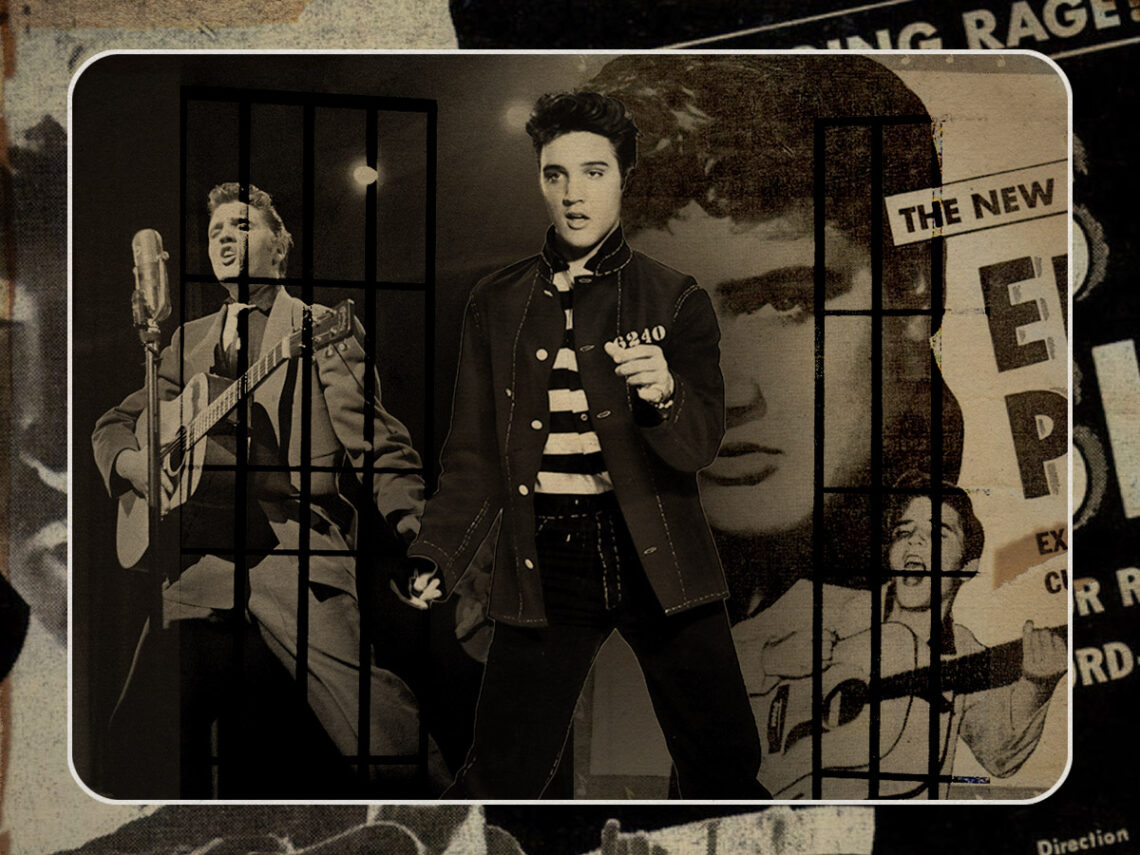
Re-evaluating the career of The King: “50,000,000 Elvis fans might be wrong”

God Save the King. Long Live the King. The King of Rock and Roll. We’re always talking about ‘kings’ as though they’re meant to be treated with the utmost reverence. Call me a contrarian, but I beg to differ.
As a Brit with a less-than-subtle disdain for the existence of our royal family, I can say without hesitation that I don’t believe in the concept of kings, that I don’t believe in their supposed divine right to rule, or believe in the fact that the aristocracy should hold power over the workers of the world. Treacherous words, I know, but I haven’t even reached the most scalding hot take yet, so brace yourself.
Not only do I refuse to acknowledge kingship in the regnant sense of the word, but I don’t believe in anointing kings as a mark of heroism or idolatry either. A man may do something remarkable in his field that is worthy of praise, but should never be put on a pedestal to the point that they’re treated as an immovable force, and one for whom criticism cannot be levelled at. Being given the title of ‘King’ of anything suggests superiority, and when we’re all susceptible to faults as human beings, is such an honorific truly deserved?
You see, when we talk about ‘The King’ in the context of popular music, we’re immediately bound to thinking about Elvis Presley due to the fact that he was bestowed this noble appellation by the masses, but was he really worthy of being known as such? Do you, in your heart of hearts, actually believe that Elvis was the true ‘King of Rock and Roll’, and that there’s never been anyone greater at their craft than him? You know where this is going…
Was Elvis Presley really ‘The King of Rock and Roll’?
To really get to the crux of this debate, we need to understand what it means for someone like Elvis to be called ‘The King’. As far as it seems, it’s used as a means of denoting something that is indisputable, and herein lies one of the main issues with the label. Calling Elvis ‘The King’ removes all possibility for constructive debate over who else should be involved in the conversation of who the greatest and most influential stars in this world are, because if you’re allowing him this distinction, then you can’t go around calling someone else ‘The King’.
Elvis, by his own admission, was not a true original, and while he may have been more successful than his contemporaries, he was self-aware enough to recognise that virtually all facets of his artistry were liberally pilfered from other performers of the era. The sound, the look and the moves were all taken from those he idolised, and adapted to fit his own persona, and while some might argue that he didn’t credit his influences anywhere near enough, he did suggest that there were other artists who were perhaps more deserving of the royal handle.

Trying to argue against the idea of Elvis being ‘The King’ is how we find ourselves using derivative phrases to make our own point. For one, Elvis referred to Chuck Berry as ‘The Real King of Rock and Roll’, who, given the amount of influence he had on Presley and the wider genre, is perhaps a more fitting recipient of the official title. Yes, you can make a claim for Berry having been a controversial figure with plenty of misdeeds against his name and use that to refute his regal credentials, but when have wrongdoings ever stopped others from holding positions of power?
In addition to this, Elvis has been dead for almost 50 years, and you can’t rule from beyond the grave. His passing in 1977 should have shaken the world of rock and roll beyond collectively grieving a star, and should have led to a The Death of Stalin-esque frenzy in an effort to crown someone ‘The New King of Rock and Roll’. While many might want to claim that they’re the most deserving of this exaltation in Presley’s absence, and let me tell you, they’re all wrong, we’re still referring to Elvis as ‘The King’ in 2025 even though he’s contributed diddly-squat to music since his corporeal form perished.
However, the immense amount of success that he enjoyed during his time on earth, whether you believe it to be deserved or not, is not something to be scoffed at. The sheer amount of material released by Presley, accompanied by the fact that plenty of these releases topped the charts around the world, led to several greatest hits compilations to be released, some within a short timespan of one another. Among the best-known and most celebrated of these is the humorously-titled 50,000,000 Elvis Fans Can’t Be Wrong: Elvis’ Gold Records, Volume 2; a bold statement if ever there was one.
Can 50,000,000 Elvis fans be wrong?
It’s this kind of herd mentality that leads people towards dangerous ways of thinking, and given how 77million people elected to vote Donald Trump in for a second term as president in 2024, there’s no reason why a group approximately two-thirds of this size can’t harbour a different incorrect point of view. Elvis’ fanbase was built entirely upon hysteria and the youthful desire to follow trends in order to be perceived as ‘cool’, and that found itself snowballing to become an army of devotees the size of modern-day Spain. So yes, 50million people can be wrong.
The title itself was derived from an article in Down Beat magazine published in 1956, titled ‘Can Fifty Million Americans Be Wrong?’, which saw journalist Les Brown criticise his followers for allowing themselves to overlook the talents of what he called “serious vocal artists”. The compilation may wryly satirise and mock Brown’s sneering hitpiece, but it does bring us to the entirely subjective matter of whether Elvis was ever really that good anyway. Having already slammed him for his lack of originality, I’ll go one step further and let it be known that beyond the showmanship, I don’t think he’s all that.

His credentials as a songwriter are nonexistent, having relied on the talents of others to come up with his material or performed covers, which begs the question as to whether an Elvis tribute act is just as worthy as the man himself. As for the voice, I’ll afford him the credit of being unique, but there’s only so much baritone warbling I can tolerate before it feels like it’s being put on for show, or to deliberately wind me up.
Even his own fans will admit that he went through stale periods creatively, neglecting to look after his health and allowing his performative and vocal abilities to deteriorate. If you’re going to call someone a king, surely consistency is a vital trait to possess, and the time spent languishing in mediocrity during the mid-to-late ‘60s shouldn’t do him any favours over someone whose output rarely if ever waned in quality.
Besides, with a wealth of new and exciting music still being released in the modern era, should we still be focusing all of our energy on praising the work of artists who passed decades ago and making baseless statements about how music isn’t as good these days? No, we ought to be nurturing new talent rather than continuing to decorate individuals in an effort to satisfy our cravings for nostalgia. He may well have been ‘The King’ to some, but the only reason there has never been a successor is because we’ve collectively failed to let go of the past. The King is dead; let him stay that way.
