


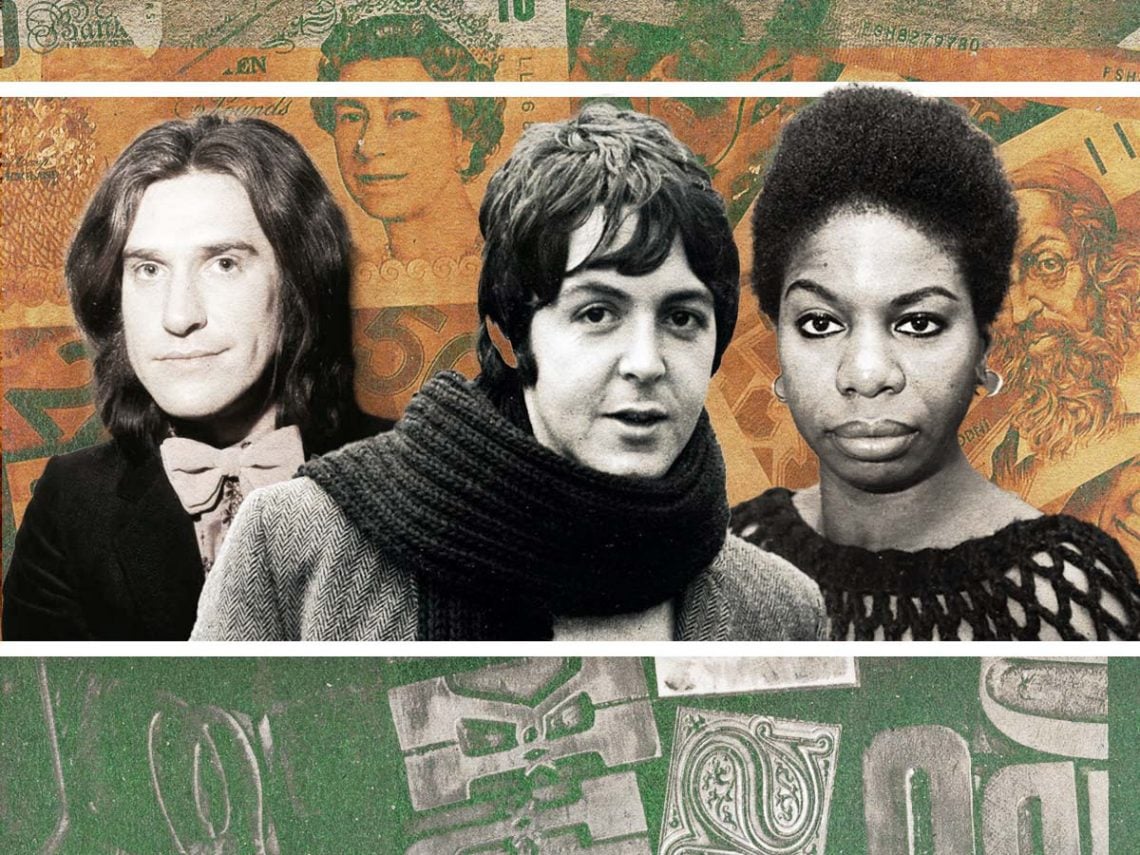
The five greatest songs about financial hardship

The first commercial vinyl records were produced in the 1930s when the world was locked into a worldwide economic depression. Over the next 40 years or so, the recording industry became wealthier than anyone could have imagined. But there was always the lurking sense – in the songs at least – that the money might one day dry up.
One of music’s greatest strengths is its ability to provide comfort in hard times. These days, a lot of us are feeling the strain financially. Music reminds us that we’ve weathered periods of economic downturn before and, more importantly, that we’re not alone.
Here, we’ve bought you a short selection of songs written during moments of scarcity and financial hardship. Some offer an unflinching look at the reality of poverty, while others look ahead to brighter days. Some criticise the government; others celebrate the importance of self-reliance and self-determination. All are united by a distrust of wealth.
The five greatest songs about financial hardship:
‘Dead End Street’ – The Kinks
“There’s a crack up in the ceiling, and the kitchen sink is leaking,” so begins perhaps the greatest song written about the plight of the English working classes. The 1960s are widely remembered as being a period of economic prosperity, urban renewal and cultural innovation. Sadly, the truth is a little more complex.
As Ray Davies later told Q Magazine: “My whole feeling about the ’60s was that it’s not as great as everyone thinks it is. Carnaby Street, everybody looking happy, that was all a camouflage. That’s what ‘Dead End Street’ was about.” Released on 1966’s Face to Face, the single – a personal favourite of Dave Davies – gives life to a section of society largely absent from the cultural dialogue of the ’60s, people for whom wealth and security seemed a distant dream.
‘The Jangling Man’ – The Cleaners From Venus
Rooted in the political turmoil of the 1980s, this brilliant piece of angst-fuelled jangle-pop by The Cleaners From Venus is a vengeful swipe at Thatcher’s conservative government. Written by Martin Newell, the track depicts a semi-fantastical revolution in which the poll tax riots of 1990 and the march on Tianoman square unfold at the same moment Watt Tyler is leading the Peasant’s revolt. As Newell observes: “They haven’t really been this angry since 1381.”
As well as blinding time and space, Newell softens a sense of dystopian drama with splashes of optimism. Though he and his partner never have “any money,” they look forward to the end of governmental tyranny. But for the time being, all they can do is dream, “dream of a feeling. To wake one day and find that you are gone.”
‘I Aint Got No, I Got Life’ – Nina Simone
This 1968 track was written at the height of the Black Power movement when countless Black activists were working together to build support networks that would benefit Black Americans. In ‘I Aint Got No’ I Got Life’, Nina Simone seeks an answer to the looming question, “Who am I?”. She begins by naming all the things she does not possess. However, the singer soon realises that an absence of money, cigarettes, clothes, and schooling doesn’t define a person; life defines a person, and she has that by the bucketload.
”I Aint Got No’ is more about identity than it is about being broke. But considering it is both deeply personal and universally relatable, it has surely given many people comfort during times of financial hardship. Wealth, possessions, religion: none of these things matter, Simone argues. Joy matters. The ability to use one’s body matters. Life matters.
‘Mile End’ – Pulp
Like The Kinks, Pulp made a name for themselves by conjuring up the romance in the mundane; the drama in the everyday. For frontman and lyricist Jarvis Cocker, there was real beauty in the empty launderette, the derelict squat and “the dog turd outside the corner shop.”
In ‘Mile End’, Cocker recalls living in a deserted fifteenth-floor apartment just off “Burditt Road”. Sure, it smelled “as if someone had died”
and the “living room was full of flies,” but it was a home. Remembering the dwelling, Jarvis would later say: “It was horrible because the bathroom sink was also broken, so I had to wash in a washing-up bowl and I had to do all the washing up in the bath. That was what really summed things up for me: I was having a bath one day, lying low in the bath, as you do, and I suddenly saw this tomato skin floating on the surface of the water. I thought, ‘This is not how I want to live'”.
‘Nobody Knows You When You’re down and Out’ – Bessie Smith
This blues standard was written by Jimmy Cox in 1923 during the Prohibition era. It tells the story of a millionaire who loses all their money, meaning Cox may well have predicted the Wall Street Crash of 1929 before America’s top economists.
The track was first recorded by Bessie Smith and released as the bottom fell out of the American stock market. Though clearly the product of a specific moment in American history, ‘Nobody Knows You’ endures as a haunting reminder that the good times must always come to an end. Of course, it also makes the point that while money might buy you champagne and “bootleg liquor”, it can’t buy you friendship.

Never Miss A Beat
The Far Out Beatles Newsletter
All the latest stories about The Beatles from the independent voice of culture.
Straight to your inbox.